

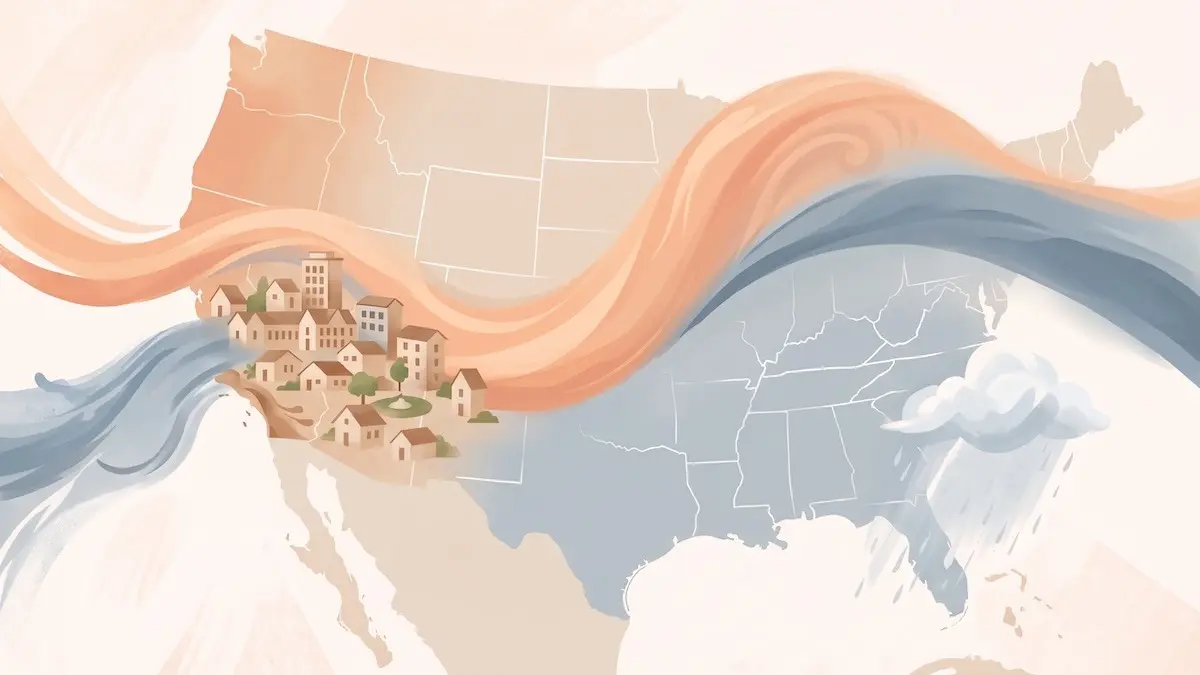
NATIONAL REPORT — As a historically powerful El Niño brews across the Pacific Ocean, real estate markets across the United States are bracing for a winter that could test the resilience of homeowners, real estate agents, insurers, appraisers, and prospective buyers alike. Driven by record-high sea surface temperatures, experts are warning of a potential "super El Niño" event that will shift jet stream patterns, bringing torrential rains and atmospheric rivers to the West Coast, severe convective storms to the Gulf Coast, and acute climate stress to regional housing markets from California to Florida.
Rather than unilaterally creating new dangers, housing experts emphasize that this severe weather pattern will act as a magnifying glass, exposing pre-existing vulnerabilities in residential infrastructure and challenging property values long before the storm clouds clear.
1. Main Facts: The Anatomy of a Super El Niño and Housing Vulnerability
The impending winter weather pattern is rooted in anomalous Pacific Ocean conditions. Howard Botts, chief scientist at climate risk analytics firm Cotality, notes that while El Niño cycles typically recur every three to seven years, the current oceanic warmth sets this event apart.
"We see El Niño events every two or three to seven years, so it’s not unprecedented that we see these," Botts said. "But with sea-level temperatures at record elevations, all the predictions are for a super El Niño event. We may remain really hyper-focused on the West Coast, particularly California, because historically, El Niños shift the wind pattern south."
This southward shift forces the jet stream directly over the southern tier of the United States. For California, this means a dramatic escalation in atmospheric rivers—long, narrow bands of concentrated moisture in the atmosphere—flowing straight off the Pacific.
Botts, who resides in the Pacific Palisades directly beneath a wildfire burn scar, observes these risks firsthand. "What I see happening all around me is, literally several times a week, before the storm events they have around here, people talking about preparation for mud flows," he noted.
Simultaneously, rising ocean temperatures cause water to expand, driving sea levels up by as much as six inches or more along coastal regions. Combined with seasonal storm waves, king tides, and full moons, the stage is set for severe coastal flooding.
Meanwhile, the Southeast and Gulf Coast face their own winter threats. Although an active El Niño typically suppresses hurricane activity during the summer months, it paves the way for cooler, wetter conditions later in the year, accompanied by a heightened frequency of severe convective storms and tornadoes. Conversely, the Pacific Northwest faces an increasingly dry outlook, which significantly elevates wildfire risks by the time late spring and summer arrive.
2. Chronology & Seasonal Progression: A Cross-Country Weather Timeline
Understanding how the super El Niño will manifest requires tracking its chronological progression across different American geographies as the seasons shift from late fall into winter and spring:
- Late Fall to Early Winter (The West Coast): The shifting jet stream drives the first major atmospheric rivers toward California and the Pacific Northwest. Coastal communities face immediate threats from high tides, expanded sea levels, and coastal erosion amplified by recent Pacific hurricanes in Orange and Los Angeles counties.
- Deep Winter (The Gulf Coast and Southeast): As the calendar turns deeper into winter, storm tracks dip across the southern tier. The Southeast and Gulf Coast transition from a subdued hurricane season to facing relentless drenching rains, flash floods, and severe weather outbreaks, including tornadoes.
- Late Winter to Early Spring (The Midwest and Northeast): Nor’easters and coastal storms begin battering New England and the Mid-Atlantic, while the Midwest and Great Lakes experience heavy winter flooding compounded by mixed precipitation events.
- Late Spring and Summer (The Pacific Northwest and Northern Tier): The weather dynamic inverts. While the southern tier dries out, the Pacific Northwest and northern agricultural states face severe drought conditions, setting the table for an aggressive wildfire season.
3. Supporting Data and Market Indicators: Insurance, Floods, and Appraisals
For the housing sector, the fallout from a super El Niño manifests quickly through market friction, transactional slowdowns, and re-evaluated property assessments.
Insurance as the Canary in the Coal Mine
Industry analysts view the property insurance market as an early warning system for climate-driven real estate distress. Surging insurance premiums, policy non-renewals, or the outright unavailability of hazard coverage serve as leading indicators of how the broader risk market views a specific region.
Cotality closely monitors transaction cancellations—frequently a red flag indicating that a home failed its physical inspection, a low appraisal, or that a frantic buyer could not secure hazard insurance before closing.
The Great Flood Insurance Misconception
A dangerous and widespread misconception among homebuyers is that hazard policies or standard homeowners insurance cover flood damage, particularly for properties located outside of mandatory Special Flood Hazard Areas (the traditional 100-year flood zones).
"We’ll see the events occurring from El Niño that will be largely flash flooding or pluvial flooding, as it’s known," Botts explained. "An intense rainfall event causes large amounts of water to appear quickly, and typically, special flood hazard areas don’t cover these kinds of events very well. They tend to be more focused on river flooding."
In fire-scarred canyons across California, this risk is compounded by the threat of catastrophic mudflows. "I live in a canyon near the coast but elevated above the free-flowing creek," Botts said. "I’ve seen neighbors all start to purchase flood insurance. Part of that is just general fear caused by the unknown of what this year means. But the other thing is we’ve had massive fires, so you’re likely to get mud flows from these intense rainfall events, too. Last year, we saw in a nearby canyon, a five-foot wall of mud moving down and filling up a number of homes and businesses."
Appraisals and Value Pressures
Michael Romano, vice president of staff appraisers for valuation at ServiceLink, underscores that a property does not need to sustain direct physical damage to suffer a reduction in market value.
"The fact that a property doesn’t sustain direct damage doesn’t necessarily mean there wouldn’t be factors that negatively influence buyers," Romano noted. "The same holds true for neighboring properties or those in the community. Marketing times may be extended, asking prices may drop and/or the seller may be more likely to offer incentives, all of which can diminish values."
Romano explains that when external factors—such as escalating insurance premiums, rising property taxes, or costly community maintenance fees—compound in a weather-impacted market, buyer demand softens. Reduced demand invariably leads to increased inventory, placing sustained downward pressure on prices. Appraisers capture these structural shifts by analyzing aggregated market data across pre-disaster, active disaster, and post-disaster timelines.
4. Official Responses and Regional Perspectives: West Coast Caution vs. Florida Resilience
Reactions from real estate leadership vary drastically depending on regional exposure and local mitigation efforts.
The West Coast and National View
For real estate agents and buyers operating in high-risk zones, experts advise moving beyond macro-level regional maps to evaluate individual structural integrity.
"If you’re an agent representing a buyer, you definitely have to look at the individual structure," Botts advised. "Does it have negative grading? You want to make sure that the ground slopes away from a foundation. I think anybody looking to buy a home or an agent should definitely utilize comprehensive property risk reports."
On the Ground in Miami
Conversely, in South Florida, the conversation surrounding El Niño takes a back seat to standard macroeconomic pressures. Alfredo Pujol, chairman of Miami Realtors + RWorld, reports that the weather pattern has barely surfaced in dialogues with local buyers and sellers.
"What has come up, and one of the things that we’re seeing, is the continued cash buyers, and where the conversations are focusing is on financing — if the rates are remaining high," Pujol said.
Pujol notes that Miami remains on a trajectory to break an annual milestone of 10 million-plus home sales. Furthermore, he anticipates that climate migration may ultimately benefit the Sunshine State. "If El Niño affects California, those residents are going to be moving to Florida," he said. "I’d say that continued migration is going to happen from California and from those states as they face issues."
Pointing to state-level interventions like the My Safe Florida Home program—which assists homeowners in installing impact-resistant windows and executing structural hardening—Pujol argues that Florida’s aggressive building code overhauls following Hurricane Andrew have fundamentally altered the risk equation.
"Building codes were changed after Hurricane Andrew and the homes have been stronger," Pujol emphasized. "We’ve been working through Miami and RWorld and Florida Realtors to speak with elected officials and work towards the insurance side. If you take the right precautions or the house has the impact glass, or the shutters, you’re going to be in a lot different position."
5. Broader Implications for the U.S. Real Estate Ecosystem
As the winter weather season unfolds, the long-term implications for the American real estate landscape are profound. The convergence of super El Niño meteorological conditions with an already strained property insurance market forces a reckoning across several pillars of the industry:
- For Homebuyers: Due diligence must extend far beyond standard home inspections. Buyers must aggressively investigate pluvial flood risks, local grading, wildfire burn-scar proximities, and historical neighborhood drainage patterns.
- For Real Estate Agents: Agents are increasingly required to act as risk advisors. Those who equip themselves with comprehensive property risk data and understand local hazard mitigation will successfully guide clients through transactions without suffering high contract cancellation rates.
- For Insurers and Lenders: Underwriting standards will likely tighten further in high-exposure zones. As coverage costs soar, affordability metrics will shift, directly impacting debt-to-income (DTI) ratios and buyer qualification limits.
- For Appraisers: While valuation methodologies rely primarily on historical comparable sales data, appraisers must remain cognizant of how broader market sentiment, local insurance shocks, and community-level climate resilience affect marketability and asset velocity.
Ultimately, Howard Botts’ guiding philosophy serves as a warning and a blueprint for the months ahead: "A strong El Niño doesn’t create the risk so much as expose it. Really try to understand individual vulnerabilities that a home may have." As the super El Niño bears down on the United States, the housing market will soon discover which properties—and which markets—are built to weather the storm.
