

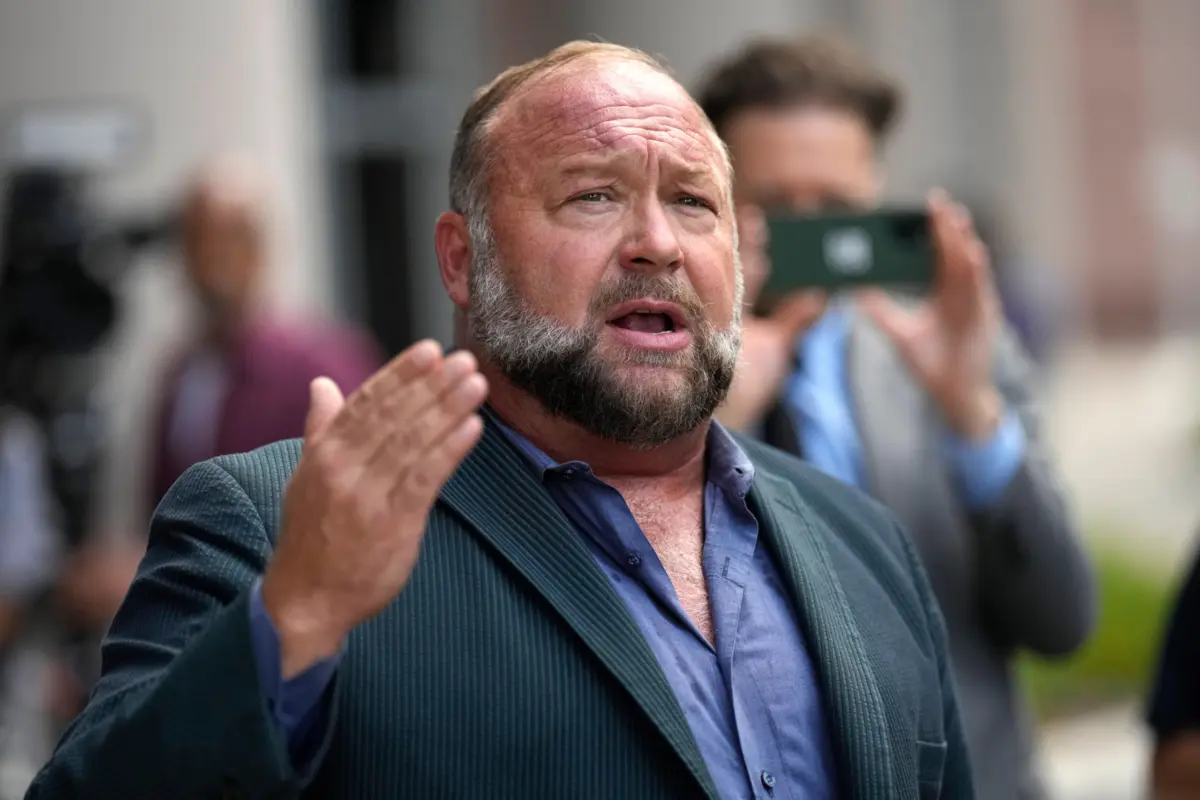
AUSTIN, Texas — In a unanimous ruling on Friday, the Texas Third Court of Appeals drastically reduced a $50 million defamation judgment against conspiracy theorist Alex Jones. The landmark penalty, originally awarded to the parents of a 6-year-old victim of the 2012 Sandy Hook Elementary School massacre, was slashed to approximately $6 million. The appellate court cited state statutory caps on punitive damages as the legal basis for the reduction.
Despite the significant financial markdown, the court’s decision leaves the underlying finding of defamation entirely intact. Jones remains liable for spreading malicious, fabricated claims that one of the deadliest mass shootings in modern American history was an elaborate "hoax" staged by the federal government to advance stricter gun control laws.
While Jones hailed the appellate decision as a monumental win for the First Amendment, legal representatives for the victims dismissed the ruling as a minor procedural footnote. They emphasized that it does little to mitigate the crushing, multi-billion-dollar legal liabilities Jones faces in other jurisdictions, which have already dismantled his media empire and forced him into bankruptcy.
Main Facts of the Appellate Decision
The Friday ruling by the Texas Third Court of Appeals directly impacts the 2022 civil lawsuit brought by Neil Heslin and Scarlett Lewis, whose son, Jesse Lewis, was among the 20 first-graders and six educators murdered at Sandy Hook Elementary School in Newtown, Connecticut.
Under the appellate court’s order:
- Compensatory Damages Upheld: The court left intact more than $4.1 million in compensatory damages awarded by the jury to compensate Heslin and Lewis for severe emotional distress and defamation.
- Punitive Damages Slashed: The court aggressively reduced more than $45 million in punitive damages down to $1.5 million.
- Statutory Caps Applied: The reduction was mandated to comply with Texas state law, which imposes a strict $750,000 cap on punitive damages per plaintiff unless specific, high thresholds of egregious conduct are proven within the strict parameters of the statute.
The three-judge panel ruled that Heslin and Lewis failed to present sufficient legal evidence during the original trial to justify breaking the state’s statutory limits on punitive damages. Furthermore, the court held that the trial judge had improperly permitted the parents to pursue higher punitive damages after the trial had concluded.
Even so, the ruling leaves Jones legally branded as a defamer who subjected grieving families to years of targeted harassment by his loyal followers.
A Timeline of Defamation, Litigation, and Fallback
To understand the weight of Friday’s appellate decision, it is necessary to examine the cascading legal and financial ruin that has engulfed Jones and his parent company, Free Speech Systems, over the past decade.
- December 14, 2012: A gunman opens fire at Sandy Hook Elementary School in Newtown, Connecticut, killing 20 children and six adults.
- 2012–2018: Shortly after the tragedy, Alex Jones uses his Infowars platform to repeatedly tell his millions of listeners that the massacre was a "false flag" operation and a hoax executed by "crisis actors."
- 2018: Sandy Hook families, including Heslin and Lewis, file multiple defamation lawsuits against Jones, Infowars, and Free Speech Systems in Texas and Connecticut courts.
- 2022: A Texas jury orders Jones to pay $45 million in punitive damages and $4.9 million in compensatory damages ($50 million total) to Heslin and Lewis. Later that year, a Connecticut jury orders Jones to pay an astronomical $1.25 billion in damages to other families of victims.
- Late 2022–2023: Faced with crushing financial judgments, Jones and Free Speech Systems file for Chapter 11 bankruptcy protection. Assets are evaluated for liquidation.
- April 2024: Jones takes Infowars off the air from its traditional studio space, shifting his broadcasts to new digital websites and his personal social media accounts, including X (formerly Twitter).
- November 2024: The Chicago-based satirical news outlet The Onion wins a bankruptcy court auction to acquire Infowars’ assets, intending to transform the platform into a parody site. However, a federal judge later overturns the auction results due to procedural disputes and questions surrounding the mechanics of the bid.
- Early 2025–2026: Legal battles continue in bankruptcy and appellate courts. While Jones attempts to dismantle his judgments via appeals, Sandy Hook families fight to seize remaining assets.
- February 2026: The Texas Third Court of Appeals issues its unanimous ruling, slashing the Texas judgment from $50 million to roughly $6 million.
Supporting Data and Financial Realities
While a reduction from $50 million to $6 million might look like a lifeline to an ordinary defendant, legal experts and financial analysts point out that Alex Jones is in a uniquely catastrophic financial position.
The Connecticut Judgment Remains Untouched
The most critical detail of the Texas appeals court ruling is what it does not touch. The $1.25 billion judgment handed down by a Connecticut jury against Jones and Free Speech Systems remains entirely valid and enforceable. Jones previously attempted to appeal the Connecticut verdict to the U.S. Supreme Court, but the nation’s highest court declined to hear the case, letting the massive liability stand.
Total Liabilities vs. Recoverable Assets
To date, the families of the Sandy Hook victims have collected little to no money from Jones. This is due to a combination of:
- Lengthy, multi-tiered appeals processes in state and federal bankruptcy courts.
- The ongoing liquidation proceedings of Free Speech Systems.
- Jones’s efforts to shield personal assets and pivot his broadcasting operations to alternative, decentralized digital streaming platforms.
The slashing of the Texas verdict removes $45 million from the ledger of what Jones technically owes Heslin and Lewis, but it represents a drop in the bucket compared to the $1.25 billion mountain of debt he owes to the Connecticut plaintiffs.
Official Responses and Legal Perspectives
The reaction to the Texas appeals court’s decision exposed a stark contrast between Jones’ celebratory public narrative and the dismissive posture of the plaintiffs’ legal representation.
Alex Jones: Framing It as a Constitutional Victory
Speaking to his followers after the ruling, Alex Jones portrayed the decision as a massive triumph for free speech and vowed to press forward with additional appeals.
"I got lawyers who are good constitutional lawyers, and they are not backing down," Jones declared on his broadcast. He characterized the Texas Third Court of Appeals decision as "a gigantic victory for the First Amendment" and promised to take the case all the way to the Texas Supreme Court to wipe out the remaining $6 million liability entirely.
During his earlier civil trials, Jones adopted a notably different tone under oath, eventually conceding that the Sandy Hook massacre was "100% real" and admitting that he was wrong to lie about it. However, outside the courtroom, he has consistently framed the litigation as a politically motivated assault on his right to question government narratives.
Mark Bankston: Dismissing the Ruling as "Irrelevant"
Mark Bankston, an attorney representing Neil Heslin and Lewis in the Texas litigation, shrugged off the appellate ruling, arguing that it had no practical bearing on the overarching justice the families are pursuing.
"The families care not at all about this irrelevant ruling which affects only two of the 19 claims they all share," Bankston said in a statement. "Jones still faces over a billion dollars of liability, so this changes absolutely nothing. All it does is highlight the absurdity of Texas law."
Christopher Mattei: Protecting the Liquidation Process
Christopher Mattei, a lawyer representing the Sandy Hook families in the Connecticut proceedings, echoed Bankston’s sentiments. Mattei emphasized that Friday’s decision in Austin does not interfere with the separate, lower-court liquidation proceedings aimed at dismantling Free Speech Systems to satisfy creditors and judgment holders.
Broader Implications for Speech, Tort Law, and Media
The long-running legal saga surrounding Alex Jones and the Sandy Hook families has reshaped the legal landscape regarding defamation, conspiracy theories, and the limits of the First Amendment in the digital age.
1. The Accountability of Alternative Media
For decades, Jones operated with relative impunity, using Infowars to broadcast debunked conspiracy theories about global institutions, federal operations, and major historical tragedies. The defamation lawsuits fundamentally altered this dynamic, establishing a critical legal precedent: media personalities, independent podcasters, and digital influencers can be held financially and civilly accountable when their deliberate falsehoods directly incite targeted harassment and real-world harm against private citizens.
2. The Mechanics of State Tort Caps
The Texas appellate court’s decision highlights the complex and often controversial nature of statutory caps on punitive damages. While states implement these caps to prevent runaway juries from issuing arbitrary or economically crippling penalties in standard civil suits, high-profile cases involving systemic, malicious disinformation campaigns test the limits of these legislative boundaries. Legal scholars note that while Texas law successfully reined in the punitive multiplier in this specific case, the broader legal system possesses mechanisms—such as the massive Connecticut verdicts—to impose catastrophic financial penalties on bad actors.
3. The Ongoing Battle Over Infowars and Digital Assets
The entanglement between Jones, the bankruptcy courts, and The Onion underscores the modern difficulty of dismantling digital empires. Even as traditional corporate assets, physical studios, and intellectual property face court-ordered liquidation, the decentralized nature of modern internet broadcasting allows controversial figures to pivot rapidly to new web domains, social media handles, and subscription streaming services. Although Jones took his original Infowars studio off the air, he continues to broadcast to dedicated audiences online, demonstrating the resilience of alternative media ecosystems in the face of institutional shutdown.
As the case prepares to move potentially to the Texas Supreme Court, the core reality remains unchanged: while the numbers on the ledger in Austin have shifted, Alex Jones remains financially cornered by a historical web of accountability for the pain inflicted on the families of Newtown.
