

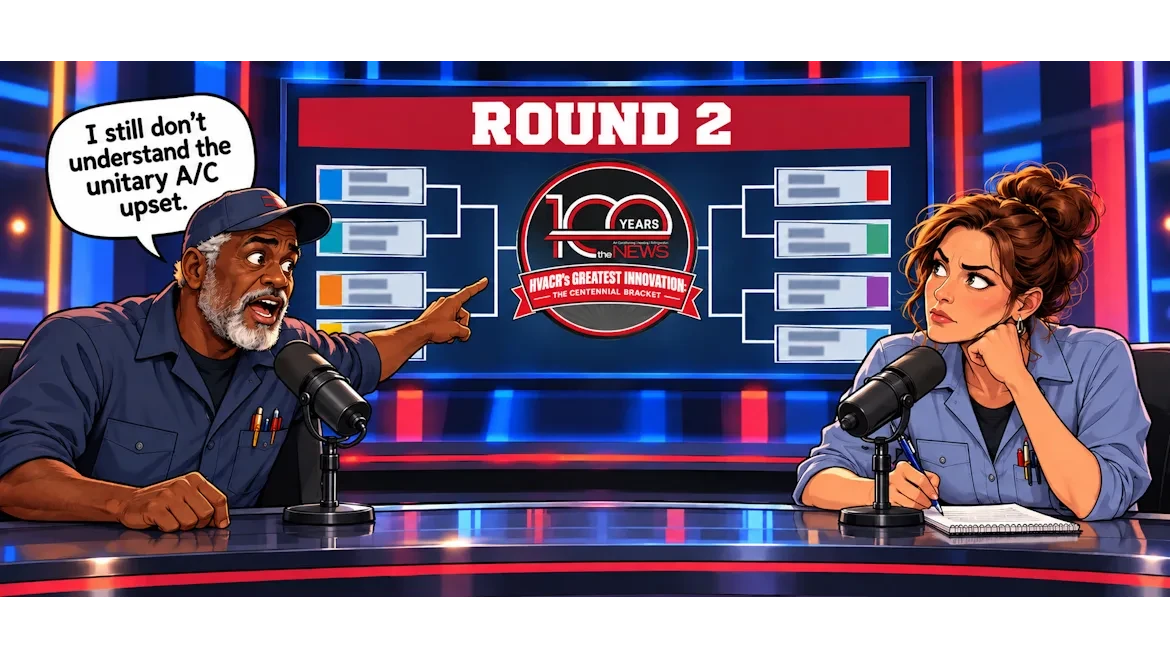
TROY, Mich. — To mark a century of chronicling the evolution of indoor environmental control, heating, ventilation, air conditioning, and refrigeration (ACHR NEWS), one of the industry’s premier trade publications has taken a decidedly modern and spirited approach to historical reflection. Rather than relying on a traditional retrospective of dry essays or retrospective timelines, the publication has launched a high-stakes, 16-contender tournament bracket designed to answer a singular, burning question: Which breakthrough invention truly deserves to be crowned the greatest HVACR innovation of the last 100 years?
Kicked off in celebration of the ACHR NEWS 100th anniversary, the "HVACR Innovation Bracket" pits a century’s worth of foundational technologies, modern efficiency drivers, and digital marvels against one another in a knockout competition. With the opening round officially in the books, the field has been cut in half, leaving eight heavy-hitting technologies to battle it out for a coveted spot in the Final Four.
As the tournament moves into its second round, the competition has sparked passionate debates among contractors, engineers, manufacturers, and technicians nationwide. The outcome of these matchups will not only highlight how far the industry has come since its infancy in the 1920s, but it will also offer a fascinating look at which technologies industry professionals value most as the trade navigates a future defined by decarbonization, electrification, and intelligent connectivity.
Main Facts: The Setup and the Survivors
The tournament began with a curated selection of 16 monumental HVACR innovations. These contenders represent a sweeping historical timeline—from the mechanical and thermodynamic leaps of the mid-20th century to the digital and refrigerant-driven revolutions of the modern era.
The opening round produced several decisive victories, alongside a few tightly contested nail-biters that left voters visibly divided. The results of Round 1 set the stage for an elite "Elite Eight" lineup:
- Smart Thermostats vs. Zoning Systems: In what can only be described as a digital blowout, smart thermostats easily cruised past traditional zoning systems, proving that the connected, Wi-Fi-enabled interface has firmly captured the hearts and minds of modern installers and end-users alike.
- Low-GWP Refrigerants vs. $textCO_2$ Refrigeration: In one of the closest and most fiercely debated matchups of the first round, low-GWP (global warming potential) refrigerants narrowly survived a surging $textCO_2$ refrigeration contender, reflecting the industry’s intense current preoccupation with impending environmental regulations and fluid transitions.
- Cold-Climate Heat Pumps vs. Geothermal HVAC: In a clash of electrification titans, cold-climate heat pumps knocked out geothermal HVAC systems. While geothermal remains the gold standard for long-term efficiency, the recent, staggering performance leaps of air-source heat pumps in sub-zero temperatures clearly propelled them to victory.
- Ductless Mini-Splits vs. High-Efficiency Condensing Furnaces: Ductless mini-splits sent high-efficiency condensing furnaces packing. The explosive market growth and architectural flexibility of mini-splits proved too much for even the most reliable combustion-heating workhorse.
- Inverter-Driven Compressors vs. Unitary Air Conditioning: Inverter technology completely eliminated traditional unitary air conditioning in this bracket matchup—much to the humorous chagrin of traditionalists, particularly in warmer climates like Texas, where single-stage and two-stage unitary units have reigned supreme for decades.
- ECM Motors vs. Refrigeration Rack Systems: Electronically commutated motors (ECMs), celebrated for driving dramatic energy savings across both air movement and fluid pumping, bested commercial refrigeration rack systems.
- TXVs vs. Building Automation Systems: Thermostatic expansion valves (TXVs)—the historic bedrock of efficient evaporator superheat control—managed to take down complex building automation systems (BAS) in a surprise upset.
- Digital Diagnostics & Bluetooth Tools vs. IAQ Accessories: Finally, the march of digitalization continued as digital manifolds, smart probes, and wireless diagnostic tools ended the tournament hopes of indoor air quality (IAQ) accessories.
Chronology: A Century of Comfort and Mechanical Evolution
To understand the weight of these matchups, one must look at the historical timeline that birthed these technologies. When ACHR NEWS first began publishing a century ago, the mechanical cooling and heating industry was in its absolute infancy. The era was defined by bulky, dangerous refrigerants like ammonia, methyl chloride, and sulfur dioxide, utilized primarily in industrial ice-making and massive, centralized comfort cooling installations for movie theaters and select commercial spaces.
The Foundation Era (1920s–1950s)
The early decades saw the commercialization of Freon (chlorofluorocarbons or CFCs) by Thomas Midgley Jr., Charles Kettering, and Albert Leon Henne in 1928, which fundamentally changed the safety profile of refrigeration. Soon after, the invention of the thermostatic expansion valve (TXV) allowed systems to automatically regulate refrigerant flow based on evaporator superheat, transforming refrigeration from a labor-intensive, manually adjusted art into a reliable science.
The Efficiency and Expansion Era (1960s–1990s)
As post-war suburbia boomed, residential air conditioning shifted from a luxury to an expectation. This era introduced centralized unitary systems, forced-air gas furnaces of escalating efficiency, and early iterations of zoning. However, energy crises in the 1970s forced a radical pivot toward efficiency. Regulations were born, and manufacturers began looking for ways to extract more cooling and heating per kilowatt-hour, laying the groundwork for variable-speed technology and high-efficiency ECM motors.
The Digital and Environmental Era (2000s–Present)
The 21st century has been defined by two massive, concurrent paradigm shifts: digital connectivity and environmental compliance. The Montreal Protocol and subsequent Kigali Amendment forced a rapid, ongoing evolution in refrigerants, transitioning the industry from ozone-depleting HCFCs to HFCs, and now to ultra-low GWP hydrofluoroolefins (HFOs) and natural refrigerants like $textCO_2$ and propane. Concurrently, the proliferation of the Internet of Things (IoT) brought smart thermostats, digital diagnostic tools, and Bluetooth-enabled gauges into the daily life of every service technician, fundamentally altering how systems are installed, diagnosed, and monitored.
Supporting Data: The Metrics Driving the Bracket
The choices made by voters in the ACHR NEWS bracket are not happening in a vacuum; they reflect hard data and shifting macroeconomic trends across the North American HVACR landscape.
According to recent market analytics:
- Heat Pump Momentum: Driven by federal incentives such as the Inflation Reduction Act (IRA) and rapid technological advancements, heat pump sales have consistently outpaced traditional fossil-fuel furnaces in various regions. Cold-climate heat pumps, capable of operating at 100% heating capacity down to sub-zero temperatures, represent the fastest-growing segment of residential heating.
- The Electrification and Inverter Shift: Traditional fixed-speed compressors are rapidly losing market share to variable-speed, inverter-driven compressors. These systems can modulate capacity anywhere from 20% to 100%, offering unprecedented humidity control, quieter operation, and energy savings exceeding 30% compared to traditional single-stage units.
- Refrigerant Compliance Realities: The transition mandated by the American Innovation and Manufacturing (AIM) Act has forced contractors to retool their vans, recertify their skills, and adopt low-GWP alternatives. The tight battle between low-GWP refrigerants and $textCO_2$ in the bracket underscores the industry’s deep engagement with these regulatory changes.
- The Labor Multiplier: The rise of digital diagnostics and Bluetooth tools is directly tied to the ongoing skilled labor shortage. With fewer experienced technicians entering the trade, smart tools that automate superheat/subcooling calculations and provide real-time diagnostic guidance have become indispensable force multipliers for contracting businesses.
Official Responses and Industry Reception
The tournament has struck a chord across the HVACR community, generating considerable engagement on social media, trade forums, and corporate breakrooms alike.
Industry leaders note that the bracket serves as an excellent vehicle for education and reflection. "When you look at the 16 innovations we started with, you are looking at the literal DNA of modern civilization," remarked one industry veteran participating in the voting rounds. "Without these technologies, modern architecture, data centers, cold chains for food and medicine, and comfortable indoor living spaces simply could not exist."
Publishers and editors at ACHR NEWS designed the tournament to be interactive precisely because the industry is undergoing such a rapid transformation today. By forcing stakeholders to choose between legacy giants—like the high-efficiency condensing furnace—and modern disruptors like the ductless mini-split, the bracket highlights generational shifts in how comfort is delivered.
Furthermore, the inclusion of everyday tools—such as digital diagnostics—alongside macro-technologies like inverter compressors emphasizes that the day-to-day life of a field technician is just as critical to the industry’s evolution as factory-floor engineering breakthroughs.
Implications: What the Tournament Reveals About the Future of HVACR
Beyond the lighthearted office debates and friendly rivalries, the ACHR NEWS Innovation Bracket offers a clear window into where the industry’s priorities lie as it enters its next century of operation.
- Decarbonization is Winning the Mindshare: The advancement of cold-climate heat pumps over geothermal systems, and ductless systems over furnaces, signals that electrification and decarbonization are no longer niche environmental concepts—they are mainstream market drivers. Contractors and engineers are voting with their clicks for flexible, electrified heating solutions.
- Connectivity is Essential: The landslide victory of smart thermostats and the strong showing of digital diagnostic tools highlight that comfort is now inextricably linked to data. Customers expect to control their environments via smartphones, while technicians expect their gauges to sync directly with cloud-based reporting software.
- Adaptability is Mandatory: The fierce competition surrounding low-GWP refrigerants and inverter technology proves that the industry is fully awake to the challenges of environmental stewardship and energy efficiency regulations.
As Round 2 opens, the stakes grow higher. The remaining eight technologies must now face off in increasingly difficult matchups, narrowing the field down to the Final Four and, eventually, crowning a single undisputed champion of the last 100 years.
Industry professionals, technicians, engineers, and readers can view the updated matchups, study the remaining contenders, and cast their votes by visiting the official ACHR NEWS innovation voting portal.
