

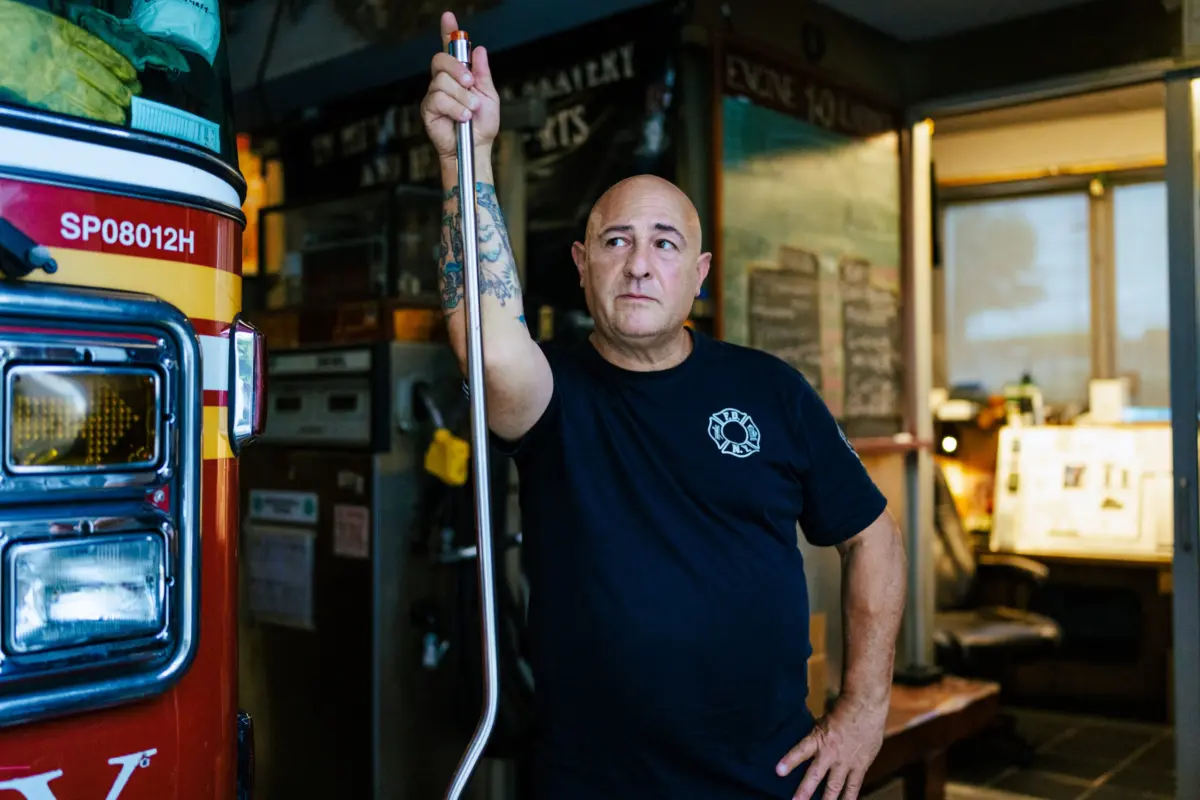
NEW YORK — Nearly a quarter-century after the catastrophic events of September 11, 2001, the heart of the New York City Fire Department’s (FDNY) historic Ten House continues to beat with the memory of that fateful Tuesday. Situated directly across the intersection from where the Twin Towers once pierced the skyline, Engine 10 and Ladder 10 operate not merely as a frontline emergency response station, but as a living, breathing monument to the resilience of a city and a nation.
As the milestone 25th anniversary approaches, the firehouse finds itself at a poignant generational crossroads. The veterans who bore witness to the apocalypse are preparing to pass the torch, while a new wave of firefighters—many born after the attacks—step forward to carry the heavy mantle of history. Among them is 65-year-old Firefighter Sal Argano, the final remaining active-duty member assigned to the station on 9/11, who remains fiercely committed to guarding the gates of memory.
Main Facts: At the Epicenter of History
Ten House is unique within the storied annals of the FDNY. While every firehouse in the five boroughs holds a sacred place in the hearts of New Yorkers, the station situated at 124 Liberty Street occupies a dual reality. It is an active, high-volume emergency response company and a de facto international memorial site.
- The Toll: On September 11, 2001, six members of the Ten House crew were among the 343 FDNY firefighters who made the ultimate sacrifice when the World Trade Center towers collapsed.
- The Station Today: Today, the house is home to a rotating roster of firefighters who balance traditional fire duty with acting as ambassadors for millions of tourists, pilgrims, and dignitaries who visit the National 9/11 Memorial plaza daily.
- The Lasting Presence: Sal Argano, who drives Engine 10, is the sole remaining active-duty firefighter stationed at Ten House in 2001 who still works within its walls.
The physical landscape surrounding the firehouse has undergone a miraculous, decades-long metamorphosis. What was once a smoking, ash-choked crater of twisted steel and pulverized concrete is now a tranquil memorial featuring twin reflecting pools, a subterranean museum housing haunting artifacts, and soaring new skyscrapers that frame the downtown skyline. Yet, inside the bay doors of Ten House, time remains anchored to the profound losses and enduring heroism of that autumn morning.
Chronology: From Apocalypse to Rebirth
To understand the weight carried by the men of Ten House, one must trace the timeline from the dust of 2001 through the grueling years of reconstruction to the present day.
September 11, 2001: The Shift That Saved a Life
For Firefighter Sal Argano, survival was a matter of improbable luck. On the morning the hijacked jets struck the World Trade Center, Argano was not at his usual post at Ten House. Instead, he had been sent on loan to a station in Brooklyn for a routine rotation.
Rushing downtown after the attacks, Argano arrived to find his home firehouse severely battered by debris and shockwaves, yet miraculously still standing. It was then that the grim reality began to set in: six of his brothers-in-arms were missing, swallowed by the catastrophic collapse.
"If I wasn’t sent out on rotation, there would have been a good chance I would not be here today," Argano reflects quietly. "I think about that all the time."
At that exact moment, future Captain Terence Brody—then 30 years old and still a cadet at the fire academy—was rushed straight from the classroom into the heart of ground zero. Thrust into an apocalyptic landscape where falling gray debris drifted down like morbid snow under a brilliant blue sky, Brody and his fellow cadets were overwhelmed by the sheer scale of the devastation. In the immediate aftermath, Ten House served as an essential forward command post and a sanctuary for exhausted, grief-stricken first responders.
The Wilderness Years of Reconstruction
As the years bled together, the crews stationed at Ladder 10 and Engine 10 had a front-row seat to the agonizingly slow rebirth of Lower Manhattan. When Robert Favata joined Ladder 10 fresh out of the academy in 2008, the area surrounding the firehouse was a deafening, chaotic construction zone dominated by a colossal pit.
For years, Favata worked alongside the massive engineering project, watching the foundations of the future memorial and commercial complex rise from the dust. "When I got here, there was nothing," Favata recalls. "I never thought they were gonna finish."
The Modern Era: A Living Monument
Today, the construction noise has been replaced by the quiet hum of global tourism. Tens of millions of visitors stream past the station every year. Some pause to trace their fingers over the large bronze relief affixed to the exterior wall, which etches the names of the fallen Ten House firefighters into eternity. Others stop to snap selfies in front of the gleaming red apparatus before crossing the street to the memorial pools.
Supporting Data & Operational Realities
Life inside Ten House requires a rare psychological fortitude. While standard firehouses deal exclusively with the adrenaline and trauma of emergency response, Ten House personnel must navigate an unyielding, daily collision between profound public grief and the mundane realities of station life.
The Visitor Demographics
- Daily Foot Traffic: Thousands of tourists pass the open bay doors daily, making it one of the most photographed and visited fire stations in the world.
- Global Reach: Firefighters frequently host visitors from international fire departments, trading uniform patches that now line the station walls alongside soot-stained, well-worn helmets hanging from the rafters.
- The Psychological Burden: Captain Terence Brody, who commands Ladder 10, notes that the company demands a specific personality type. “This is definitely one of those companies where if you don’t want to ingratiate yourself to the public, it’s definitely not the right place,” Brody explains. “People around the world know this firehouse. They’re going to come by and say hello.”
Balancing Two Worlds
Despite the rewards of connecting with the global community, the constant stream of onlookers can take a toll. Argano notes that younger firefighters—many of whom were toddlers or entirely un-born when the towers fell—frequently keep a lower profile to protect their peace of mind.
The questions from tourists can range from deeply moving expressions of solidarity to jarringly flippant remarks. Argano recalls a recent incident where a visitor casually asked what made Ten House so special. Rather than engaging in a lengthy, emotionally draining history lesson, Argano simply shrugged and replied, "It’s just a fire station." Afterward, he admitted that some moments simply require too much emotional expenditure. "If I need to explain to you all of that, then it’s like, ‘Pull up a seat,’" he says with a weary smile. "Let me get another cigarette. It’s gonna be a long one."
Official Responses and Reflections on a Milestone
As the 25th anniversary of 9/11 approaches, the leadership and veterans of Ten House are confronting a monumental transition. The generation of firefighters who inherited the immediate trauma of the attacks is moving toward retirement, raising urgent questions about how institutional memory will be preserved.
The Passing of the Torch
Captain Brody, now 55, submitted his retirement papers, with his final shift scheduled for October. For Brody, whose career as a firefighter and screenwriter (notably penning scripts adapted into Hallmark Channel movies) has unfolded entirely in the shadow of the World Trade Center, the closing circle is deeply poetic.
"It’s interesting to think that my first day in the field was right across the street, and this is where I’m gonna end my career," Brody observes.
For Firefighter Robert Favata, now 46, the upcoming anniversary brings a wave of emotional vulnerability. As one of the veteran members who absorbed the oral histories of the 9/11 survivors when he joined in 2008, Favata worries whether he has done enough to pass that sacred knowledge down to the newest recruits.
Choking back tears, Favata states, "When I got here, so many of the guys worked 9/11 and they told me their stories of that day. I just hope I can give like a percentage of what they’ve told me to the younger guys."
Implications: Preserving History When the Living Witnesses Leave
The impending departure of veterans like Brody and the eventual retirement of Argano highlight a critical challenge facing historical institutions worldwide: How do you maintain the authenticity of a living memory once the last direct witnesses step away?
For the FDNY, Ten House serves as a microcosm of a broader societal shift. As historical events pass from living memory into the pages of textbooks, institutions rely heavily on physical artifacts, ritual, and intentional storytelling to bridge the generational gap.
Sal Argano recognizes this vulnerability better than anyone. At 65 years old, while others are packing their gear for the final time, Argano insists he is not yet ready to leave. He fears that a vital, irreplaceable piece of the firehouse’s soul will vanish the moment the last 9/11 survivor walks out the door for good.
"I’m not done. I’m gonna be here as long as I can," Argano declares, his eyes fixed on the bustling street outside. "I’m going to keep telling them what I know, what I saw, what I’ve been through. Telling them the history of this firehouse. Everything I can remember."
Until that day comes, Sal Argano remains at his post—driving Engine 10, greeting the world with a handshake, and standing eternal guard at the crossroads of American history.
