

WASHINGTON — For generations, private real estate investing has been bound by an exclusionary rule of scale: high capital barriers to entry. Whether purchasing physical properties directly or participating passively in institutional-grade syndications, joint ventures, and private equity funds, accredited and high-net-worth individuals have long faced steep minimum investment thresholds. Typically ranging from $50,000 to $100,000—factoring in down payments, closing costs, renovation reserves, or sponsor-mandated minimums—these financial walls have historically made true portfolio diversification nearly impossible for everyday investors.
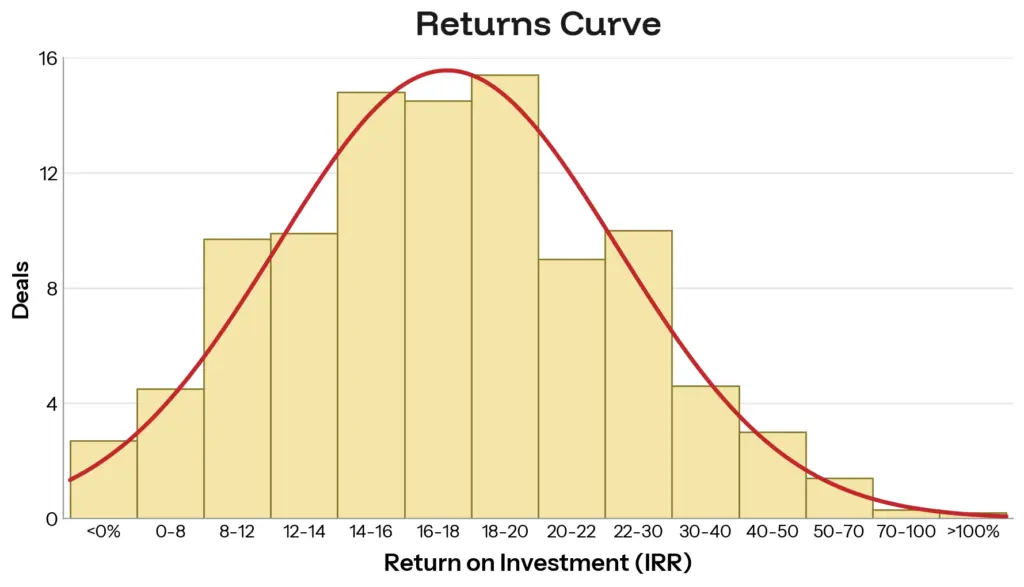
However, a quiet structural shift in the private wealth management sector is challenging this paradigm. Through the rise of private co-investing clubs and micro-syndications, modern investors are breaking down institutional-grade real estate deals into bite-sized tickets of $2,500 to $5,000. By spreading modest amounts of capital across dozens of distinct projects, these investors are achieving a distribution of outcomes that mirrors a classic statistical bell curve. This strategy is fundamentally transforming real estate syndication from a high-stakes, concentrated gamble into a systematic, asset-backed wealth-building vehicle modeled after modern stock market index investing.
Main Facts: The Mechanics of the Real Estate Bell Curve
At its core, the returns bell curve relies on a fundamental statistical reality: risk can never be entirely eradicated from investing, no matter how exhaustive the underwriting or how conservative the projected Internal Rate of Return (IRR).
In any large portfolio of private real estate assets, performance naturally distributes across a spectrum:
- The Underperformers: A small percentage of deals will inevitably stumble due to unforeseen macroeconomic shifts, poor local market execution, or operational missteps by the sponsor.
- The Outliers: Another small fraction will dramatically surpass underwriting expectations, benefiting from unexpected appreciation, aggressive rent growth, or compressed cap rates.
- The Core Majority: The vast majority of investments will land safely in the middle, delivering solid, predictable returns consistent with initial projections.
When an investor concentrates $100,000 into a single multifamily syndication, they are essentially placing all their chips on one segment of the bell curve. If that specific property underperforms—or worse, goes into foreclosure—the financial and psychological toll can be devastating.
Conversely, by dispersing that same $100,000 across 20 to 40 micro-investments of $2,500 to $5,000 each, the investor captures the statistical law of averages. The exceptional performance of top-tier deals offsets the drag of underperforming assets, smoothing out overall portfolio volatility and anchoring performance around a healthy average.
Chronology: From Concentrated Ownership to Micro-Diversification
To understand the evolution of this strategy, one must examine the shifting landscape of private equity over the past decade.
- The Era of Direct Active Investing (Pre-2015): Historically, individual real estate investors focused on active ownership. Purchasing duplexes, triplexes, or small commercial spaces required massive capital outlays, exhaustive property management, and sleepless nights. Diversification was severely limited by personal net worth and borrowing capacity.
- The Rise of Traditional Syndications (2015–2020): As online crowdfunding platforms and real estate syndication networks matured, passive investing gained mainstream traction. While investors no longer had to unclog toilets, they were still constrained by high investment minimums. A portfolio of just five syndications required a quarter-million dollars in liquid capital.
- The Emergence of Co-Investing Clubs (2020–Present): To solve the capital bottleneck, private co-investing communities began pooling capital to negotiate institutional-level access with major sponsors. By aggregating capital at the club level, individual members gained the ability to write $2,500 checks into institutional-grade deals. This structural innovation opened the door to hyper-diversification, allowing everyday participants to scale portfolios spanning dozens of properties, asset classes, and geographic regions.
Supporting Data: Averaging Out to Above-Average Returns
The mathematical argument for micro-diversification is robust, mirroring the historical behavior of major public equity indexes like the S&P 500.
Market data consistently shows that even during bull markets, roughly 25% to 30% of individual stocks within the S&P 500 lose money. In bear markets or corrections, that figure can surge to 75%. Yet, because the index automatically absorbs these individual failures and harnesses the outsized gains of market leaders, the S&P 500 has maintained a historical average annual return of roughly 10%.
Private real estate co-investing clubs operating under similar structural principles report comparable—and often superior—results. Aggregate performance data from established co-investing groups indicates combined average returns (incorporating both realized full-cycle deals and current projections) hovering around 16.39%.
Furthermore, this multi-axis diversification model operates across several distinct parameters:

- Asset Class Diversity: Portfolios built through micro-investing are no longer restricted to traditional multifamily housing. Investors can gain fractional exposure to industrial warehouses, retail centers, raw land, mobile home parks, single-family rental portfolios, and hospitality assets.
- Geographic Distribution: Capital can be deployed across fast-growing Sunbelt metros, stable Midwestern markets, secondary hubs, and even international opportunities (such as select Canadian developments), insulating portfolios from regional economic downturns.
- Capital Stack Positioning: Rather than relying exclusively on high-risk equity syndications, micro-investors can allocate capital to secured debt instruments, such as short-term notes backed by real property at conservative Loan-to-Value (LTV) ratios yielding double-digit fixed returns.
- Duration Staggering: By mixing long-term equity holds (typically five to seven years) with short-term debt instruments (such as 12-to-18-month promissory notes), investors ensure a steady, staggered stream of liquidity rather than a single, tax-heavy realization event.
Official Perspectives and Industry Expert Responses
Wealth management professionals and alternative asset analysts have increasingly weighed in on the micro-syndication trend, noting its structural alignment with modern portfolio theory (MPT).
"Diversification has always been the only free lunch in finance, yet private real estate has traditionally forced investors to eat heavy, concentrated meals," notes a senior wealth strategist specializing in alternative assets. "By enabling fractional participation in private equity and private credit, co-investing clubs are finally applying public market indexing principles to private bricks-and-mortar assets."
Sponsors and operators of commercial real estate funds have also acknowledged the shifting demographics of their capital stacks. While institutional capital remains the primary driver for mega-projects, syndicators increasingly value groups of co-investors for their relationship stability and aggregate liquidity depth.
"Working with aggregated co-investing groups allows us to diversify our investor base while streamlining communications," explains a managing partner at a national multifamily acquisition firm. "From an operator perspective, capital is capital, but a diversified investor pool often proves more resilient during macroeconomic tightening cycles because individual participants are not over-leveraged in a single asset."
Implications: Dollar-Cost Averaging, Tax Optimization, and Replacing Bonds
The adoption of a bell curve, micro-allocation strategy carries profound implications for individual portfolio construction, transforming how investors handle risk, taxation, and fixed-income allocation.
The Power of Dollar-Cost Averaging in Real Estate
Just as monthly contributions to a retirement account protect stock investors from timing the market, micro-investing enables real estate dollar-cost averaging. Committing $2,500 to a new deal every month eliminates the perils of market-timing risk. Whether cap rates are compressing or interest rates are spiking, a steady, programmatic deployment of capital ensures that an investor builds a balanced vintage-year portfolio, capturing various economic cycles.
Staggered Tax Benefits and the "Lazy 1031"
Private real estate syndications frequently utilize accelerated depreciation and cost segregation studies, generating substantial passive losses in year one (often offsetting 65% to 80% of initial capital). By continually funding new deals on a monthly or quarterly basis, investors practice a form of the "lazy 1031 exchange." As mature projects go full-cycle and trigger capital gains tax liabilities, newly generated depreciation write-offs from ongoing investments help offset those tax burdens within the same calendar year.
Reimagining Fixed Income: Real Estate as a Bond Substitute
Traditional fixed-income assets, particularly government and corporate bonds, have faced severe scrutiny due to inflation and interest rate risk. While bonds offer low default risk, they frequently fail to protect purchasing power during inflationary spikes.
In contrast, structured private real estate investments—such as cash-flowing equity syndications yielding 6% to 10% annual distributions alongside 14% to 18% total annualized returns, or secured debt notes paying 14% to 16% quarterly interest—fulfill the traditional functions of bonds while providing vital structural advantages:
- Inflation Hedging: Real estate assets inherently reprice rents and values upward with inflation.
- Low Stock Market Correlation: Unlike Real Estate Investment Trusts (REITs), which trade on public exchanges and correlate heavily with broader equities, private syndications remain insulated from daily market sentiment.
- Recession Resilience: Essential asset classes like workforce housing and industrial logistics maintain high demand regardless of economic cycles.
Conclusion
The evolution of private real estate from an elite, concentrated asset class into an accessible, index-style strategy marks a turning point for individual wealth management. By dismantling high capital barriers and embracing the statistical realities of the returns bell curve, investors can step off the emotional roller coaster of single-property ownership.
While risk can never be entirely engineered out of real estate, embracing micro-diversification across multiple asset types, geographic markets, and capital structures ensures that outlier failures are absorbed by the law of averages—paving a steady, resilient path toward long-term financial independence.
