

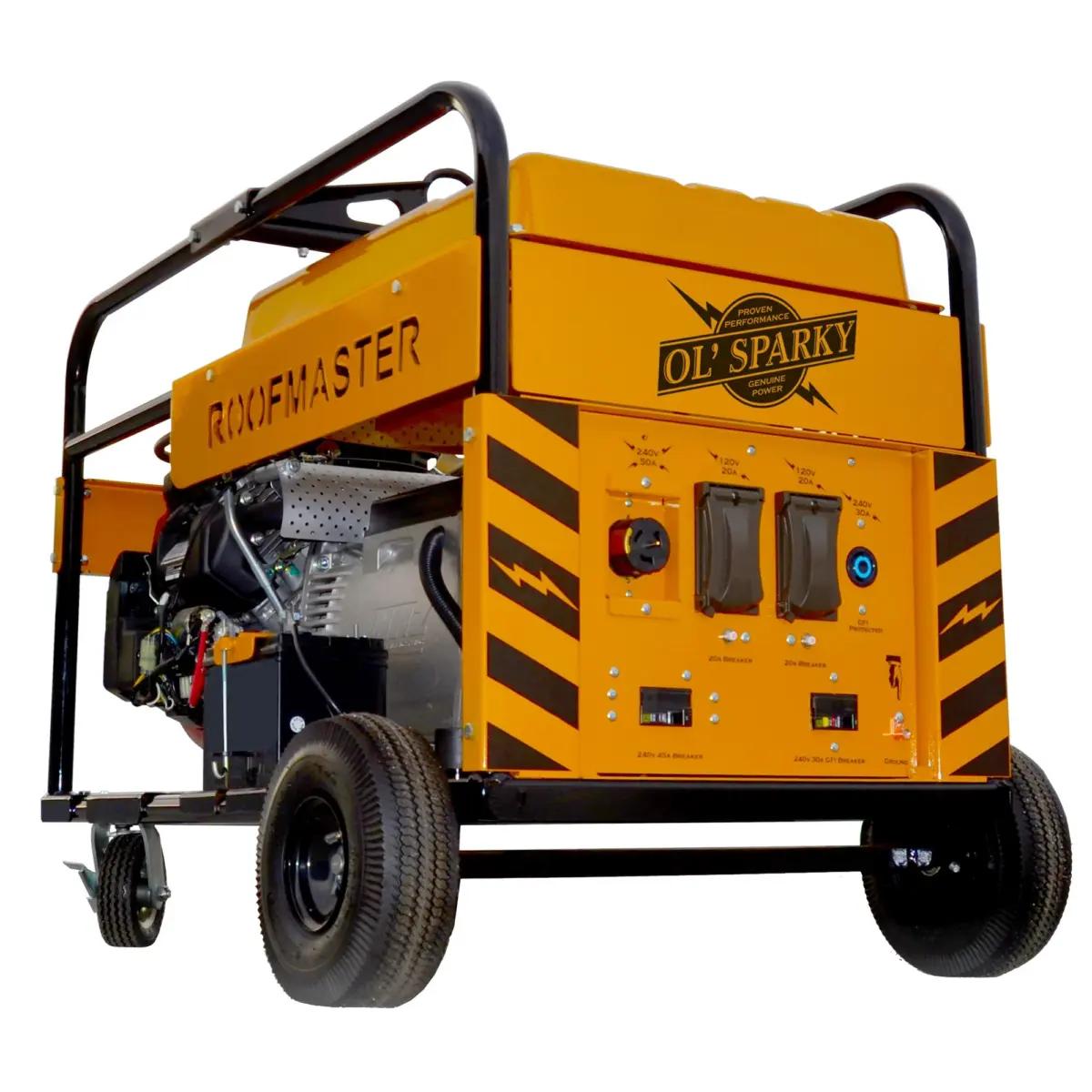
Main Facts: The Hidden Danger of "Dirty Power" on Job Sites
In the modern construction and industrial fabrication sectors, the rapid advancement of digital technology has introduced highly sophisticated microprocessors into everyday tools. Equipment such as automatic hot-air welders, manufactured by industry leaders like Leister, now rely on precise electronic control boards to regulate temperature, drive speed, and system diagnostics. However, a critical mismatch has emerged on work sites worldwide: the discrepancy between the delicate power requirements of these advanced machines and the low-quality electricity produced by common portable generators.
At the heart of this issue is Total Harmonic Distortion (THD)—a technical metric that measures the degree to which an electrical voltage waveform deviates from a perfect, clean sinusoidal curve. The greater the distortion of this waveform, the more "dirty" the power becomes. For standard utility-grade electricity, THD is typically maintained well below 5%.
Typical Utility Power (Clean Sine Wave)  --->  THD < 5%   ---> Safe for sensitive electronics
Budget Job-Site Generator (Distorted)   --->  THD 25-30% ---> High risk of motherboard failure
According to industry experts, including Ryen Van Grol, a veteran Territory Sales Manager specializing in industrial welding and power equipment, many of the portable generators sold at high-volume "big-box" retail stores produce power with THD levels ranging from 25% to 30%. While these budget-friendly generators are perfectly adequate for running simple, robust mechanical tools, they are fundamentally unsuited for sensitive digital electronics.
Manufacturers of industrial hot-air welders and electronic tools generally specify that portable generators must deliver power with a maximum THD of less than 6% to 7%—with some strictly requiring less than 5%—to prevent irreversible component degradation. Using high-THD generators risks catastrophic control board failure, motor burnout, and erratic tool behavior, leading to thousands of dollars in equipment damage and project downtime.
Chronology of a Power Failure: How "Dirty Power" Destroys Equipment on Site
The destruction of sensitive industrial electronics by a low-quality generator is rarely instantaneous; rather, it is a cumulative process driven by thermal and electrical stress. Examining a typical operational timeline reveals how these failures develop over a standard working shift.
+-----------------------------------------------------------------------------+
| 07:00 AM - Setup & Startup                                                  |
| Generator starts. Digital welder initializes, but microprocessors run warm  |
| due to distorted voltage waveforms.                                         |
+-----------------------------------------------------------------------------+
                                      |
                                      v
+-----------------------------------------------------------------------------+
| 10:30 AM - Heavy Load Fluctuations                                          |
| Secondary tools (saws, drills) cycle on/off. Generator's AVR struggles;     |
| voltage sags and surges ripple through the system.                           |
+-----------------------------------------------------------------------------+
                                      |
                                      v
+-----------------------------------------------------------------------------+
| 02:00 PM - Thermal & Electrical Saturation                                  |
| Continuous harmonic currents cause capacitors to overheat and voltage      |
| regulators to degrade under persistent stress.                              |
+-----------------------------------------------------------------------------+
                                      |
                                      v
+-----------------------------------------------------------------------------+
| 04:15 PM - System Failure                                                   |
| A final voltage spike or localized thermal runaway causes the welder's      |
| motherboard to burn out. Operation halts.                                   |
+-----------------------------------------------------------------------------+
Phase 1: Setup and Startup (07:00 AM)
A roofing or fabrication crew arrives on-site and starts a standard 10kW utility generator purchased from a local hardware retailer. An automatic hot-air welder is plugged in alongside several basic power tools. Upon startup, the welder’s digital interface boots up normally. However, behind the scenes, the high THD (around 25%) immediately forces the welder’s internal power supply and microprocessors to run significantly hotter than designed as they struggle to filter the irregular electrical signal.
Phase 2: Heavy Load Fluctuations (10:30 AM)
As the workday intensifies, crew members connect auxiliary tools to the same generator, such as screw guns, reciprocating saws (sawzalls), and battery chargers. Each time these tools are switched on and off, they draw rapid spikes of current. Because the generator lacks high-quality copper windings and advanced electronic voltage regulation, its engine and alternator cannot respond quickly enough. This creates severe voltage sags and spikes, compounding the existing harmonic distortion and sending unstable voltage waves directly into the sensitive welder.
Phase 3: Thermal and Electrical Saturation (02:00 PM)
After several hours of continuous operation under these conditions, the internal components of the welder’s control board reach a critical thermal threshold. The harmonic currents, which do no useful work, are converted entirely into waste heat within the welder’s capacitors and voltage regulators. The machine may begin to exhibit erratic behavior, such as minor temperature fluctuations or brief control-panel flickering.
Phase 4: System Failure (04:15 PM)
A worker engages a heavy-duty circular saw connected to the same generator. The sudden, massive inductive load causes the generator’s voltage to drop sharply, followed by an immediate over-correction spike from the generator’s basic automatic voltage regulator (AVR). This voltage surge, riding on a highly distorted waveform, punctures a critical semiconductor or capacitor on the welder’s motherboard. The welder shuts down instantly, showing a blank screen or an unrecoverable error code. The project is halted, and the tool must be sent to an authorized service center for an expensive motherboard replacement.
Supporting Data: The Physics of Harmonic Distortion and Load Profiles
To understand why this degradation occurs, it is necessary to examine the physical differences between clean and distorted power, as well as the behavior of different electrical loads.
Understanding Linear vs. Non-Linear Loads
Electrical loads are categorized into two primary groups, each interacting differently with a generator’s alternator:
- Linear Loads: These loads draw current that is proportional to the voltage waveform. Examples include incandescent lights, electric heaters, and simple electric motors (such as those in older screw guns, saws, and drills). Linear loads do not distort the voltage waveform, making them highly compatible with basic, high-THD generators.
- Non-Linear Loads: These loads draw current in abrupt pulses rather than a smooth, continuous wave. Examples include computers, variable-frequency drives, LED lighting systems, and modern digital welders. The pulsing draw of non-linear loads distorts the voltage sine wave, creating harmonic currents that feedback into the generator.
When a sensitive non-linear load (like a digital welder) is paired with a low-quality generator that already possesses a high baseline THD, the mutual interference escalates rapidly.
| Parameter | Utility Power / Inverter Generator | Standard Retail Generator |
|---|---|---|
| THD Percentage | < 3% to 5% | 20% to 30% |
| Waveform Shape | Smooth, clean sine wave | Jagged, stepped, or clipped wave |
| Alternator Windings | High-grade pure copper, tight pitch | Lower-grade copper or aluminum alloys |
| Voltage Regulation | Digital Inverter / Advanced Electronic AVR | Basic mechanical or low-cost electronic AVR |
| Suitability | Safe for microprocessors & digital controls | Strictly limited to linear mechanical tools |
The Impact of Harmonic Currents on Alternator Quality
The primary differentiator between a high-end commercial generator and a budget consumer model lies in the quality of the alternator’s internal components. High-quality generators utilize premium, high-purity copper windings with a tighter pitch, which naturally minimizes the generation of harmonic frequencies.
Budget generators often feature looser tolerances, inferior winding configurations, or aluminum windings. When subjected to the pulsing current demands of non-linear loads, these lower-grade alternators experience localized magnetic saturation, which further deforms the output voltage waveform and pushes the THD to levels that are destructive to digital control boards.
Official Responses: Manufacturer Guidelines and Warranty Realities
Major manufacturers of industrial tools and power equipment have long recognized the dangers of dirty power and have established strict operational guidelines to protect their products and clarify warranty boundaries.
Leister and Hot-Air Welder Manufacturers
Leister, a global leader in plastic welding and industrial heating technologies, explicitly outlines power supply requirements in its technical documentation. The manufacturer states that its digital automatic welders require a stable, clean power source.
Field service technicians from Leister and authorized repair centers consistently report that a high percentage of control board failures sent in for repair are directly attributable to generator over-voltage, voltage sags, or high harmonic distortion. Manufacturers emphasize that operating their equipment on a generator with a THD exceeding 6% constitutes improper use, which can void the product’s warranty.
Generator OEM Specifications
Major commercial generator manufacturers, such as Honda (with their EU-series inverter generators) and Generac (commercial grade), actively market "Clean Power" technologies. Honda, for instance, guarantees that its inverter-equipped models produce a THD of less than 3%, making them safer for sensitive electronics than standard household utility power.
Conversely, manufacturers of budget-tier utility generators often omit THD ratings from their promotional materials and standard specification sheets. Industry experts warn that if a generator’s manufacturer does not readily publish its THD rating, users should assume the unit produces high-THD power (often exceeding 20%) and is unsuitable for electronic equipment.
Implications: Protecting Capital Investments and Optimizing Job-Site Efficiency
The systemic issue of high THD on construction sites has broad financial and operational implications for contractors, project managers, and business owners.
                  FINANCIAL DECISION MATRIX

   Option A: Low-Cost Generator Setup
   +-------------------------------------------------------------+
   | Budget Generator Purchase Cost:                      $600   |
   | Risk of Welder Motherboard Damage (Replacement Cost): $2,500 |
   | Estimated Job-Site Downtime Cost (Per Day):          $1,500 |
   | Total Risk Exposure:                                 $4,600 |
   +-------------------------------------------------------------+

   Option B: Professional Low-THD Setup
   +-------------------------------------------------------------+
   | Premium Inverter/Low-THD Generator Cost:            $2,800 |
   | Risk of Motherboard Damage:                             $0 |
   | Risk of Job-Site Downtime:                              $0 |
   | Total Risk Exposure:                                 $2,800 |
   +-------------------------------------------------------------+
The True Cost of Equipment Damage and Downtime
While a high-quality, low-THD generator or inverter generator may cost significantly more than a standard big-box retail model, the price difference is quickly offset when compared to the cost of equipment repairs. A professional automatic hot-air welder is a major capital investment, often costing between $3,000 and $10,000. Replacing a fried control board can easily cost upwards of $1,500 to $3,000 in parts and specialized labor.
Furthermore, the indirect costs of project downtime can be devastating. On commercial roofing or civil engineering projects, a stalled welding operation can delay subsequent phases of construction, leading to contract penalties, wasted labor hours, and compromised client relationships.
Best Practices for Job-Site Power Management
To mitigate the risks associated with high THD and ensure the longevity of high-end industrial tools, contractors should implement the following operational protocols:
- Verify Generator Specifications: Before purchasing or renting a generator, demand the official THD specification from the manufacturer. Ensure it is certified to operate at less than 6% THD (ideally less than 3%) under full load.
- Segregate Electrical Loads: Never run sensitive digital equipment on the same generator circuit as high-draw, cycle-heavy linear tools like saws, drills, or compressors. Dedicate a high-quality, low-THD inverter generator solely to sensitive electronics, while utilizing cheaper utility generators for basic mechanical tools.
- Inspect Connections and Extension Cords: Regularly inspect all power cords, plugs, and extension cords. Frayed wires, loose connections, and excessively long cord runs cause voltage drops and localized resistance, which can compound waveform distortion and increase thermal stress on the tool’s internal electronics.
- Invest in Inverter Technology: For highly sensitive applications, utilize modern inverter generators. These units convert raw AC power to DC, and then digitally invert it back to AC, producing an incredibly stable, clean sine wave that remains consistent regardless of engine speed or load fluctuations.
Ultimately, protecting high-end industrial tools requires a shift in perspective. Viewing the generator not merely as a basic utility, but as an integral component of a high-performance tool system, is essential to safeguarding capital investments, maintaining warranty coverage, and ensuring uninterrupted productivity on the job site.
