

The commercial roofing industry is undergoing a significant shift as building owners and contractors seek sustainable, cost-effective alternatives to traditional tear-offs and replacements. At the forefront of this movement is silicone roof coating, which has emerged as one of the fastest-growing and most technically demanding sectors in roof maintenance.
However, transitioning into silicone application is not as simple as purchasing a few rollers and buckets of paint. The process requires highly specialized equipment, rigorous safety protocols, and a deep understanding of application mechanics. With equipment investment costs ranging from a modest $1,000 to upwards of $30,000, commercial roofing contractors must carefully evaluate their business models, labor capabilities, and regional weather patterns before investing in a specific application method.
Main Facts: The Division Between Roller and Spray Systems
The decision-making process for applying silicone roof coatings is divided into two primary methodologies: roll-applied systems and spray-applied systems. Each method presents a distinct set of operational parameters, financial commitments, and technical requirements.
+---------------------------------------------------------------------------------+
|                               SILICONE APPLICATION                              |
+---------------------------------------------------+-----------------------------+
|                   SPRAY SYSTEMS                   |        ROLLER SYSTEMS       |
|                 ($15k - $30k Capex)               |      (~$1k - $3k Capex)     |
+---------------------------------------------------+-----------------------------+
| - High production rate                            | - Low capital entry point   |
| - High technical complexity                       | - Simple operation & safety |
| - High risk of wind drift                         | - Wind-tolerant application |
| - Best for large, open roofs                      | - Ideal for tight spaces    |
+---------------------------------------------------+-----------------------------+
The Roll-Applied Approach: Low Capital, High Reliability
For contractors entering the silicone market or those focusing on localized, smaller-scale projects, the roll-applied method represents the most accessible entry point.
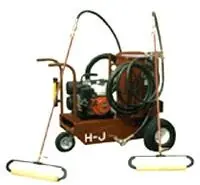
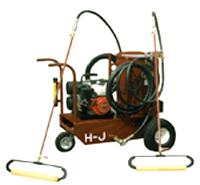
- Equipment Design: Commercial-grade silicone rollers differ significantly from standard residential paint rollers. They typically range in width from 14 inches to 40 inches, featuring a large 6-inch diameter. These rollers are mounted onto heavy-duty frames equipped with integrated wheels and an accompanying vat. The vat features calibrated flow holes designed to control the distribution of high-viscosity silicone onto the roof substrate.
- Financial Commitment: A complete commercial-grade roller setup can be acquired for approximately $1,000 to $3,000, making it an exceptionally low-risk capital expenditure (Capex).
- Operational Advantages: Beyond cost, the primary benefit of roller systems is their immunity to wind conditions. While high winds can completely halt spray operations due to overspray risks, roller crews can continue working safely and efficiently.
The Spray-Applied Approach: High Efficiency, High Complexity
For high-volume commercial contractors, spray application is the industry standard for rapid installation. However, the high viscosity and moisture-curing nature of silicone require industrial-grade machinery.
- Equipment Design: Standard paint sprayers are incapable of processing high-solids silicone. Instead, contractors must invest in heavy-duty hydraulic piston pumps. These systems require powerful engines, specialized high-pressure hoses, and advanced instrumentation. High-end units also feature hydraulic auxiliaries to power mixer attachments and integrated lifts capable of raising and lowering the fluid section directly into 55-gallon drums.
- Financial Commitment: Industrial silicone sprayers range in price from $15,000 to $30,000. The wide price disparity is primarily driven by hose length capabilities, chassis durability, engine displacement, and automated features.
- Operational Advantages: A trained spray crew can coat tens of thousands of square feet per day, far outpacing the production rates of roller-based crews. This speed reduces labor hours on large, unobstructed roof decks.
Chronology: The Evolution of Liquid-Applied Roofing Membranes
To understand the current dominance of silicone and the complexity of modern application machinery, it is necessary to examine how the roof restoration market has evolved over the past several decades.
  1970s - 1980s: Asphalt & Coal Tar Emulsions
  │   • High maintenance, poor UV resistance, labor-intensive
  ▼
  1990s: Acrylic & Polyurethane Coatings
  │   • Improved reflectivity, but prone to degradation under ponding water
  ▼
  2000s - 2010s: High-Solids Silicone Revolution
  │   • Superior UV stability, ponding water resistance, moisture-cure chemistry
  ▼
  Present: Advanced Hydraulic Systems & Automated Application
• High-pressure pumps, precision vats, and strict safety protocols- The Early Era (1970s–1980s): Asphalt and Coal Tar Emulsions
Early roof coatings were primarily asphalt- or coal-tar-based emulsions. These materials were highly viscous, emitted strong volatile organic compounds (VOCs), and required rudimentary mop-and-bucket application methods. They offered limited UV resistance and required frequent reapplication. - The Synthetic Transition (1990s): Acrylics and Polyurethanes
As chemical engineering advanced, acrylic and polyurethane coatings gained market share. Acrylics offered excellent reflectivity and were easy to spray using standard airless equipment. However, they were water-soluble during application and failed rapidly under ponding water. Polyurethanes offered better durability but were highly sensitive to moisture during the curing process, often leading to blistering. - The Silicone Revolution (2000s–Present): High-Solids Formulations
The introduction of high-solids, moisture-cure silicone revolutionized the restoration market. Silicone offered permanent resistance to ponding water, outstanding UV stability, and long-term flexibility. However, its high solids content (often exceeding 90%) meant the material was incredibly thick and heavy, rendering older spray technologies obsolete and driving the development of the $30,000 hydraulic systems used today.
Supporting Data: Operational and Financial Comparison
Choosing between spray and roller systems requires a careful analysis of labor costs, material yields, and equipment maintenance. The table below illustrates the operational trade-offs between the two methodologies.
| Operational Metric | Roll-Applied System (Low-Cost) | Spray-Applied System (High-End) |
|---|---|---|
| Initial Capital Investment | $1,000 – $3,000 | $15,000 – $30,000 |
| Average Daily Production Rate | 5,000 – 8,000 sq. ft. | 15,000 – 25,000 sq. ft. |
| Required Crew Size | 2 – 3 workers | 4 – 5 workers |
| Wind Limitation Threshold | Up to 20-25 mph | Cutoff at 10-12 mph (Overspray risk) |
| Material Waste / Overspray Loss | Negligible (<2%) | 5% – 15% (depending on wind) |
| Cleanup & Maintenance Time | 15 – 30 minutes | 1 – 2 hours (requires solvent flushing) |
| Primary Target Market | Small to mid-size roofs, congested decks | Large, open warehouse & industrial roofs |
The Physics of Silicone Viscosity
The primary reason spray equipment is so expensive lies in the fluid dynamics of silicone. High-solids silicone coatings typically exhibit a viscosity ranging from 10,000 to 35,000 centipoise (cP). For comparison, water has a viscosity of 1 cP, while motor oil is around 250 cP.
To pump a fluid this viscous through 150 to 250 feet of high-pressure hose and atomize it through a spray tip without shearing the material requires a pump operating at pressures between 3,000 and 4,000 PSI, with a flow rate of at least 2 to 3 gallons per minute. Attempting to run this material through underpowered equipment will cause the pump to seize, leading to costly downtime and equipment damage.
Official Responses and Expert Perspectives
Industry veterans emphasize that purchasing equipment is only the first step in a successful silicone application program. Training, safety, and manufacturer support are critical components of a contractor’s success.
Pat Amicucci, an industry expert with Roofmaster®, a leading roofing equipment supplier with 70 years of market experience, highlights the nuanced nature of this investment:
"Fitting your company with the right options is not all black and white. Crews need to be familiar with the operations and dangers associated with the equipment. Some of the equipment cost can range upwards of $30,000 or as little as $1,000 to get you set up."
Amicucci stresses that a contractor’s choice should align with their immediate project pipeline and regional climate patterns. For instance, in coastal or high-wind regions, relying solely on high-end spray rigs can lead to costly delays. In those environments, having a commercial-grade roller system as a backup ensures that crews remain productive even when wind conditions prevent spraying.
Safety and Regulatory Standards
Regulatory bodies, including the Occupational Safety and Health Administration (OSHA) and the Roof Coatings Manufacturers Association (RCMA), also warn of the unique hazards associated with high-pressure spray equipment:
- High-Pressure Injection Injuries: Fluid escaping from a spray tip at 3,000+ PSI can easily penetrate human skin, injecting highly toxic silicone directly into deep tissue. This requires immediate emergency medical intervention to avoid amputation.
- Respiratory Hazards: Spraying silicone atomizes the material into the air. OSHA requires workers within the spray zone to wear appropriate personal protective equipment (PPE), including half-mask or full-face respirators equipped with organic vapor cartridges and particulate pre-filters.
- Overspray Liability: Atomized silicone particles can drift significant distances in the wind. If these particles land on nearby vehicles or adjacent buildings, the contractor can face substantial liability claims.
Implications: The Strategic Future of Roof Restoration
The rapid adoption of silicone coatings carries broad implications for the commercial roofing sector, affecting business scaling, labor dynamics, and environmental sustainability.
┌─────────────────────────────────────────────────────────┐
│              STRATEGIC BUSINESS DECISION                │
└────────────────────────────┬────────────────────────────┘
                             │
              Is your average project size:
              ├── < 15,000 sq. ft.? ──> Invest in Rollers (Low risk, high flexibility)
              └── > 15,000 sq. ft.? ──> Invest in Sprayers (High output, requires skilled labor)
Business Scaling and Capital Allocation
For small to mid-sized roofing companies, the low barrier to entry offered by roll-applied systems allows them to compete in the profitable roof restoration market without taking on significant debt. Conversely, for large enterprises, investing in a $30,000 hydraulic spray rig is a justifiable capital expense that can be amortized quickly over several large-scale industrial projects.
The Labor Shortage and Technical Training
The roofing industry continues to grapple with a chronic shortage of skilled labor. Operating and maintaining a complex hydraulic spray system requires specialized mechanical knowledge. Contractors who fail to invest in thorough training for their crews often experience frequent equipment failures, clogged lines, and inconsistent coating thicknesses, which can void manufacturer warranties. The simplicity of roller systems offers a practical alternative for companies struggling to recruit and retain highly technical equipment operators.
Environmental and Landfill Impact
From an environmental perspective, the rise of silicone coatings—regardless of the application method—is a major positive for the construction industry. By restoring existing roofs rather than tearing them off, contractors prevent millions of tons of roofing waste from entering landfills each year. Furthermore, the high reflectivity of white silicone coatings significantly reduces building energy consumption, mitigating the urban heat island effect and aligning with increasingly stringent local and state energy codes.
Ultimately, as the commercial roofing market continues to prioritize restoration over replacement, the demand for silicone applications will only increase. Whether a contractor chooses to start with a $1,000 roller setup or scale up to a $30,000 hydraulic spray rig, success will depend on proper training, a clear understanding of the technology, and a strategic alignment of equipment with the company’s operational capabilities.
