

Berlin — For over a decade, major technology companies have promised that voice would eventually replace touchscreens and physical keyboards as our primary interface for computing. Yet, despite billions spent on virtual assistants like Siri, Alexa, and Google Assistant, that promised future never quite materialized. Voice commands remained largely confined to setting kitchen timers, checking the weather, or awkwardly trying to send text messages while driving. For most productivity tasks, we returned to our screens and keyboards.
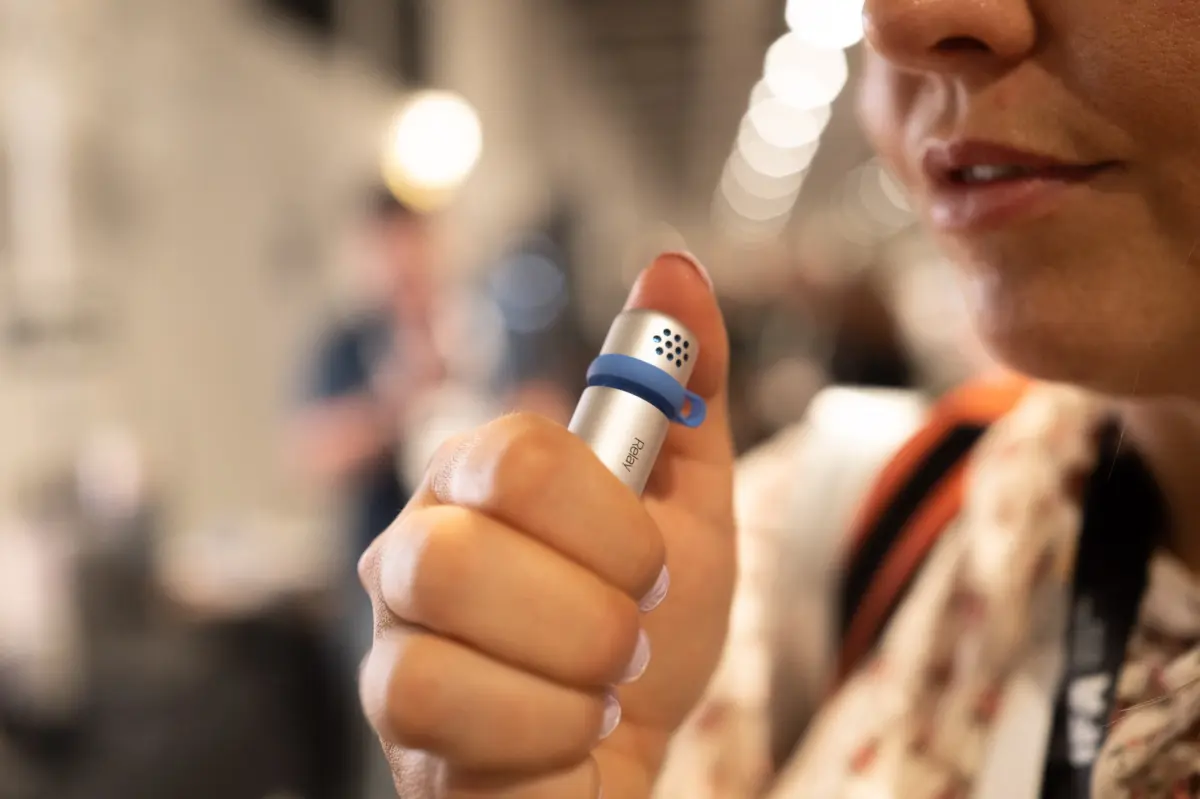
That widespread skepticism, however, faced a compelling challenge at the IFA tech trade show in Berlin. A cohort of former designers from Nothing—the British hardware startup celebrated for its transparent aesthetics and rebellious design language—unveiled the Relay Q. Roughly the size of a standard cigarette lighter, this sleek, tactile AI microphone attempts to bridge the gap between human thought and digital text, offering a tantalizing glimpse into what a truly voice-controlled workflow might look like.
Main Facts: What Is the Relay Q?
The Relay Q is a standalone, pocket-sized AI hardware device engineered to function as a seamless conduit between the user’s voice and their computer. Rather than acting as a standalone smart speaker or relying on a smartphone screen, it is built explicitly for rapid dictation, system navigation, and agentic task execution.

- Form Factor & Design: Shaped like a compact lighter and available in striking dual-color finishes—such as a Dyson-esque silver and electric blue, or a jazzier baby blue and orange—the device prioritizes physical tactility. The top features a press-to-speak button designed for a soft yet deeply responsive feel.
- Whisper Technology: Unlike traditional microphones that require normal conversational volume, the Relay Q is calibrated to capture whisper-level audio. This allows users to subtly dictate text or issue commands in quiet shared offices or public spaces without disrupting others.
- Dual-Mode Functionality: The tip of the device slides off to reveal a built-in magnet, transforming the main module into a subtle wearable pin that attaches securely to a user’s collar, keeping the microphone close to the mouth.
- Software Ecosystem: The hardware serves as a gateway to Relay’s proprietary AI desktop software, which is powered by Google Gemini. Currently optimized for macOS (with Windows and Android support slated for future deployment), the software integrates deeply with local operating systems, granting the AI permission to control applications and execute complex commands.
- Pricing and Availability: Early supporters can pre-order the Relay Q for $150. This introductory bundle includes the hardware, a separate MagSafe remote (for iPhone integration), and a 12-month subscription to "Relay Unlimited," the company’s software service. General shipping is scheduled to begin in January 2027, with retail prices expected to climb prior to launch.
Chronology: From Concept to IFA Debut
The development of the Relay Q reflects a broader industry pivot toward specialized, single-purpose AI hardware—a market that has seen mixed results with devices like the Rabbit R1 and Humane AI Pin.
- The Design Exodus: Formed by alumni of Nothing, the Relay engineering and design teams sought to leverage their experience building celebrated consumer audio and mobile products. Recognizing that past AI hardware failures often stemmed from poor ergonomics and uninspired aesthetics, they concentrated heavily on the physical relationship between user and device.
- September 2026 (IFA Berlin): The Relay Q made its global public debut at the IFA conference. Tech journalists and industry analysts were given hands-on demonstrations of the hardware’s whisper-dictation capabilities and its desktop automation software.
- Late 2026 / Early 2027 Pre-Order Window: Following its IFA unveiling, the company opened early-bird pre-orders at the $150 price point, locking in early adopters ahead of the targeted January 2027 global fulfillment date.
- Future Roadmap: While initial software compatibility is strictly tied to macOS, the company outlined plans to expand platform support to Windows PCs and Android ecosystems concurrently with or shortly after the initial hardware rollout.
Supporting Data & Technical Architecture
The technical ambitions of the Relay Q rely heavily on deep ecosystem integration and advanced audio capture engineering.
To achieve hands-free utility while maintaining privacy, the hardware employs a multi-tiered input system:

- Direct Tactile Input: Users hold the top button on the handheld module to stream audio. Double-clicking the top button acts as a shortcut for pressing "Enter" or "Send" on the host computer.
- Wearable Integration: When detached and mounted to clothing via its magnetic pin, the microphone can still be triggered via the main module’s button, or optionally through a dedicated MagSafe remote attached to the back of an iPhone.
- Software Agent Integration: Once voice data is captured, it is processed via Relay’s desktop application, which integrates Google Gemini’s large language models. During live demonstrations at IFA, whispering a request to draft a professional email instantly triggered the local Gmail client to open, populate the recipient fields, and draft the message based on spoken parameters.
- Personalization Engine: The Relay software includes customizable writing profiles, allowing users to train the AI on their specific vocabulary, tone, and stylistic preferences to ensure generated text mirrors their authentic voice rather than generic machine-generated prose.
Official Responses and Industry Reception
Reaction among technology critics at IFA was a mixture of cautious optimism and nostalgic reflection on historical methods of communication.
Industry observers noted that the device sidesteps the primary pitfall of previous AI wearables—namely, the social awkwardness of talking aloud to oneself in public spaces. By engineering the Relay Q to pick up whispering, the designers addressed a fundamental barrier to adoption in open-plan offices, libraries, and public transit.
Furthermore, design critics praised the device’s lineage. Drawing directly from the playbook of Nothing, the hardware avoids the clinical, uninspiring white plastic typical of corporate tech accessories, instead leaning into playful, high-contrast colorways that invite users to touch, fidget with, and display the device proudly.

However, questions remain regarding data privacy and deep OS integration. Because the Relay software requires permission to read and control other applications on the host computer to execute voice commands, privacy advocates will likely scrutinize how user voice data and local application states are handled by the Gemini-backed backend.
Implications: Will We Ever Stop Typing?
The debut of the Relay Q forces a deeper philosophical question about the future of human-computer interaction: Must typing always remain our default method for generating written thought?
For professional writers, journalists, and knowledge workers, the prospect of voice-driven drafting evokes historical parallels. Before the widespread adoption of personal computers and word processors, journalists and authors routinely dictated their copy over the telephone to news desks, organizing their thoughts entirely in their heads before translating them verbally into published prose.

If devices like the Relay Q can reliably capture dictation without forcing users to speak at full volume, and if AI software can accurately adapt to an individual’s personal writing style without flattening their unique voice into sterile corporate-speak, the implications for productivity could be profound. It suggests a future where writing is no longer tethered to a physical keyboard and a stationary desk, but can happen fluidly, anywhere, through whispered thought alone.
Yet, significant hurdles remain. Typing offers a tactile, deliberate pause for reflection that speech often lacks; editing on the fly through voice commands is notoriously difficult compared to highlighting and deleting text with a mouse. Whether consumers will embrace a $150 single-purpose microphone when smartphones and laptops already possess built-in voice assistants remains the ultimate test.
As the tech industry watches the Relay Q move toward its January 2027 shipping date, it stands as a fascinating test case. It proves that the dream of a voice-first computing future is far from dead—it just needed better design, smarter privacy considerations, and the ability to let us whisper our thoughts to our machines.
