

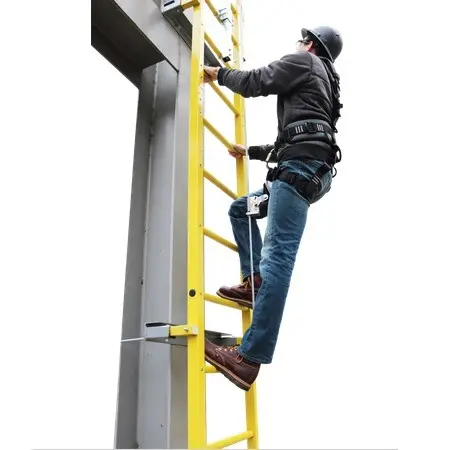
For decades, vertical ascent has been a routine yet inherently hazardous aspect of commercial building maintenance and roofing operations. To access a roof deck or navigate a high-clearance hatch, contractors and facility managers have historically relied on fixed ladders. For safety, these structures were traditionally enclosed in steel cages—a visual indicator of security that gave workers a sense of protection.
However, regulatory shifts and modern safety engineering have dismantled the long-held assumption that ladder cages provide adequate fall protection. Following sweeping amendments to the Occupational Safety and Health Administration (OSHA) standards, the industrial safety landscape is undergoing a profound transition. Cages are being phased out in favor of active fall arrest and ladder safety systems.
This comprehensive analysis explores the technical realities, regulatory timelines, and practical implications of OSHA 1910.28(b)(9), offering a roadmap for contractors and building owners to achieve compliance and protect personnel.
Main Facts: The New Regulatory Paradigm
The regulatory framework governing fixed ladders changed fundamentally on November 19, 2018, when OSHA updated its Walking-Working Surfaces standard (28 CFR 1910). The most critical takeaway of this update is that cages and wells are no longer recognized as compliant fall protection for fixed ladders that extend more than 24 feet above a lower level.
+-----------------------------------------------------------------------------+
|                         OSHA 1910.28(b)(9) KEY RULE                         |
|                                                                             |
|  For any fixed ladder extending >24 feet above a lower level:               |
|  - Cages/wells are NO LONGER considered compliant fall protection.          |
|  - Active personal fall arrest or ladder safety systems are REQUIRED.       |
+-----------------------------------------------------------------------------+
Under the revised standard, any fixed ladder exceeding the 24-foot threshold must be equipped with either a ladder safety system or a personal fall arrest system (PFAS). This applies to both internal access points, such as those leading to a roof hatch, and external structures designed for primary roof access.
While existing cages installed prior to the 2018 amendment are temporarily grandfathered, any modification, repair, or new installation of a fixed ladder triggers immediate compliance requirements. Ultimately, OSHA has established an absolute deadline: by November 18, 2036, every single fixed ladder over 24 feet in the United States must be retrofitted with a compliant safety system, completely rendering legacy cages obsolete.
Chronology: The Multi-Decade Compliance Timeline
OSHA’s transition plan spans nearly two decades, designed to allow building owners to amortize the cost of retrofitting existing infrastructure while ensuring that all new installations prioritize modern safety engineering.
       2018 (Nov 19)                 Present Day                  2036 (Nov 18)
<------------|----------------------------|----------------------------|------------>
      Rule Takes Effect             Interim Phase              Absolute Deadline
      - New ladders require         - Repairs/Replacements     - ALL fixed ladders >24'
        PFAS/Safety Systems           trigger immediate          must be retrofitted,
      - Existing cages                compliance                 regardless of age
        grandfathered
November 19, 2018: The Rule Takes Effect
This date marks the official boundary between legacy installations and the modern standard.
- New Installations: Any fixed ladder installed on or after this date extending more than 24 feet must feature an integrated ladder safety system or a personal fall arrest system from day one.
- Existing Installations: Fixed ladders installed prior to this date were permitted to keep their existing cages or wells as a temporary means of compliance under a grandfather clause.
The Present-Day Interim Phase: Maintenance and Partial Replacements
We are currently in a critical interim phase where building modifications trigger immediate compliance. Under OSHA 1910.28(b)(9)(i)(C), if any portion of an existing grandfathered ladder, cage, or well is damaged and replaced, the entire ladder must be upgraded. Facility managers cannot simply repair a damaged cage; they must install a compliant ladder fall arrest cable system or rigid rail system.
November 18, 2036: The Absolute Compliance Deadline
This date represents the hard stop for all legacy systems. On and after November 18, 2036, the grandfather clause officially expires. Every fixed ladder exceeding 24 feet in height—regardless of when it was built or how well-maintained its cage is—must be equipped with an active ladder safety system or personal fall arrest system. Cages will no longer be recognized as a legal means of protection.
Supporting Data: Why Cages Failed and How Safety Systems Work
To understand why OSHA enacted such a sweeping regulatory shift, it is necessary to examine the physical limitations of traditional safety cages compared to modern engineered systems.
The Physics of Fall Injuries in Cages
For generations, safety cages were assumed to catch falling workers by enclosing them. However, forensic safety studies and biomechanical data revealed a grim reality: cages do not stop falls. Instead, they act as a physical chute.
When a worker slips from a ladder rung inside a cage, gravity pulls them downward. Because the cage is wider than the human body to allow climbing room, the falling worker typically bounces off the metal hoops and vertical slats on the way down.
This results in severe ricochet injuries, including:
- Traumatic brain injuries from striking metal bands.
- Multiple fractures as limbs catch on cage components.
- Failure to decelerate, leading to high-velocity impact at the base of the ladder.
In contrast, an active ladder safety system or personal fall arrest system is engineered to decelerate and stop a fall within inches, preventing the worker from striking the ladder structure or the ground.
+----------------------------------------------------------------------------------+
|                          COMPARING FALL PROTECTION METHODS                       |
+----------------------------+-----------------------------------------------------+
| Feature                    | Legacy Safety Cage      | Engineered Safety System  |
+----------------------------+-----------------------------------------------------+
| Mechanism                  | Passive containment     | Active fall deceleration  |
| Deceleration Distance      | Unlimited (falls to base)| Inches (typically < 2 feet) |
| Impact Mitigation          | High risk of hitting bars| Prevents structure contact|
| Compliance Post-2036       | Non-compliant           | Fully compliant           |
+----------------------------+-----------------------------------------------------+
Anatomy of an OSHA-Compliant Ladder Safety System
OSHA defines a Ladder Safety System as an assembly designed to eliminate or reduce the possibility of a worker falling off a ladder. Unlike standard fall arrest systems used on flat roofs, these vertical systems must move dynamically with the climber.
A compliant system typically consists of five key components:
- The Carrier: A rigid rail or flexible cable secured vertically along the center of the ladder. Flexible cable systems, such as a stainless steel wire rope, are highly popular due to their durability and ease of installation on existing rungs.
- The Safety Sleeve (Cable Grab): A mechanical device that glides freely along the carrier as the worker climbs. In the event of a sudden downward acceleration (a slip or fall), the sleeve instantly locks onto the cable or rail, arresting the fall.
- The Connector: A heavy-duty carabiner or short lanyard that connects the safety sleeve to the climber’s harness.
- The Body Harness: A full-body harness designed to distribute fall arrest forces across the thighs, pelvis, chest, and shoulders.
- Support Brackets: Top and bottom anchorages engineered to withstand the extreme dynamic loads generated during a fall arrest event.
The Critical Harness Nuance: OSHA 1910.140(d)(1)(iv)
A common point of confusion for contractors transitioning to vertical fall arrest systems is the type of harness required. Traditional fall protection harnesses utilize a dorsal (back) D-ring, which is ideal for horizontal work surfaces or self-retracting lifelines.
However, vertical ladder safety systems require a different configuration. OSHA standard 1910.140(d)(1)(iv) dictates that a personal fall arrest system must:
"…sustain the employee within the system/strap configuration without making contact with the employee’s neck and chin area."
If a climber falls while connected to a vertical cable via a rear dorsal D-ring, the force of the fall can pull the harness straps upward and forward around the neck, causing severe airway obstruction or cervical spine trauma.
To prevent this, climbers must use a harness equipped with a sternal (chest) D-ring or a waist-mounted D-ring designed specifically for ladder climbing. This keeps the climber positioned upright and close to the ladder, ensuring that fall forces are safely absorbed by the harness’s sub-pelvic and shoulder straps without compromising the throat or chin.
Official Responses and Industry Perspective
The response to the OSHA update has been a mix of proactive adoption and logistical concern. While safety coordinators have welcomed the change, building owners are grappling with the scope of retrofitting millions of linear feet of fixed ladders across the country.
The Contractor’s Consultative Role
Roofing and maintenance contractors are finding themselves on the front lines of this regulatory transition. When called to inspect a roof deck or install a new hatch ladder, contractors must act as consultants, educating property owners on the liabilities of maintaining non-compliant legacy cages.
Industry experts emphasize that contractors who proactively identify non-compliant ladders not only protect their own workers but also shield building owners from severe OSHA citations and civil liability in the event of an accident.
Supplier and Manufacturer Innovation
The safety equipment manufacturing sector has responded by developing highly adaptable retrofit kits. Companies like Roofmaster, which has supported the construction and roofing industries for over 70 years across five national locations, have been instrumental in supplying contractors with the specialized hardware required to meet these evolving standards.
By offering complete systems—ranging from robust access ladders to specialized ladder fall arrest cable systems—manufacturers have streamlined the retrofitting process, reducing the time and labor required to bring older facilities up to code.
Implications: Liability, Enforcement, and Future-Proofing
The implications of ignoring the transition from cages to active fall arrest systems are severe, touching on legal, financial, and operational aspects of property management.
+-----------------------------------------------------------------------------+
|                        RISKS OF DELAYING COMPLIANCE                        |
|                                                                             |
|  [!] OSHA Citations: Penalties for non-compliance can exceed $15,000 per    |
|      ladder, climbing significantly for repeated or willful violations.     |
|                                                                             |
|  [!] Civil Liability: In the event of a fall, maintaining a grandfathered   |
|      cage that could have been retrofitted may be viewed as negligence.      |
|                                                                             |
|  [!] Operational Bans: Contractors may refuse to service roofs with         |
|      non-compliant or hazardous vertical access points.                     |
+-----------------------------------------------------------------------------+
OSHA Enforcement and Penalties
OSHA inspectors actively evaluate vertical access points during routine facility audits. If an inspector identifies a fixed ladder installed or modified after November 19, 2018, that relies solely on a cage for fall protection, the facility owner faces immediate citations.
Under current penalty structures, serious violations can incur fines exceeding $15,000 per occurrence, while willful or repeated violations can skyrocket past $150,000.
Civil Liability and Negligence
Beyond regulatory fines, the civil liability associated with a fall from a ladder cage is immense. If a worker is injured or killed falling through a legacy cage, plaintiff attorneys will argue that the building owner was aware of the inherent dangers of cages—given the highly publicized 2018 OSHA ruling—and failed to take reasonable steps to mitigate the hazard. Retrofitting with an active fall arrest system is a critical step in risk management.
The Road to 2036: A Proactive Strategy
While 2036 may seem distant, waiting until the deadline approaches is a high-risk strategy. As the final compliance date nears, demand for ladder safety systems, engineering surveys, and qualified installers will surge, likely driving up costs and creating supply chain bottlenecks.
Building owners and facility managers should adopt a phased upgrade strategy:
- Audit: Identify all fixed ladders on-site and document their heights, installation dates, and current safety mechanisms.
- Prioritize: Immediately upgrade any ladders that are damaged, undergoing modification, or used frequently by employees and contractors.
- Integrate: Mandate that any new construction or roof replacement project includes the installation of a compliant ladder safety system.
- Train: Ensure that all staff who climb fixed ladders are trained in the proper inspection and use of vertical fall arrest harnesses and safety sleeves.
By taking these steps today, businesses can ensure worker safety, eliminate regulatory risk, and achieve seamless compliance long before the final deadline arrives.
