

BERLIN — In the rapidly evolving landscape of electric mobility, automotive engineers have long chased the holy grail of range extension. While much of the industry has focused on brute-force solutions—stuffing ever-larger, heavier, and more expensive lithium-ion battery packs into heavy chassis—Volkswagen has taken a drastically different philosophical route.
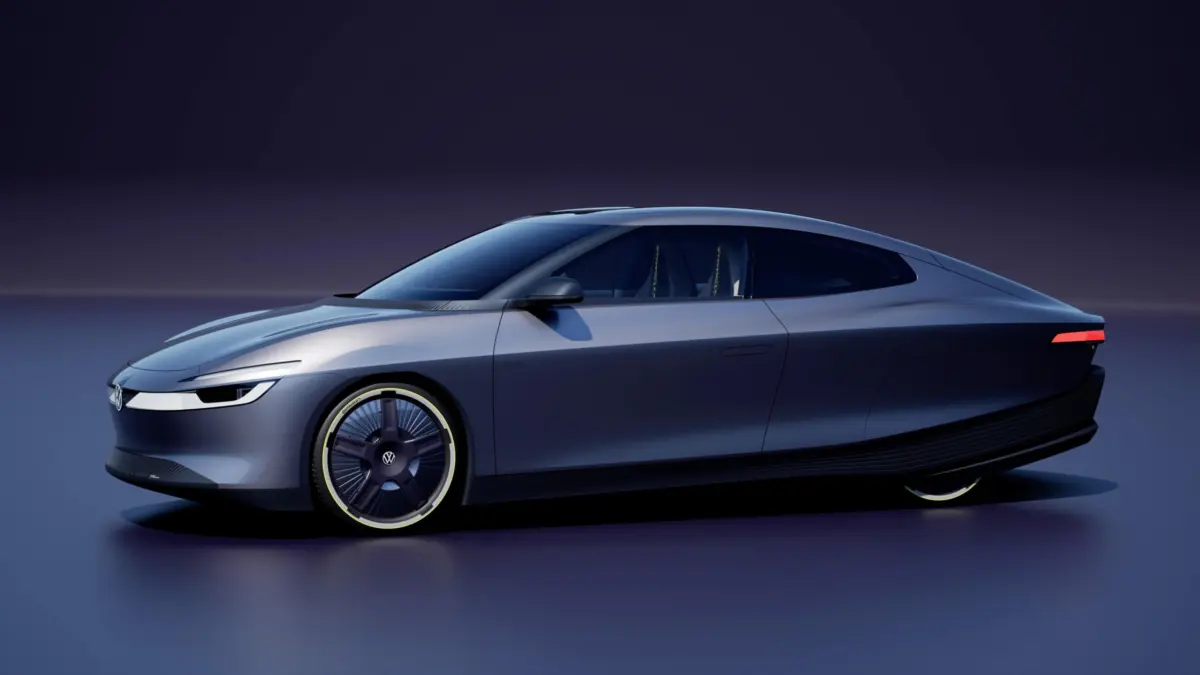
No, that futuristic teardrop-shaped vehicle cruising down the autobahn is not a Tesla Cybercab. Meet the Volkswagen Mission Efficiency, a near-production 2+2 electric coupe prototype that is currently rewriting the rulebook on energy conservation, aerodynamic drag, and real-world efficiency. Built upon an adaptation of VW’s versatile MEB+ platform and utilizing front-wheel-drive components derived from the upcoming ID. Polo and ID. Cross models, this rolling laboratory proves that the future of EV range extension may lie not in chemistry, but in physics.
With a staggering drag coefficient ($C_d$) of just 0.158, the Mission Efficiency lays claim to the title of the world’s most aerodynamic road-approved vehicle. But more than just a wind-tunnel darling, it has backed up its geometry with hard numbers, recently completing an astonishing real-world journey from Wolfsburg to Vienna on a single charge.
Main Facts: Breaking Down the Engineering Marvel
To understand the scope of Volkswagen’s achievement with the Mission Efficiency, one must look at the convergence of design, weight-saving measures, and shared component architecture that makes the vehicle possible.
The prototype was conceived to answer a singular question: How far can an electric vehicle travel if every single molecule of air resistance and every unnecessary gram of weight is aggressively eliminated?
- Record-Breaking Aerodynamics: Featuring an ultra-slippery teardrop silhouette, covered rear wheels, a completely sealed underbody, frameless windows, and flush door handles, the car achieves a $C_d$ of 0.158.
- The Powertrain: It shares its core mechanicals with the mainstream ID. Polo, including a 99 kW front-wheel-drive electric motor, high-voltage battery architecture, and a structure composed of lightweight aluminum and high-strength carbon fiber materials.
- Battery Capacity: The vehicle relies on a modest 54.9 kWh (net) battery pack—substantially smaller than the massive 80kWh to 100kWh packs found in many long-range modern crossovers and sedans.
- Energy Consumption Metrics: During controlled flat-terrain testing at a constant 68 km/h with auxiliary features like air conditioning deactivated, the car recorded an unprecedented energy consumption rate of just 6.48 kWh per 100 kilometers.
- Minimalist Interior & Weight Reduction: To keep mass to an absolute minimum, the traditional heavy touchscreen infotainment system has been replaced with a "bring-your-own-device" setup—featuring a smartphone/tablet dock and a portable Bluetooth speaker. Additionally, roof-mounted integrated solar panels provide up to 30 kilometers of supplementary range daily exclusively for auxiliary electronics.
Chronology: From Concept Brief to the Wolfsburg-to-Vienna Endurance Test
The journey of the Mission Efficiency from a digital rendering to a record-shattering road prototype represents a focused, rapid development cycle spearheaded by Volkswagen’s advanced engineering teams.
Phase 1: The Design Brief and MEB+ Integration
The project commenced as an internal challenge to maximize the potential of Volkswagen’s MEB+ platform. Engineers realized that instead of developing an entirely bespoke, hyper-expensive carbon-fiber monocoque—a-la Volkswagen’s historical XL1 efficiency car—they could achieve massive efficiency gains by combining radical aerodynamics with off-the-shelf components from upcoming volume-production models like the ID. Polo. By utilizing the 99 kW motor and structural components from the upcoming supermini, the team ensured the project maintained a realistic pathway toward eventual road-going applications.
Phase 2: Wind Tunnel Optimization
Months were spent in the aero-acoustic wind tunnel refining the vehicle’s profile. Designers abandoned conventional styling cues in favor of maximum laminar airflow. The rear track was narrowed, wheel spats and covers were meticulously engineered, and every seam, glass junction, and surface transition was smoothed out to prevent turbulent air detachment.
Phase 3: The Wolfsburg-to-Vienna Endurance Run
The ultimate test of the prototype took place on public roads in a rigorous long-distance real-world evaluation. Volkswagen dispatched the Mission Efficiency on a grueling 1,278.36-kilometer (794.34-mile) trek starting from its corporate headquarters in Wolfsburg, Germany, and culminating in Vienna, Austria.
The results stunned even the engineering team. Operating on a single charge of its modest 54.9 kWh battery, the EV consumed an average of only 6.89 kWh per 100 kilometers (rising marginally to 7.51 kWh/100 km when factoring in standard charging losses). Traveling at an average real-world speed of 67.72 km/h across varying traffic and topographical conditions, the vehicle successfully completed the immense voyage—and remarkably rolled into Vienna with 164 kilometers of remaining range still left in the battery pack.
Supporting Data: Aerodynamic Superiority at Speed
One of the most counter-intuitive and impressive traits of the Mission Efficiency is how its aerodynamic advantages scale with velocity. In standard passenger cars, energy consumption spikes exponentially as speeds climb due to aerodynamic drag, which increases with the square of the velocity.
However, because the Mission Efficiency cuts through air molecules with almost zero disturbance, its efficiency curve behaves differently when compared to its sibling, the ID. Polo:
- At Urban Speeds: In stop-and-go city traffic, rolling resistance and vehicle weight dictate efficiency. Here, the Mission Efficiency performs respectably, aided by its lightweight construction.
- At Highway Speeds (Above 80 km/h): As aerodynamic drag becomes the dominant resistive force, the prototype pulls dramatically ahead. At speeds exceeding 80 km/h, the Mission Efficiency consumes over 30 percent less energy than the standard ID. Polo.
- At High-Speed Autobahn Velocity (140 km/h): Perhaps the most striking data point is its high-speed efficiency. At a blistering 140 km/h (approx. 87 mph), the Mission Efficiency consumes the exact same amount of energy that a standard ID. Polo requires while traveling at a much more modest 100 km/h (approx. 62 mph).
This data proves that aero-optimization is not just a gimmick for low-speed hypermiling contests; it is a vital tool for making high-speed electric touring practical without necessitating prohibitively large battery capacities.
Official Responses: Volkswagen’s Vision for the Future
Volkswagen executives and chief engineers have been vocal about the broader implications of the Mission Efficiency prototype, emphasizing that the vehicle is more than just a one-off PR stunt.
"The mission of Mission Efficiency was to prove that we do not need to rely on oversized, resource-heavy batteries to achieve massive driving ranges," noted a lead spokesperson during the vehicle’s technical presentation. "By treating aerodynamics and weight reduction with the utmost seriousness, we can democratize long-distance electric mobility using components that are already cost-effective and scalable for mass production."
Company engineers have stressed that the car is essentially a "re-bodied ID. Polo supermini," demonstrating that the technology required to break these efficiency records is remarkably close to assembly-line readiness. By avoiding exotic, ultra-costly chemistry breakthroughs, Volkswagen is signaling to the market that efficiency gains can be achieved today through clever mechanical and industrial design.
Industry Implications: The Aero Race Heats Up
Volkswagen is not alone in its newfound obsession with the wind tunnel. Across the global automotive sector, manufacturers are desperately searching for ways to maximize EV range while combating consumer anxieties regarding charging infrastructure, battery degradation, and high vehicle purchase prices.
- Ford’s Skunkworks Project: Ford has established secretive skunkworks teams dedicated entirely to shaving aerodynamic drag off its upcoming generations of electric trucks and universal EV platforms.
- Luxury and Performance Brands: High-end marques—including Mercedes-Benz with its EQS lineup, Audi with the development of the upcoming A2 e-tron, and Porsche—are aggressively redesigning their vehicle silhouettes, integrating active aero shutters, underbody panels, and wheel designs optimized specifically to cheat the wind.
The Consumer Conundrum: Form vs. Function
The critical question facing the entire automotive industry moving forward is one of market acceptance: What will actually make it into production, and how will consumers respond to these ultra-slippery, teardrop-shaped vehicles?
Historically, automotive buyers prioritize emotional styling, commanding seating positions, and conventional three-box or SUV silhouettes over pure aerodynamic efficiency. The unmistakable "teardrop" profile required to achieve a $C_d$ of 0.158 often results in tapered rear cabins, unconventional proportions, and wheel covers that may not appeal to the mainstream aesthetic sensibilities of everyday car buyers.
Furthermore, the stripping away of heavy amenities—such as Volkswagen’s "bring-your-device" infotainment approach—requires a cultural shift among drivers who have grown accustomed to sprawling, multi-screen digital cockpits and energy-intensive climate control systems.
Conclusion
The Volkswagen Mission Efficiency stands as a monument to engineering discipline. It proves unequivocally that the future of electric vehicle range does not belong exclusively to those who build bigger batteries, but to those who respect the laws of aerodynamics. As legacy automakers and EV startups alike race to incorporate these lessons into upcoming model years, the automotive landscape is shifting.
Whether consumers are ultimately ready to embrace the teardrop aesthetic remains to be seen, but one thing is certain: the era of the aerodynamic revolution has officially arrived.
