

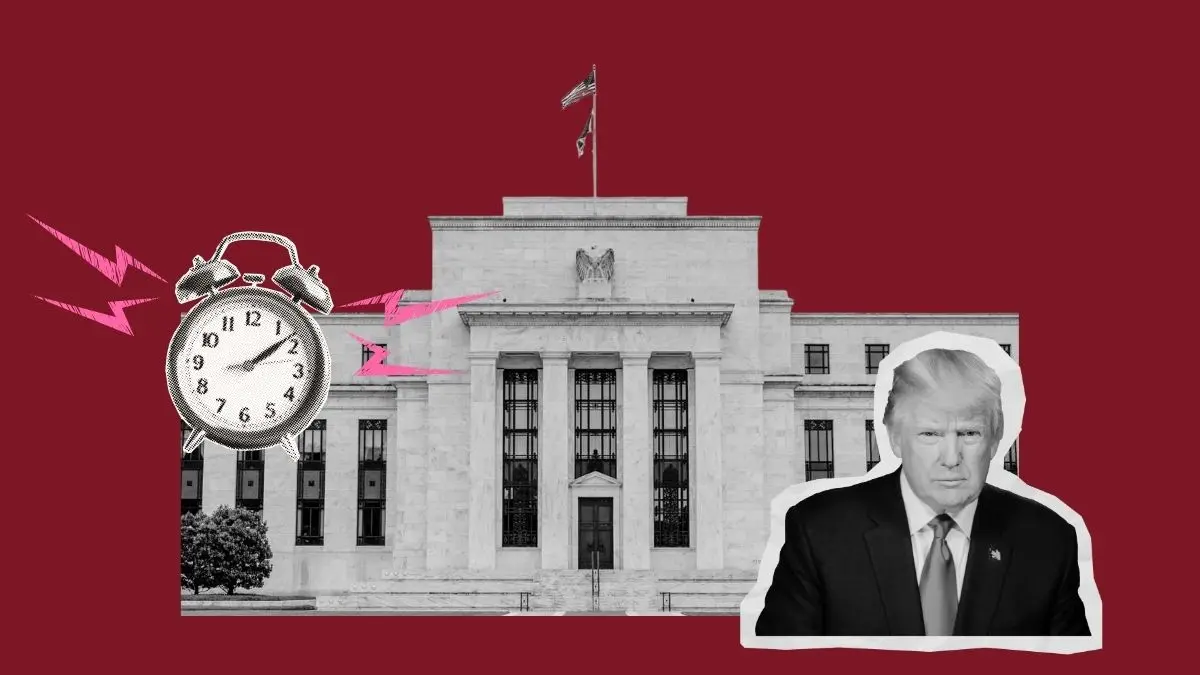
WASHINGTON — President Donald Trump has escalated his aggressive campaign to reshape the leadership of the nation’s central bank, officially launching proceedings to remove Federal Reserve Governor Lisa Cook.
In a formal communication delivered by the White House this week, the administration gave Cook a strict three-week window to respond to unresolved allegations of mortgage fraud. The maneuver represents a calculated, step-by-step effort to satisfy procedural mandates laid down by the Supreme Court earlier this year, setting the stage for a landmark legal confrontation that could permanently redefine the boundaries of executive power and central bank independence.
The unfolding drama pits the executive branch directly against the long-standing statutory autonomy of the Federal Reserve. At the center of the dispute are allegations of financial impropriety dating back years, a sharply divided Supreme Court precedent, and accusations of politically motivated interference in monetary policy.
The Main Facts
The core of the White House’s action rests on a letter reportedly signed by Deputy Chief of Staff Dan Scavino. The correspondence formally notifies Cook that President Trump is "considering" her removal from the Federal Reserve Board of Governors.
The rationale outlined in the letter diverges slightly from standard criminal accusations. Instead of focusing strictly on whether a statutory violation occurred, the White House accuses Cook of "gross negligence" tied to historical mortgage applications. The administration argues that this alleged conduct fundamentally undermines her trustworthiness and fitness to serve as a steward of the U.S. financial system, asserting that such behavior constitutes grounds for removal "for cause" even if it never culminates in formal criminal charges.
Cook, who has adamantly denied any wrongdoing, has not been charged with a crime by the Department of Justice, though federal investigators launched a probe into the matter last year. Her legal team, spearheaded by high-profile defense attorney Abbe Lowell, has dismissed the White House’s latest actions as a transparently political maneuver designed to bypass statutory protections and exert undue influence over interest rate decisions.
The conflict directly tests the "for-cause" removal standard governing independent regulatory agencies. While Congress deliberately structured the Federal Reserve to operate free from short-term political pressures—insulating governors through lengthy 14-year terms—the exact threshold required to unseat a sitting Fed governor has remained a gray area in constitutional law until now.
Chronology of the Conflict
To understand the gravity of the current White House letter, it is necessary to trace the rapid escalation of events that brought the executive branch and the central bank onto a collision course.
- May 2022: Lisa Cook is confirmed to the Federal Reserve Board of Governors following a historic 50-50 Senate vote that required a tie-breaking vote from then-Vice President Kamala Harris. Cook becomes the first Black woman to serve in the role.
- Late 2023 / Early 2024: Federal Housing Finance Agency (FHFA) Director Bill Pulte issues public referrals and urges the Department of Justice to investigate Cook, alleging that she falsified bank documents to secure favorable mortgage terms on properties prior to her appointment at the Fed.
- Mid-2024: The Department of Justice officially launches an inquiry into the mortgage fraud allegations. Cook’s defenders immediately label the investigation a politically inspired fishing expedition.
- Late June: The U.S. Supreme Court delivers a highly anticipated 5-4 ruling on executive overreach regarding the central bank. Writing for the majority, Chief Justice John Roberts limits the president’s ability to summarily fire Fed members, affirming that Congress intended the institution to maintain structural independence. However, the ruling explicitly leaves open the window for removal "for cause," stipulating that Cook is legally entitled to formal notice and a fair opportunity to respond before any termination can occur.
- Immediately Following the Ruling: President Trump takes to social media to signal his intention to take "appropriate action immediately," declaring that individuals accused of wrongdoing should not dictate economic policy.
- The Present: The White House delivers its three-week ultimatum letter to Cook, marking the formal initiation of the removal process meticulously designed to comply with the Supreme Court’s procedural hurdles.
Supporting Data and Background
The allegations animating the White House’s removal push originated outside traditional financial regulatory channels, stemming largely from the advocacy of FHFA Director Bill Pulte. Pulte publicly urged Attorney General Pam Bondi and federal investigators to probe Cook’s historical mortgage documentation, alleging irregularities in disclosures related to primary residences and investment properties.
However, financial and legal analysts note that the transactions in question occurred well before Cook took her seat at the Marriner S. Eccles Federal Reserve Building.
The structural architecture of the Federal Reserve is intentionally rigid. Established by the Federal Reserve Act of 1913, the central bank was designed to be politically independent. Governors serve staggered, 14-year terms that span multiple presidential administrations, specifically to prevent any single executive from packing the board with partisan allies who might manipulate monetary policy for short-term political gain—such as lowering interest rates ahead of an election.
The hurdle of removing a governor is exceptionally high. Under the statute, a president may remove a governor before their term expires only "for cause." Historically, legal scholars interpreted "for cause" to mean gross inefficiency, neglect of duty, or malfeasance in office directly related to the execution of their official duties. By shifting the argument to personal conduct predating public service—framed as "gross negligence" regarding trustworthiness—the Trump administration is attempting to stretch the legal definition of "cause" into uncharted territory.
Official Responses and Legal Strategies
The battle lines between the White House and Governor Cook are firmly drawn, characterized by sharply contrasting interpretations of law, ethics, and institutional norms.
The White House Perspective
Supporters of the administration’s actions argue that the executive branch has a constitutional obligation to ensure that individuals wielding vast economic power maintain unassailable personal integrity. From this viewpoint, a high-ranking official facing credible allegations of mortgage fraud or document falsification—even if committed prior to taking office—suffers from compromised credibility. The administration maintains that moving to oust Cook is not an attack on the Fed’s independence, but rather an exercise of necessary oversight to purge the government of compromised actors.
Governor Cook and Her Legal Team
Governor Cook and her legal counsel view the proceedings as an existential threat to the central bank’s independence. In public statements following the Supreme Court’s June ruling, Cook did not mince words regarding the true motives behind the investigation:
"This was never about mortgage documents signed years before I became a Federal Reserve governor. It was an attempt to remove me on a manufactured pretext because I refused to bow to political pressure and continued to set interest rates based only on what would best serve the American people."
Attorney Abbe Lowell echoed these sentiments in his formal response to the White House’s ultimatum, signaling that the legal team is fully prepared to return to the federal courts.
"No matter what President Trump tries to do next, this much is clear under the facts and Supreme Court precedent — there is no valid cause for removing Governor Cook," Lowell stated. "As we did before, we will challenge this latest pretext and preserve her position and the historic role of the Fed."
Broader Implications for the U.S. Economy and Governance
The outcome of this high-stakes standoff carries profound implications that extend far beyond the political fate of a single Federal Reserve governor.
1. The Precedent of "For-Cause" Removal
If the Trump administration successfully ousts Cook using historical, non-official conduct as "cause," it will permanently lower the legal bar required to dismiss independent agency heads. Future presidents would find it significantly easier to pressure or purge officials running regulatory bodies such as the Securities and Exchange Commission (SEC), the Federal Trade Commission (FTC), and the Federal Reserve.
2. Market Reactions and Central Bank Credibility
Global financial markets rely heavily on the predictability and perceived neutrality of the U.S. central bank. Any credible threat to the independence of the Federal Open Market Committee (FOMC)—the body responsible for setting benchmark interest rates—can trigger volatility in bond yields, currency valuations, and equity markets. Investors routinely price economic risk based on the assumption that monetary policy decisions are insulated from political whims. A prolonged legal battle over the composition of the Fed board injects unwanted uncertainty into macroeconomic forecasting.
3. The Ultimate Arbiter: The Judiciary
With the White House establishing a three-week countdown for Cook’s response, the dispute is virtually guaranteed to return to the federal court system. Legal experts anticipate that Cook’s attorneys will seek an emergency injunction to block any removal order the moment the administration attempts to execute it.
Ultimately, the federal courts—and potentially the Supreme Court once again—will have to decide whether personal financial allegations from a governor’s pre-board life meet the strict constitutional threshold of "for cause," or whether the administration’s actions constitute an impermissible encroachment on the independence of the world’s most powerful central bank.
