

Introduction
The commercial roofing industry is undergoing a significant transition, driven by the search for sustainable, cost-effective, and long-lasting restoration solutions. At the center of this movement is silicone roof coating. Renowned for its ponding water resistance, UV stability, and energy-saving reflective properties, silicone has quickly become one of the fastest-growing segments in the commercial roofing market.
However, transitioning to silicone is not merely a matter of changing materials; it requires a fundamental shift in application technology, crew training, and capital investment. According to industry experts, the equipment required to apply these high-performance coatings represents a wide spectrum of complexity and cost, ranging from entry-level setups costing under $1,000 to advanced, heavy-duty hydraulic spray systems exceeding $30,000. For commercial roofing contractors, choosing the right application method is a high-stakes decision that directly impacts labor efficiency, project margins, and liability management.
Main Facts: The Equipment Divide in Silicone Application
Silicone coatings present unique material characteristics. Unlike traditional acrylic or asphaltic coatings, high-solids silicone is highly viscous, moisture-curing, and chemically dense. This makes the selection of application equipment a critical operational decision. The market is primarily divided into two methodologies: roll-applied systems and spray-applied systems.
+---------------------------------------------------------------------------------------+
|                               SILICONE APPLICATION METHODS                            |
+------------------------------------+--------------------------------------------------+
|          ROLL-APPLIED SYSTEMS      |               SPRAY-APPLIED SYSTEMS              |
+------------------------------------+--------------------------------------------------+
| Cost: $1,000 - $3,000              | Cost: $15,000 - $30,000+                         |
| Best for: Small to mid-size jobs   | Best for: Large-scale, high-volume projects      |
| Wind Sensitivity: Low (No drift)   | Wind Sensitivity: High (Overspray risk)          |
| Maintenance: Simple cleaning       | Maintenance: Intensive (High-pressure lines)     |
+------------------------------------+--------------------------------------------------+
The Low-Cost, Low-Risk Entry: Roll-Applied Systems
For contractors entering the silicone market or those managing smaller, highly obstructed roof footprints, roll application is the most practical choice.
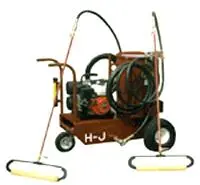
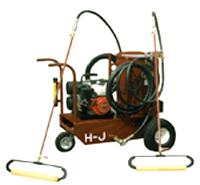
- Equipment Profile: Commercial-grade power rollers typically range in width from 14 inches to 40 inches, featuring a 6-inch diameter. These rollers are mounted on specialized wheeled frames integrated with a distribution vat. The vat utilizes a series of calibrated gravity-fed holes to meter and control the flow of the silicone directly ahead of the roller.
- Financial Commitment: This setup requires a modest initial investment, starting at approximately $1,000.
- Operational Advantages: Beyond low capital expenditure, roll application eliminates the risk of wind-blown overspray, making it the preferred method in high-wind environments or densely populated urban areas where nearby vehicles and structures are at risk.
The High-Efficiency, High-Capital Route: Spray-Applied Systems
For large-scale industrial and commercial roofs, manual rolling is often cost-prohibitive from a labor standpoint. Here, high-pressure spray systems are the industry standard.
- Equipment Profile: Standard paint sprayers are incapable of handling the high viscosity and solids content of commercial silicone. Professional silicone sprayers are heavy-duty, hydraulically driven units capable of delivering pressures up to 4,000 PSI and flow rates of several gallons per minute.
- Financial Commitment: These systems range from $15,000 to upward of $30,000.
- Technical Variables: The wide price variance is driven by several factors, including:
- Hose Length: Pushing highly viscous silicone through hundreds of feet of high-pressure hose requires immense power. Longer runs require larger fluid sections and more robust engines to overcome pressure drop.
- Hydraulic Auxiliaries: Premium units feature integrated hydraulic lifts to easily raise and lower the pump’s fluid section out of 55-gallon drums, alongside built-in mixer attachments to maintain material consistency.
- Construction Durability: High-end units are built with hardened materials designed to resist the abrasive nature of solids suspended in silicone coatings.
Chronology: The Evolution of Silicone and Application Technology
Understanding the current landscape of silicone equipment requires examining how both the chemistry of roof coatings and the mechanics of their application have evolved over the last several decades.
  1970s - 1980s            1990s - 2000s            2010s - Present
  [Acrylics & Urethanes]  -> [Early Silicones]    -> [High-Solids Silicone]
  High solvent content,      Lower VOCs, improved    Moisture-cure, 90%+ solids,
standard sprayers. durability. requires heavy hydraulic pumps.- The Late 20th Century (1970s–1980s): Acrylics and Urethanes Dominate
During this era, water-based acrylics and solvent-borne urethanes were the standard for elastomeric roof coatings. These materials possessed lower viscosities and could be applied using standard, medium-pressure airless sprayers. However, these coatings suffered from poor ponding water resistance and required frequent re-coating. - The Turn of the Millennium (1990s–2000s): The Rise of First-Generation Silicones
As environmental regulations tightened around Volatile Organic Compounds (VOCs), manufacturers began developing early-generation silicone coatings. While these offered superior water resistance, they contained high solvent levels to keep viscosity low enough for standard equipment. This solvent content led to shrinkage during curing and raised environmental concerns. -
The Modern Era (2010s–Present): High-Solids and Heavy Machinery
To meet strict green building standards, chemical manufacturers engineered high-solids (often 90% to 98% solids by volume) silicone formulations. These modern coatings contain almost no solvents, meaning the thickness applied wet is the thickness retained when dry.However, this chemical breakthrough created an operational bottleneck: the material was incredibly thick and cured rapidly upon exposure to atmospheric moisture. This physical change rendered older, lower-pressure sprayers obsolete, forcing equipment manufacturers like Roofmaster to develop specialized, high-pressure, hydraulic-driven pumps and heavy-duty delivery systems capable of handling these demanding materials without constant clogging or mechanical failure.
Supporting Data: Operational Economics and Physics of Flow
To understand why silicone application equipment is priced so diversely, contractors must look at the underlying physics of fluid dynamics and the economics of labor versus capital expenditure.
The Physics of High-Viscosity Spraying
Silicone coatings exhibit non-Newtonian, shear-thinning behavior, meaning their viscosity decreases under shear stress (such as being forced through a spray tip). However, getting the material from the container, through the hose, and to the gun requires overcoming immense friction.
The pressure drop ($Delta P$) in a hose can be estimated using the Hagen-Poiseuille equation for laminar flow:
$$Delta P = frac8 mu L Qpi R^4$$
Where:
- $mu$ = Dynamic viscosity of the silicone
- $L$ = Length of the hose
- $Q$ = Flow rate (gallons per minute)
- $R$ = Inside radius of the hose
Because the pressure drop is inversely proportional to the fourth power of the hose radius ($R^4$), even a slight reduction in hose diameter or an increase in hose length ($L$) dramatically increases the pressure required at the pump. This explains why a system designed to pump silicone through 250 feet of hose requires a massive hydraulic motor and fluid section, pushing the equipment cost toward the $30,000 threshold.
Cost-Benefit Analysis: Roll vs. Spray
For a commercial roofing contractor, the decision to purchase a $30,000 sprayer versus a $1,500 power roller system depends heavily on project scale and labor costs.
| Metric | Power Roller System ($1,500) | High-End Hydraulic Sprayer ($25,000) |
|---|---|---|
| Average Production Rate | 1,500 – 2,500 sq. ft. per day | 10,000 – 15,000 sq. ft. per day |
| Crew Size Required | 2–3 laborers | 3–4 laborers (including ground support) |
| Overspray Risk | Negligible | High (Requires masking and monitoring) |
| Setup & Cleanup Time | 30 minutes | 1.5 – 2 hours |
| Equipment Lifespan | Moderate (Simple mechanical parts) | High (Requires rigorous maintenance) |
While the sprayer represents a capital expenditure 16 times greater than the roller system, it delivers a production rate up to six times faster. On a 100,000-square-foot industrial roof, the labor savings alone can offset the cost of a high-end sprayer in a single project. Conversely, on a 10,000-square-foot roof with numerous HVAC units and penetrations, the setup, cleanup, and masking time of a spray system can make the power roller a more profitable choice.
Official Responses and Industry Insights
Industry leaders emphasize that equipment selection cannot be boiled down to a simple mathematical formula. It requires a deep understanding of crew competency, safety regulations, and localized environmental factors.
Pat Amicucci of Roofmaster, an industry-recognized brand with 70 years of commercial roofing expertise, emphasizes that fitting a contracting company with the right equipment is highly nuanced:
"Silicone has become one of the fastest-growing roof coating applications today and one of the more technical. Crews need to be familiar with the operations and dangers associated with the equipment. Fitting your company with the right options is not all black and white."
Amicucci highlights that the technical learning curve is steep, particularly regarding the maintenance of high-pressure hydraulic sprayers. Because silicone cures upon contact with moisture in the air, any moisture entering the pump or hoses can cause the material to cure inside the machine, resulting in catastrophic equipment failure and thousands of dollars in repairs.
Furthermore, safety coordinators warn of the physical dangers associated with high-pressure sprayers. Operating at pressures near 4,000 PSI introduces the risk of skin injection injuries—a severe medical emergency where fluid is forced through the skin into underlying tissues. Contractors investing in high-end sprayers must implement rigorous safety training protocols to mitigate these risks.
Implications for the Commercial Roofing Sector
The rapid adoption of silicone coatings and the high cost of entry for advanced application machinery are reshaping the commercial roofing landscape in several key ways.
+-----------------------------------------------------------------------------+
|                          MARKET & INDUSTRY IMPACTS                          |
+-----------------------------------------------------------------------------+
|                                                                             |
|  [Barriers to Entry] --------> Encourages tiered market; small contractors  |
|                                start with rollers, scale to sprayers.       |
|                                                                             |
|  [Risk Management] ----------> High insurance premiums for sprayers due to  |
|                                overspray; drives urban roller usage.        |
|                                                                             |
|  [Sustainability Trends] ----> Cost-effective restoration reduces landfill  |
|                                waste from traditional roof tear-offs.       |
|                                                                             |
+-----------------------------------------------------------------------------+
1. The Stratification of Roofing Contractors
The capital requirements of silicone equipment are creating a tiered market. Small-scale residential and commercial contractors can easily enter the silicone market using roll-applied systems, focusing on localized repairs and smaller flat roofs.
Meanwhile, large-scale, nationwide contractors are leveraging high-end hydraulic sprayers to secure massive industrial warehouse contracts, offering rapid turnaround times that smaller competitors cannot match.
2. Liability and Risk Management in Urban Environments
As cities push for "cool roof" retrofits to combat urban heat island effects, the demand for reflective silicone coatings is skyrocketing. However, spraying in urban centers carries significant liability due to wind drift.
A single gust of wind can carry atomized silicone droplets onto nearby parking lots, damaging hundreds of vehicles. This environmental liability is driving a resurgence in advanced, wide-format power roller systems, which offer a middle ground: higher productivity than manual rolling, but without the overspray risks of spraying.
3. Sustainability and Waste Reduction
The economic viability of silicone restoration—facilitated by efficient application equipment—is keeping millions of tons of roofing waste out of landfills. Instead of tearing off aged EPDM, TPO, or built-up roofs, contractors can restore them in place. By choosing the appropriate application machinery, roofing professionals can deliver a warranted, 20-year waterproof system at a fraction of the cost and environmental impact of a full roof replacement.
Ultimately, whether a contractor opts for a highly mobile, low-cost power roller or a state-of-the-art hydraulic spray rig, success in the rapidly expanding silicone market depends on matching the equipment to the specific constraints of the project, the capabilities of the crew, and the financial strategy of the business.
