

By Anthony Capkun
Published August 12, 2026
Main Facts
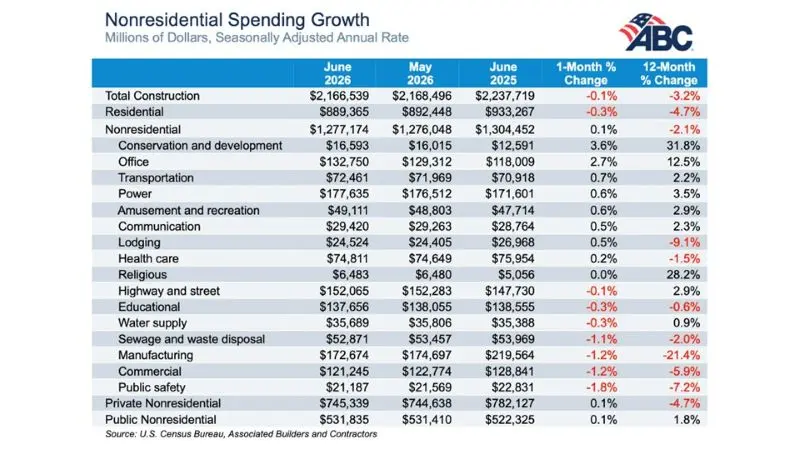
National nonresidential construction spending experienced a modest uptick of 0.1% in June 2026, according to a comprehensive economic analysis released by Associated Builders and Contractors (ABC). The analysis utilizes primary data published by the U.S. Census Bureau to evaluate the financial health and trajectory of the American commercial, industrial, and institutional building sectors.
On a seasonally adjusted annual rate (SAAR), total nonresidential construction spending reached $1.277 trillion for the month. While the headline figure points toward stability, a deeper dive into the subcategories reveals a starkly bifurcated marketplace. Out of the 16 primary nonresidential subcategories tracked by federal and industry economists, exactly half (8 categories) experienced positive monthly growth, while the other half contracted or remained flat.
Both public and private nonresidential sectors grew at the exact same pace of 0.1% month-over-month. However, the broader year-over-year picture tells a more cautionary tale for private contractors. Private nonresidential construction spending plummeted by nearly 5% compared to the same period in 2025. This downturn is largely driven by a sharp pullback in manufacturing investments and sluggish performance in traditional commercial segments, which are being masked on paper by a historic, high-intensity boom in data center construction.
Without the colossal capital infusions funneled into artificial intelligence (AI) infrastructure, cloud computing facilities, and massive server farms, the private nonresidential construction landscape would look substantially weaker. As policymakers, developers, and industry leaders digest the June 2026 numbers, the consensus is clear: the nonresidential construction market is no longer rising on a broad tide; rather, its growth is concentrated in highly specialized niches while major segments face a protracted correction.
Chronology of Market Shifts: From the 2025 Peak to Mid-2026
To fully understand the nuances of the June 2026 report, it is necessary to examine the timeline of economic pressures and shifting capital allocations that have defined the nonresidential construction sector over the past year and a half.
- Early to Mid-2025 (The Apex): Private nonresidential construction spending across the United States reached a historic peak in April 2025, buoyed by post-pandemic supply chain recoveries, massive federal legislation (such as the CHIPS Act and the Infrastructure Investment and Jobs Act), and an initial wave of localized manufacturing and industrial facility groundbreakings.
- Late 2025 (The Correction Begins): Following the April 2025 high-water mark, elevated interest rates, tighter lending standards from regional banking institutions, and construction cost inflation began to take a toll. Private developers started delaying or canceling speculative commercial office, retail, and warehouse projects.
- Early 2026 (The Divergence Accelerates): By the first quarter of 2026, the divergence between technology-driven infrastructure (data centers) and traditional industrial/manufacturing builds became pronounced. While heavy industrial projects began facing severe year-over-year adjustments, the digital revolution—catalyzed by generative AI deployment—demanded unprecedented physical footprint expansions.
- June 2026 (The Current Snapshot): The latest Census Bureau data highlights this ongoing saga. Total spending sits at $1.277 trillion, but the underlying momentum is severely uneven. While data center construction surges ahead at a breakneck pace, the rest of the private sector struggles to find its footing amid a post-peak cooling period.
Supporting Data and Sector Breakdown
A granular examination of the June 2026 U.S. Census Bureau data and ABC’s analytical metrics illustrates the divergence occurring across different building typologies.
Private vs. Public Performance
- Monthly Growth: Both private and public nonresidential construction spending ticked upward by 0.1% in June 2026.
- Year-Over-Year Private Decline: Private nonresidential construction spending fell by nearly 5% compared to June 2025.
- The Excluding-Data-Center Metric: When data center projects are stripped entirely from the equation, private nonresidential construction spending actually fell by 0.6% in June 2026 alone, and is down a striking 7.9% on a year-over-year basis.
The Manufacturing Slump
One of the most notable shifts in the June 2026 report is the rapid cooling of the manufacturing construction sector. After years of unprecedented expansion driven by domestic semiconductor fabrication plants, EV battery factories, and clean-energy supply chain investments, manufacturing construction recorded the sharpest year-over-year decline among all nonresidential categories. Spending in this category plummeted by 21.4% from June 2025 levels, signaling that the initial wave of mega-factory groundbreakings has matured, and developers are exercising extreme caution before committing capital to new industrial plants.
The Data Center Phenomenon
Conversely, the data center subcategory continues to defy broader economic gravity.
- Monthly Surge: Data center construction spending jumped by 7% in June 2026 alone.
- Annual Expansion: Spending in this sector skyrocketed by 46% compared to June 2025.
- Backlog Impact: According to ABC’s proprietary Construction Backlog Indicator (CBI), contractors who have secured contracts to work on data centers are enjoying vastly superior financial visibility and project pipelines compared to their peers. Specifically, the 13% of ABC member contractors working on data centers report an average construction backlog of 11.0 months. In stark contrast, the remaining 87% of contractors not involved in the data center space report an average backlog of just 8.5 months.
Official Responses and Expert Analysis
Industry leaders and economists have been quick to dissect the implications of the June 2026 numbers, pointing out that headline figures can easily obscure the true underlying economic pressures facing trade contractors and engineering firms.
Anirban Basu, Chief Economist for Associated Builders and Contractors, offered a sobering assessment of the private sector’s trajectory during a media briefing following the release of the Census Bureau report.
"Despite an ongoing data center construction boom, private nonresidential construction spending has declined to a seasonally adjusted annual rate of $745.3 billion since the April 2025 peak, which translates into a decline exceeding 7%," Basu stated.
Basu emphasized that the health of the broader construction market is heavily propped up by a single tech-centric asset class. Without the immense capital expenditures being poured into digital infrastructure, the private nonresidential sector would be experiencing a much deeper recession.
"Tellingly, private nonresidential construction spending excluding data centers fell 0.6% in June 2026 and is down 7.9% year over year," Basu added, underlining the precarious nature of relying on a narrow segment of the market to drive national commercial growth.
Other industry analysts note that while data center builders are seeing historic margins and extended backlogs, structural engineers, steel fabricators, and electrical contractors specializing in traditional retail, hospitality, office, and light manufacturing are being forced to navigate a lean environment. Competition for non-tech projects has intensified, putting downward pressure on bidding margins for standard commercial work.
Implications for the Construction Industry and Economy
The June 2026 nonresidential construction spending report carries profound implications for stakeholders across the entire built environment, from macroeconomic planners to local trade subcontractors.
1. Workforce Reallocation and Specialization
The stark divergence between data center growth and manufacturing contraction means that labor force demands are shifting rapidly. Contractors cannot simply assume that general construction skills are universally transferable. The specialized mechanical, electrical, and plumbing (MEP) requirements needed to build massive server farms—featuring intense cooling systems, massive power draw capabilities, and fiber-optic integration—require advanced technical proficiencies. Firms unable to pivot toward high-tech infrastructure may find themselves competing for a shrinking pool of traditional commercial contracts.
2. Supply Chain and Power Grid Bottlenecks
The explosive 46% year-over-year growth in data center construction is not without its operational challenges. As thousands of megawatts of new data center capacity break ground, developers, utilities, and general contractors are running up against severe infrastructural bottlenecks. Local electrical grids across major data center hubs (such as Northern Virginia, central Ohio, Texas, and the Pacific Northwest) are struggling to keep up with power demands. Consequently, future construction timelines may increasingly depend on electrical transmission upgrades and on-site power generation solutions (such as microgrids or dedicated green energy power purchase agreements).
3. Monetary Policy and Interest Rate Sensitivities
With private nonresidential spending ex-data-centers down nearly 8% year-over-year, pressure is mounting on the Federal Reserve and commercial lending institutions. High interest rates have disproportionately punished speculative real estate development, manufacturing expansions requiring heavy debt financing, and commercial office retrofits. If the broader nonresidential sector continues to contract outside of the tech bubble, commercial real estate developers will continue lobbying for aggressive monetary easing to unlock stalled project pipelines.
4. Public Sector Stability
While private spending experiences extreme highs in tech and lows in manufacturing, public nonresidential construction spending has provided a steady, albeit modest, floor for the industry. Public investments in highway and street construction, educational facilities, water and sewage infrastructure, and public safety buildings continue to perform predictably, backed by long-term federal funding packages. Contractors diversified into public-private partnerships (P3s) or municipal bidding are finding these projects crucial for maintaining stable revenue streams while private commercial markets undergo their post-2025 correction.
Conclusion
The June 2026 U.S. Census Bureau and ABC data underscore a definitive chapter in American construction history. The industry is currently riding the twin waves of an unprecedented digital infrastructure boom and a necessary post-peak cooling period in traditional industrial and commercial building. For contractors, success in this environment requires strategic agility, a clear understanding of regional market dynamics, and the technical capacity to capture high-margin, specialized opportunities in sectors like data center development. As the second half of 2026 unfolds, industry participants will be closely monitoring macroeconomic indicators, interest rate decisions, and power grid capacities to see how long the digital gold rush can sustain broader nonresidential market momentum.
