

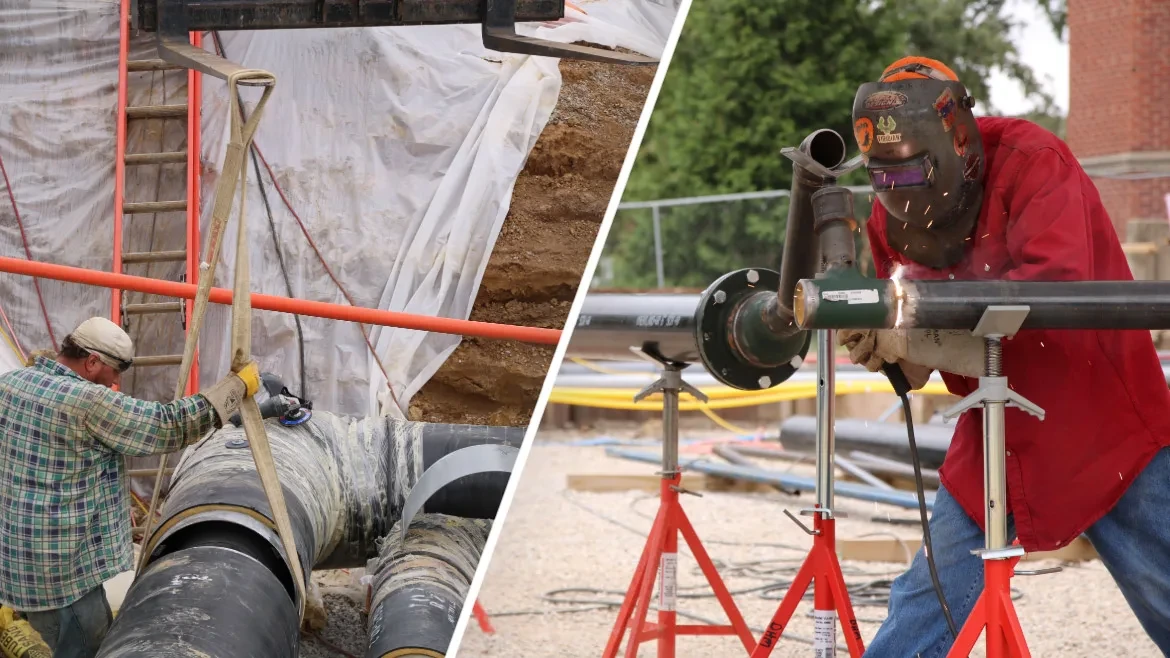
CHARLESTON, Illinois — For students walking across the historic campus of Eastern Illinois University (EIU), the physical transformation currently underway is impossible to miss. Temporary bypass piping snakes its way above ground across select quads and walkways, while deep excavations open windows into a vast utility network normally hidden far beneath the sidewalks.
Below grade, an army of specialized contractors is replacing miles of aging steam and condensate piping, remediating hazardous materials, and rehabilitating the subterranean brick and concrete tunnels that have reliably served generations of university buildings.
While heavy construction on underground utilities rarely captures the imagination the way a gleaming new facility does, university leadership views this multi-million-dollar modernization effort as foundational to the institution’s future. As EIU navigates shifting enrollment trends, modernizes its academic offerings, and prepares for the future construction of a state-of-the-art Integrated Science Building, officials emphasize that long-term campus progress depends entirely on the stability of what lies beneath.
Main Facts
The current campus-wide utility overhaul is a comprehensive, multi-phase infrastructure project designed to address decades of deferred maintenance across EIU’s subterranean district energy network.
At the core of the project is the complete replacement of failing steam and condensate distribution lines. Rather than abandoning the university’s historical central utility distribution grid, EIU leadership opted to aggressively rehabilitate the existing system. This network consists of both modern concrete trenches and historic, century-old brick archway tunnels that carry far more than just steam. Once crews reach the heart of campus, these subterranean corridors also house critical infrastructure for potable water, natural gas, compressed air, and telecommunications.
The scope of the project extends well beyond simple pipe fitting. Crews from Urbana-based Davis-Houk Mechanical Inc. (DHM) are executing extensive environmental remediation, including the safe abatement of asbestos-containing pipe insulation, cleaning legacy debris from tunnel floors, and upgrading egress routes to meet modern worker safety standards.
Crucially, this underground modernization is tied directly to the upcoming construction of EIU’s planned Integrated Science Building. By tying the new facility directly into the revitalized campus steam network, the university has eliminated the need to purchase and install an independent packaged boiler, maximizing the educational value of every construction dollar spent.
Chronology
The roots of EIU’s current utility project stretch back decades, reflecting a history of underfunded infrastructure repairs that eventually necessitated a comprehensive, state-backed capital intervention.
- 2009: University records show mechanical contractors, including Davis-Houk Mechanical, performing early upgrade work on campus, such as natural-gas-fired steam boiler replacements.
- 2011: EIU officially transitions its steam generation capabilities away from an aging, coal-fired central plant, opening the new Renewable Energy Center along Illinois Route 130. While initially designed to feature biomass gasification, the plant ultimately relies on clean-burning natural gas to generate campus steam.
- Present Day: Years of cumulative thermal expansion and contraction cycles result in critical condensate piping failures across the distribution network. Backed by state funding secured to combat deferred maintenance, EIU launches its massive, four-phase underground rehabilitation project.
- The Near Future: Once current utility upgrades and structural tunnel repairs are fully complete, EIU plans to completely decommission the old, historic central steam plant, whose landmark smokestack has already been demolished. Concurrently, new distribution piping sized specifically for the south end of campus is being installed to ready the site for the future Integrated Science Building.
Supporting Data and Technical Scope
Managing a district energy system of this magnitude requires balancing historic architecture with modern engineering demands. The technical specifications of the EIU project highlight the sheer scale of the operation:

- Energy Source: Steam originates miles away from the campus core at the Renewable Energy Center on Illinois Route 130, traveling via direct-buried piping before feeding into the historic campus tunnel network.
- Contractor Partnership: Davis-Houk Mechanical Inc. (DHM), an institutional and industrial mechanical contractor based in Urbana, is executing the construction. DHM brings deep regional expertise, having completed comparable steam-distribution projects at institutions like the University of Illinois.
- Phased Execution: The project is divided into four distinct operational phases. To ensure continuous operation of campus facilities, temporary above-ground infrastructure is deployed while existing subterranean tunnels are temporarily de-energized.
- Site Adjustments: Certain legacy buildings, such as Carman Hall—which is no longer occupied as a residence hall—have been intentionally disconnected from the updated utility piping grid to optimize operational efficiency. Conversely, new capacity is being routed precisely where future academic and student life expansions are slated to occur.
Official Responses
University administrators and industry experts alike have emphasized that the visibility of a campus is often tied to the reliability of its invisible infrastructure.
Matt Bierman, Vice President for Business Affairs at EIU, likens the utility overhaul to repairing a compromised roof before remodeling a home’s interior spaces.
"Everything feeds from this," Bierman said. "It’s just like fixing a roof before you start working on the interiors. We’ve got to get our infrastructure in place, so that as we do make some adjustments across the campus, that we’re ready for those."
Reflecting on the financial realities of running a modern higher education institution, Bierman acknowledged the cumulative toll of historical underfunding.
"Some of it’s years and years of underfunding and under-repairs, deferred maintenance, that we just finally put together a package that the state has agreed to fund," he noted. "That’s why it’s such a large project."
Eric Wahls, Director of Facilities Planning & Management at EIU, pointed out the immediate fiscal benefits of leveraging the existing district grid rather than relying on decentralized solutions for new buildings. By connecting the upcoming science facility to the main steam line, Wahls noted, "We were able to cut a package boiler out. We basically get more building for our money."
Rob Thornton, President and CEO of the International District Energy Association (IDEA), praised EIU for prioritizing its core distribution network—a segment of district energy systems that often goes overlooked until catastrophic failure occurs.
"That network is invisible by design, and the tunnels and piping are the part almost no one thinks about, yet they determine whether the system actually delivers on its promise," Thornton said. "Reliability is decided underground."
For local contractor Chris Rennels, President of Davis-Houk Mechanical, the project carries deep personal significance. Having grown up nearby with a father who spent nearly 30 years working as an EIU facilities plumbing foreman, Rennels views the massive undertaking as both a professional milestone and a homecoming.

"EIU’s home for me, and that’s another thing that makes this project special," Rennels said. "They were fortunate enough to get funding available to be able to replace and hopefully put them in a good position for years to come."
Implications
The comprehensive overhaul of EIU’s utility infrastructure carries significant long-term implications for the university’s operational resilience, financial stewardship, and academic future.
1. Enhanced Reliability and Safety
By replacing failing condensate lines, abating hazardous asbestos insulation, and upgrading tunnel egress pathways, EIU is dramatically reducing the risk of unexpected mid-winter heating outages. These improvements ensure that the campus can maintain optimal environmental conditions for student housing, dining, and instructional spaces without emergency interventions.
2. Streamlined Capital for the Integrated Science Building
The decision to route appropriately sized utility distribution to the south end of campus directly supports the planned Integrated Science Building. By avoiding the capital expense of a dedicated package boiler for the new facility, EIU preserves valuable construction funding for specialized laboratories, advanced instructional technology, and modern collaborative spaces dedicated to chemistry, biochemistry, and biological sciences.
3. Preserving Strategic Flexibility
As higher education institutions nationwide face pressures to decarbonize and explore alternative thermal technologies—such as heat pumps, geothermal exchange, and low-temperature hot water systems—experts note that maintaining a robust, well-mapped distribution network preserves future options. A sound distribution grid acts as a neutral canvas, ready to integrate emerging energy sources as funding and technology evolve.
4. A Restructured Physical Footprint
As EIU continues to evaluate its spatial needs—ranging from the retirement of the old central steam plant and smokestack to the potential conversion of historic Pemberton Hall into a dedicated welcome center—the modernized utility grid provides a dependable framework.
Ultimately, EIU’s massive underground project proves that long-term campus progress cannot happen in a vacuum. Before the university can successfully build upward and outward into a new era of higher education, it must first rebuild the vital network resting safely beneath its feet.
