

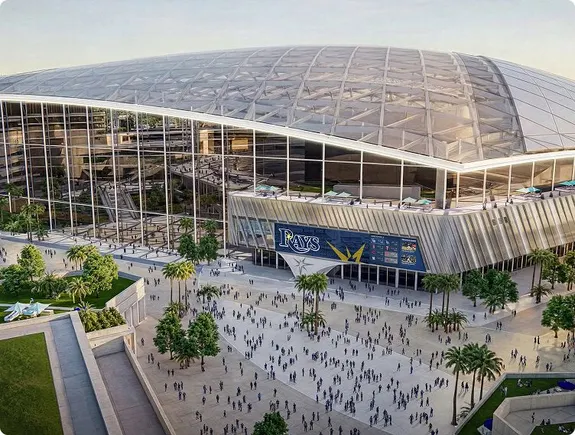
TAMPA, Fla. — The Tampa Bay Rays’ turbulent, years-long journey to secure a permanent, state-of-the-art home reached a critical milestone on Monday. In an announcement posted to the Major League Baseball franchise’s official stadium Request for Qualifications (RFQ) portal, a specialized selection committee ranked a powerhouse joint venture comprising AECOM Hunt, Turner Construction, and HORUS Construction Services as the top-ranked builder to construct the forthcoming $2.3 billion ballpark.
The decision brings the organization one step closer to putting down roots in Tampa’s vibrant Westshore District, specifically slated for a 130-acre mixed-use development on Hillsborough Community College’s Dale Mabry campus. However, while the designation as the top-ranked contractor marks a significant procedural triumph, the project is not yet a done deal. The finalization of the contract hinges on upcoming financial approvals from local government entities, casting a bright spotlight on a complex public-private funding framework that has already seen its share of high-stakes political drama.
Project Snapshot
- Award: Major League Baseball Stadium Megaproject
- Estimated Value: $2.3 billion
- Location: Tampa, Florida (Westshore District / Hillsborough Community College Dale Mabry Campus)
- Client: Tampa Bay Rays MLB Franchise
- Top-Ranked Contractor: Joint Venture of AECOM Hunt, Turner Construction, and HORUS Construction Services
- Seating Capacity: Approximately 31,000 (plus capacity for concerts and multi-sport events)
Main Facts: The Anatomy of the $2.3 Billion Deal
The proposed $2.3 billion facility is designed to be much more than just a baseball diamond; it is envisioned as the anchor of a massive, multi-faceted urban development designed to revitalize a major commercial corridor in the Tampa Bay area.
According to design renderings and planning documents released by the franchise earlier this year, the ballpark will feature an intimate, modern seating capacity of 31,000 spectators. Beyond hosting 81 home games a year for the American League franchise, the venue is engineered to host high-profile concerts, soccer matches, and other entertainment events, maximizing year-round economic output.
To secure this vision, the selection committee combed through proposals from some of the most prominent builders in the North American construction industry. The winning joint venture—AECOM Hunt, Turner Construction, and HORUS Construction Services—outmaneuvered several rival heavy-hitting teams, including:
- A joint venture composed of Mortenson, Beck, and Envision
- A joint venture composed of Gilbane and Barton Malow
- H.J. Russell and Co.
Despite securing the top spot, the joint venture’s ultimate appointment is contingent on the City of Tampa and the Hillsborough County Commission approving a formal financing structure over the coming weeks. According to reports from the Tampa Bay Times, the public sector is currently lined up to contribute approximately $960 million toward the total cost of the megaproject. Meanwhile, the Tampa Bay Rays franchise will cover the remaining balance and, crucially, assume financial responsibility for any budget overruns that materialize during construction.
Should negotiations with the AECOM Hunt-Turner-HORUS partnership break down over fiscal terms or contract specifics, franchise leadership retains the right to pivot and open formal talks with the runner-up construction groups.
Chronology: A History of Resiliency and Relocation
The announcement of a top-ranked builder represents the latest chapter in a long, winding saga defined by shifting locations, political negotiations, and natural disasters.
The Pinellas County Collapse
The Rays’ search for a new home has been plagued by friction for nearly a decade. Most notably, the franchise was deeply enmeshed in a $1.3 billion stadium deal in neighboring Pinellas County. That agreement appeared to be heading toward execution before it abruptly collapsed in March 2025 due to debilitating financing delays and local political hesitation. The sudden death of the Pinellas project forced the organization to completely reevaluate its regional strategy, ultimately steering the team’s focus toward the heart of Tampa.
Pivoting to the Westshore District
Undeterred by the setback, the Rays quickly established a new blueprint. On March 2, the franchise officially revealed dazzling renderings for a new stadium and surrounding mixed-use district in Tampa’s Westshore District, anchoring the project to Hillsborough Community College’s Dale Mabry campus.
By June 29, the team formally issued an RFQ to identify a Construction Manager at Risk (CMAR) to oversee the build. Throughout the summer and early fall, prospective contractors submitted bids, culminating in Monday’s pivotal ranking announcement.
The Tropicana Field Interlude
Adding a layer of unique irony to the proceedings, AECOM Hunt is already intimately familiar with the Rays’ current operational headaches. In the wake of Hurricane Milton—which tore through the region and decimated the fabric roof of Tropicana Field in St. Petersburg—AECOM Hunt was brought in to rebuild the ballpark’s roof. This ongoing institutional familiarity with the franchise’s infrastructure needs provides the joint venture with a distinct advantage as they transition from emergency repairs to ground-up construction.
Supporting Data: A Track Record of Mega-Stadium Construction
The AECOM Hunt and Turner Construction partnership is arguably the most dominant force in modern American sports architecture and construction. The two firms have repeatedly teamed up to deliver multi-billion-dollar sports and entertainment complexes across the United States.
- Philadelphia Mixed-Use Arena: In October, the joint venture secured a massive $1.5 billion contract to construct a shared, state-of-the-art multisport venue in Philadelphia, designed to house both the Philadelphia 76ers (NBA) and the Philadelphia Flyers (NHL).
- Huntington Bank Field (Cleveland): In April, the duo broke ground on Huntington Bank Field in Brook Park, Ohio. That $2.4 billion project is slated to become the ultra-modern new home of the NFL’s Cleveland Browns.
- Local Inclusion (HORUS): Bringing regional expertise to the table is Tampa-based HORUS Construction Services. According to its corporate profile, HORUS operates nationwide with established regional offices in St. Petersburg, Gainesville, and Orlando. The firm brings deep expertise in complex civil and governmental infrastructure, aviation facilities, and major healthcare projects, ensuring local minority and community business participation standards are strongly represented in the execution of the work.
Official Responses and Stakeholder Perspectives
As the stadium project moves from conceptual planning to political debate, public officials and team executives are facing heightened scrutiny regarding the allocation of taxpayer funds.
The proposed $960 million public contribution from the city and county has drawn both staunch defenders and vocal critics. Proponents within local government argue that a modern sports and entertainment district will serve as an essential economic engine, transforming the Westshore District into a regional hub, generating thousands of construction and permanent hospitality jobs, and driving tourism revenue for decades to come.
Conversely, community advocates and fiscal watchdogs have expressed apprehension regarding the exposure of local taxpayers to a multi-million-dollar commitment, particularly in light of recent economic fluctuations and competing infrastructural demands such as public transit, affordable housing, and school funding.
The inclusion of the Rays’ guarantee to cover all cost overruns has been touted by team leadership as a vital safeguard for local government bodies. Franchise representatives emphasized in previous statements that the partnership model minimizes public risk while maximizing shared civic benefits.
Over the coming weeks, intense debate is expected within the Hillsborough County Commission and the Tampa City Council chambers as lawmakers review the fine print of the financing plan. Public hearings and workshops will provide citizens with a platform to voice their perspectives before any final vote is cast.
Implications: What This Means for Tampa Bay and MLB
The progression of the Tampa Bay Rays’ stadium project carries profound implications for the region’s cultural identity, real estate market, and long-term economic trajectory.
1. Securing Long-Term MLB Stability in Central Florida
For years, persistent rumors regarding the long-term viability of Major League Baseball in the Tampa Bay market—fueled by fluctuating attendance figures at the aging Tropicana Field and various relocation threats—cast a shadow over the franchise. Securing a commitment to a cutting-edge, $2.3 billion facility firmly anchors the Rays in the Tampa Bay market for generations. It guarantees that the region will remain a major league sports hub well into the latter half of the 21st century.
2. Urban Revitalization in the Westshore District
The choice of the 130-acre site at Hillsborough Community College is poised to transform the Westshore District into one of the most dynamic live-work-play environments in the Southeast. By integrating a 31,000-seat ballpark with surrounding commercial, residential, and retail spaces, the project mimics successful urban ballpark models seen in cities like Atlanta (The Battery) and St. Louis (Ballpark Village). This development is expected to spur surrounding real estate investment, improve local transportation infrastructure, and create a vibrant year-round destination.
3. A Bellwether for Public-Private Megaprojects
As cities across North America grapple with the soaring costs of sports infrastructure—exemplified by multi-billion-dollar price tags in Cleveland, Philadelphia, and Buffalo—the Tampa Bay project serves as a critical case study in public-private risk distribution. By shifting the burden of cost overruns onto the franchise while utilizing a collaborative construction manager at risk (CMAR) delivery method via heavyweights like AECOM Hunt, Turner, and HORUS, the project sets a potential benchmark for how municipalities and private sports franchises can navigate complex fiscal arrangements in an era of surging construction costs.
Looking Ahead
With the selection committee having made its choice, all eyes now turn to the political arena. If the City of Tampa and the Hillsborough County Commission give the green light to the financing plan in the coming weeks, construction crews could soon mobilize on the Dale Mabry campus, turning years of planning, setbacks, and renderings into concrete reality for Florida’s sports landscape.
