

PHOENIX — Water is life. Few people understand the gravity of that phrase quite like Jaren Murphy. Based in Phoenix—where shrinking water levels in the Colorado River routinely dominate front-page news and shape regional politics—Murphy steps into his new role as the president of the water sector for McCarthy Building Cos. with a front-row seat to the nation’s most pressing civil engineering challenge.
Having officially taken the helm this month after serving as the water business unit leader and senior vice president since September 2024, Murphy is decidedly bullish on the future of water infrastructure projects. His optimism is well-founded, heavily bolstered by a massive influx of capital, including a landmark $30.5 billion federal investment aimed at modernizing domestic water systems.
As the construction industry adapts to a shifting climate, aging urban skeletons, and soaring demands from power-hungry data centers and advanced manufacturing, the water sector has evolved from a quiet municipal utility into one of the most dynamic, high-stakes markets in modern construction. Construction Dive recently sat down with Murphy to discuss how the landscape has transformed, what McCarthy prioritizes when bidding on multi-million-dollar projects, and what the next decade holds for an industry where demand perpetually outpaces supply.
Main Facts: The Multi-Billion-Dollar Evolution of Water Engineering
The American water infrastructure market is undergoing a structural paradigm shift, transitioning from localized, routine municipal repairs to generational, multi-billion-dollar megaprojects.
- Leadership Transition: Jaren Murphy assumed the role of President of Water at McCarthy Building Cos. this month, following a tenure as senior vice president and water business unit leader that began in September 2024.
- Market Scale Shift: Just a few years ago, a $200 million to $250 million project was considered massive on a national scale. Today, almost every major municipality and water resource district commands a capital improvement plan exceeding $1 billion.
- Economic Drivers: The sector is fueled by a combination of acute geographical crises (such as severe droughts in the American Southwest) and structural decay (such as 1960s- and 1970s-era municipal systems in the Midwest and East).
- Federal Tailwinds: The market is further propelled by historic federal funding, underscored by a $30.5 billion federal investment initiative directed toward local and regional water infrastructure.
- Project Delivery Preferences: McCarthy strictly prioritizes collaborative delivery methods—specifically Construction Manager at-Risk (CMAR) and progressive design-build frameworks—to navigate the high complexity of upgrading active, operational water and wastewater facilities.
Chronology: From Regional Utility Work to National Megaprojects
To understand where the water infrastructure market is heading, industry leaders must examine how rapidly it has transformed over the past five years. The timeline of this sector highlights an unprecedented acceleration in project scale, complexity, and financing.
2021: The $250 Million Ceiling
As recently as 2021, the construction landscape looked fundamentally different. A typical large-scale water project across the United States commanded a budget between $200 million and $250 million. During this period, projects valued in the comma-heavy realm of $1 billion were exceptionally rare anomalies. In fact, only one such project existed on a national radar of that magnitude: the monumental Northeast Water Purification Plant intake pump station for the city of Houston, constructed by McCarthy.
2024: The Rise of the Megaproject
By late 2024, the market had completely rewritten its own rules. Driven by population shifts, industrial expansion, and climate pressures, nearly every prominent municipality, water district, and regional authority established capital improvement plans valued at $1 billion or more. Concurrently, leadership shifts within major construction firms—such as Jaren Murphy stepping up to guide McCarthy’s water business unit—signaled a corporate pivot toward capturing these massive, complex capital allocations.
2025–Present: Collaborative Delivery and Federal Injection
Today, the industry is defined by an integration of alternative project delivery methods and historic federal funding infusions. With $30.5 billion in federal investments flowing into the space, contractors are no longer just digging trenches or pouring concrete tanks; they are implementing advanced purification technologies, water reuse systems, and smart-grid monitoring tools under tight regulatory and operational constraints.
Supporting Data: Regional Pressures and Financial Tailwinds
The unprecedented expansion of the water sector is not uniform; it is dictated by distinct regional challenges that require tailored engineering and construction approaches.
| Region | Primary Driver | Key Technology / Focus |
|---|---|---|
| The Southwest | Colorado River drought, water scarcity, population boom | Advanced water purification, direct/indirect potable reuse, closed-loop systems |
| The Midwest & East | Aging infrastructure (built in the 1960s and ’70s), severe weather | Stormwater management, flood resilience, facility overhauls |
| Texas & The South | Industrial growth, high-tech manufacturing, data centers | Specialized industrial treatment, high-capacity supply expansion |
According to Murphy, McCarthy’s internal metrics reflect this broader macroeconomic growth. While water construction consistently accounts for approximately 5% of McCarthy’s total construction portfolio, the absolute dollar value of that 5% has skyrocketed.
"That’s been fairly consistent," Murphy explains regarding the company’s portfolio distribution. "As McCarthy has grown overall, the water business has grown right alongside it. That’s driven by larger and larger projects across the U.S. in different sectors—healthcare, mission-critical and data centers, solar, renewable energy. There are many things that are growing in size and growing in dollar value. So that percentage for water has stayed the same, even though it represents a bigger dollar value."
Official Responses: Inside McCarthy’s Project Selection Criteria
Selecting and executing a multi-million or billion-dollar water project requires a delicate balance of engineering precision, labor forecasting, and risk management. In his interview with Construction Dive, Murphy detailed the strategic philosophy that guides McCarthy’s pursuit of new contracts.
The Mandate for 100% Collaborative Delivery
Traditional hard-bid, low-bid project delivery models are rapidly falling out of favor in the complex world of modern water infrastructure. Murphy emphasizes that McCarthy strictly seeks out environments built on early collaboration.
"We’re looking for 100% collaborative delivery in our water projects," Murphy states. "We’re looking for a construction manager at-risk or design-build, progressive design-build primarily, where we can get involved very early on in a project. That helps us understand the trajectory of the project, the technologies used, obviously the budget and how we’re going to find the craft labor to build the project. We like to get involved from a very early stage in those projects and partner with our owners and our engineers."
Operating on a "Running Kitchen Sink"
One of the defining challenges of water and wastewater construction is that facilities cannot simply be powered down for a weekend renovation. Communities rely on uninterrupted water flow and continuous treatment 24 hours a day, 365 days a year.
Murphy vividly illustrates this operational hurdle:
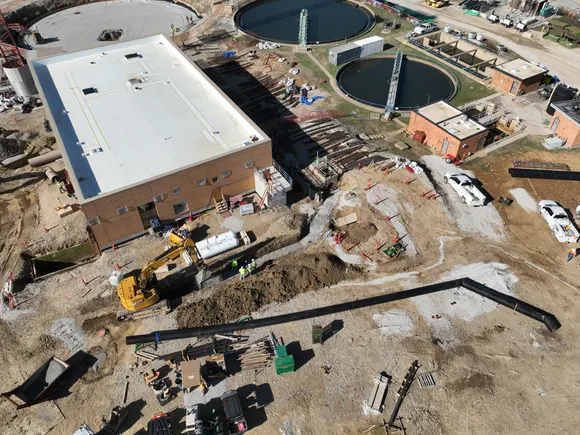
"Many of our projects are, basically, where we’re changing out the drain on a kitchen sink while the sink is running. You can’t shut down a plant. It has to keep creating water and has to keep treating water. And there’s a lot of things that are very complex on how you’re going to build it, or how it’s all going to come together."
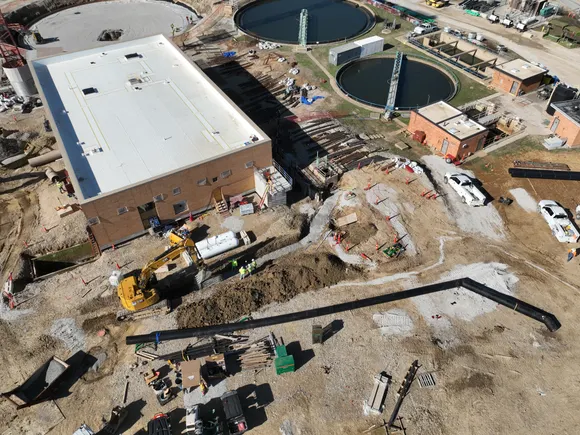
This operational reality exposes the fatal flaw of traditional hard-bid environments. A design that appears flawless on a two-dimensional blueprint often clashes with the chaotic reality of physical space, existing underground utilities, and active machinery. By engaging contractors before designs are finalized, project teams can bridge the gap between theoretical specifications and real-world construction feasibility.
Implications: The Next Decade of Water Construction
Looking ahead over the next 10 to 20 years, the implications for the water construction market are profound. Far from being a temporary spending boom, the demand for sophisticated water engineering is slated to become a permanent pillar of American infrastructure development.
1. Long-Term Realities in the Southwest
The ecological constraints facing the Colorado River basin are not short-term anomalies. Municipalities across Arizona, Nevada, and California are fundamentally restructuring how they manage water. Murphy predicts that the demand to construct advanced water purification plants and large-scale alternative supply solutions will aggressively drive the Southwest market for the next 10, 15, or even 20 years.
2. The Midwest’s Aging Infrastructure Tipping Point
While the West wrestles with scarcity, the Midwest and East face a ticking clock of material degradation. Most municipal water and wastewater treatment plants currently operating in these regions were constructed during the building booms of the 1960s and 1970s, designed with a standard 50-year operational lifespan.
"Now, we’re right in the spot where we need to upgrade our plants, our technology, [and] things need to be changed when it comes to that aging infrastructure," Murphy notes. The capital investments required to replace these half-century-old systems are only just beginning.
3. Industrial and Economic Interdependence
States like Texas continue to experience explosive industrial development, attracting massive investments from high-tech manufacturing, semiconductor fabrication plants, and energy-intensive data centers. These industries require specialized water treatment and reliable resource sourcing, creating sustained tailwinds for commercial builders.
Ultimately, Murphy believes the water sector will consistently shatter financial records because the foundational rule of human development remains unchanged: nothing grows without water.
"You can’t grow a community, you can’t grow a city, you can’t grow an industry without water," Murphy concludes. As the nation funnels tens of billions of dollars into this vital lifeline, the construction industry stands at the very front end of a historic, transformative growth wave.
