

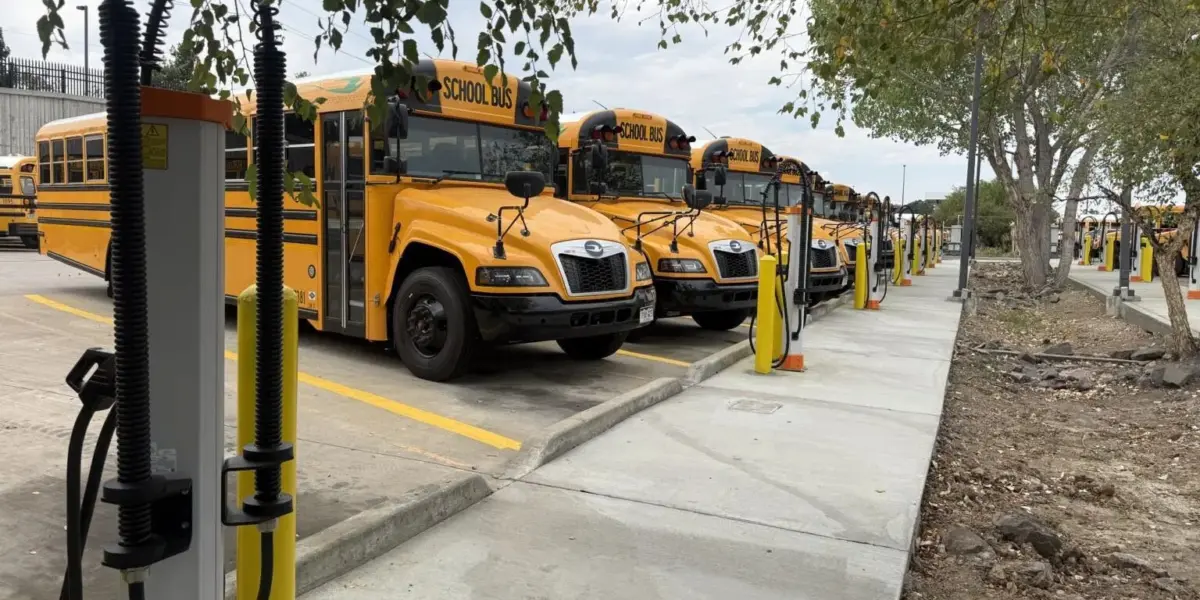
DENVER — As the morning sun rises over the Mile High City, a quiet revolution is taking place at the Hilltop Bus Terminal. Colorado’s largest school district is gearing up for a new academic year with a heavy-duty technological upgrade designed to clean up the air, slash operating costs, and modernize municipal transit.
Just in time for the district’s first day of classes, Denver Public Schools (DPS) has officially brought online a robust new charging hub featuring 26 dedicated plugs backed by a cutting-edge 650-kilowatt distributed charging system. The infrastructure milestone supports an influx of 25 brand-new Blue Bird Vision electric school buses, catapulting the district’s zero-emission fleet to 28 vehicles.
With electric buses now accounting for 12% of the district’s iconic yellow fleet, DPS is setting a high benchmark for sustainable public transportation in the American West. The project is a masterclass in modern depot electrification, combining advanced power-sharing architecture, smart-grid management, and substantial grant-funding to offset steep upfront expenses.
Main Facts: The Hilltop Depot Infrastructure and Fleet Expansion
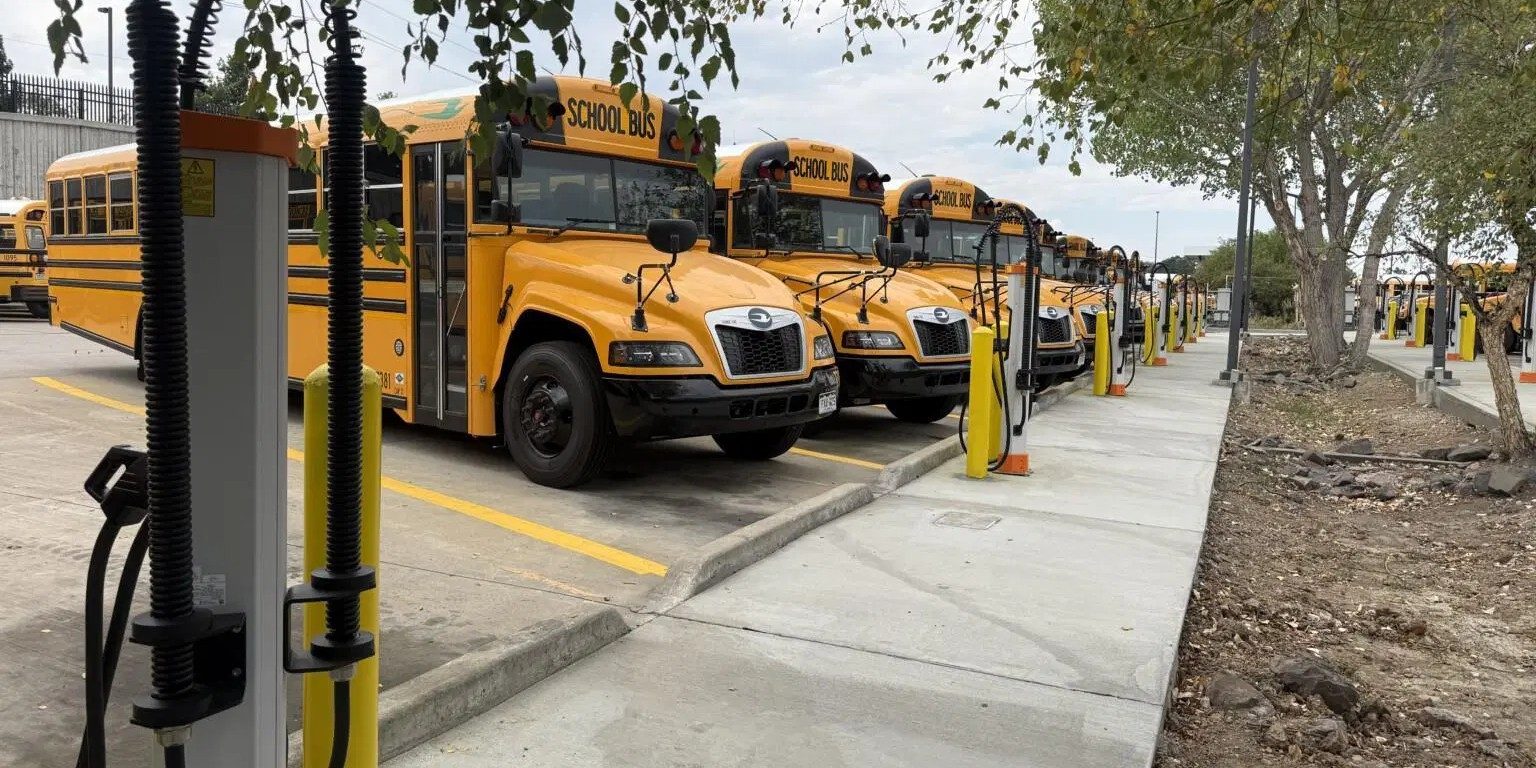
The centerpiece of the district’s latest green initiative is the newly commissioned charging installation at the Hilltop Bus Terminal. Engineered by electrical systems provider Winn-Marion, the depot features 13 dual-port Kempower Satellite dispensers connected to a centralized 650-kW distributed power system.

Instead of routing a fixed amount of electricity to every single plug—a method that can strain local grids and lead to wasted capacity—the Kempower system dynamically distributes the available 650 kW across active ports. This intelligent power allocation means that a bus slated for a grueling, long-distance morning and afternoon route can draw a higher charging output, while a vehicle handling a shorter neighborhood loop receives a tailored, lower-amperage charge.
This dynamic capability is uniquely suited for school bus fleets. Unlike passenger cars that may need rapid, ad-hoc fast charging at all hours of the day, school buses adhere to predictable, highly regimented schedules. They spend predictable blocks of time parked at the depot overnight and during midday hours, allowing smart software to trickle-charge or fast-charge vehicles precisely when it is most efficient and cost-effective. PowerFlex, a leader in intelligent energy management systems, oversees the depot’s smart charging protocols, ensuring that power draw is optimized to avoid costly peak-demand utility rates.
The hardware supporting this operation includes 25 newly integrated Blue Bird Vision electric buses, joining three legacy electric buses previously acquired by the district. The addition marks a dramatic scaling-up of DPS’s clean-transportation roadmap, shifting electric mobility from an experimental pilot phase to a core pillar of municipal operations.
Chronology: From Concept to the First Day of School
The journey toward Denver’s modernized electric bus terminal has been years in the making, accelerated by federal and state clean-transportation funding.
- The Pilot Phase: DPS initially dipped its toes into zero-emission student transit by deploying a modest fleet of three electric school buses, allowing mechanics, drivers, and administrators to familiarize themselves with the operational nuances of electric heavy-duty vehicles.
- Securing the Fleet: Buoyed by early successes and armed with substantial federal, state, and regional grants, DPS placed an order for 25 additional Blue Bird Vision electric school buses, pushing total inventory to 28 units.
- The Infrastructure Buildout: Recognizing that 28 heavy-duty vehicles require significant electrical muscle, the district partnered with Winn-Marion and PowerFlex to design and construct the Hilltop Bus Terminal charging hub.
- Installation and Commissioning: Construction crews installed the 13 dual-port Kempower Satellite dispensers and tied them into a unified 650-kW distributed architecture over the spring and summer months.
- System Testing and Integration: PowerFlex integrated smart-charging software to manage load balancing and energy costs.
- Ready for the Bell: The charging hub officially achieved operational readiness just ahead of the district’s August 24 start date, ensuring a seamless transition for the upcoming school year.
Supporting Data: The Economics of Going Electric
While the environmental benefits of transitioning away from fossil fuels are frequently highlighted, the financial calculus is what ultimately convinces municipal budget directors to make the switch. However, the initial capital expenditure remains a formidable hurdle.
According to financial figures provided by DPS to local media outlet Denver7, a brand-new electric school bus commands an upfront price tag of roughly $400,000. By comparison, a traditional diesel-powered school bus costs around $140,000. Without external financial assistance, this nearly threefold price difference would render fleet electrification economically unfeasible for most public school districts.
Fortunately, heavy-duty grants, Volkswagen settlement funds, and clean-air rebates covered the vast majority of the capital costs for both the buses and the Hilltop charging infrastructure.
Once the vehicles are on the road, the operating cost savings are substantial:

- Fuel Costs: DPS estimates that electricity will cost approximately $1,900 per bus annually. Conversely, a diesel bus guzzles roughly $6,800 in fuel per year. Across the 25 new electric buses alone, this translates to an estimated annual fuel savings of approximately $123,000.
- Maintenance Savings: Because electric motors possess a fraction of the moving parts found in internal combustion engines—lacking transmissions, oil changes, exhaust systems, and spark plugs—DPS projects that the electric buses will require roughly 75% less maintenance over their operational lifespans.
Despite these immediate operational savings, district officials maintain a pragmatic view on long-term lifecycle costs. DPS notes that comprehensive real-world data comparing the total 15-to-20-year lifespans of electric versus diesel buses is still maturing across the industry. Each electric bus is equipped with a high-capacity battery valued at $93,000, backed by a robust eight-year warranty. Major battery servicing or replacement milestones are projected to arrive around years nine or 10—roughly the same timeline when traditional diesel buses typically begin requiring expensive engine overhauls and transmission repairs.
Official Responses and Strategic Implications
The deployment of Colorado’s largest electric school bus fleet carries profound implications for public health, municipal sustainability goals, and regional air quality.
The Public Health Imperative
The health arguments for ditching diesel are increasingly urgent. Across the United States, roughly 26 million children ride yellow school buses every single day, yet approximately 95% of the nation’s school bus fleet continues to run on diesel fuel.
According to the American Lung Association, diesel exhaust is a complex mixture containing fine particulate matter and toxic air pollutants linked to asthma attacks, reduced lung function, and cardiovascular disease. Children are uniquely and disproportionately vulnerable to these airborne toxins because their lungs are still developing, and they breathe at a faster rate relative to their body weight than adults. By removing diesel particulate emissions from neighborhoods and school drop-off zones, DPS is directly safeguarding the respiratory health of its students.

Alignment with Climate Goals
Beyond local health benefits, the electrification initiative plays a vital role in Denver’s broader environmental strategy. Denver Public Schools has established a legally binding and aggressive climate goal: cutting its overall greenhouse gas emissions by at least 90% by the year 2050.
Because municipal transportation currently accounts for roughly 14% of the district’s total carbon footprint, electrifying the bus fleet is a mandatory step toward achieving net-zero ambitions. To measure progress, DPS plans to leverage its new monitoring software to track real-time electricity consumption, route efficiency, and ongoing maintenance metrics. This data-driven approach will help district logisticians fine-tune routes and maximize battery life as future fleet expansions are considered.
Furthermore, Kempower—the Finnish-rooted charging technology provider powering the Hilltop terminal—is cementing its footprint across the United States. In addition to its success in Colorado, Kempower’s modular and scalable charging solutions are currently energizing electric school bus depots across Quebec, Louisiana, Kansas, Massachusetts, Indiana, and Wisconsin, proving that the architecture deployed in Denver is rapidly becoming a gold standard for clean student transit across North America.
As the yellow electric buses roll out of the Hilltop Bus Terminal to pick up their first passengers of the school year, Denver is offering a clear blueprint for how cities can successfully bridge the gap between ambitious climate pledges and practical, daily municipal operations.
