

By The ACHR NEWS Archives & Industry Analysis Desk
Main Facts
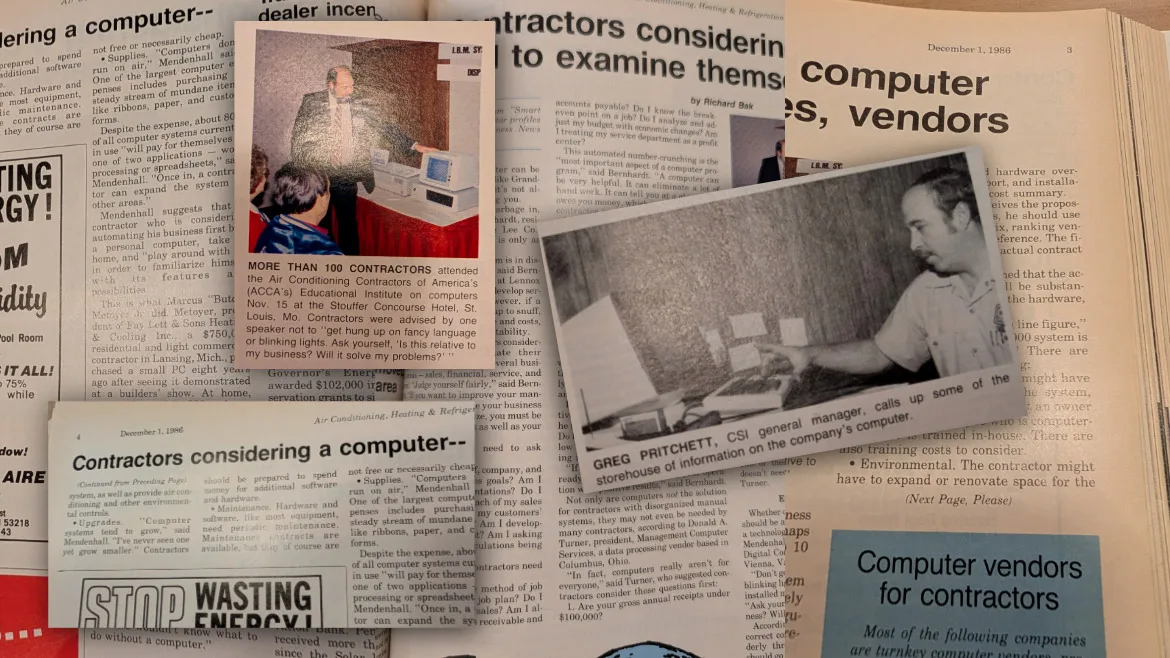
As the heating, ventilation, air conditioning, and refrigeration (HVACR) industry grapples with the rapid ascent of artificial intelligence, a fascinating historical mirror emerges. Today, contractors find themselves asking whether artificial intelligence is an operational necessity or an overhyped distraction. Yet, a deep dive into the archives of The ACHR NEWS reveals that nearly four decades ago, the industry was locked in an identical philosophical and practical struggle.
In the fall of 1986, the fundamental question wasn’t whether contractors should implement neural networks or generative AI, but something vastly more foundational: Do HVAC contractors even need computers?
Back then, electronic data processing was largely perceived as an exotic, intimidating frontier. Computers were formidable, climate-controlled mainframes guarded by engineers manipulating stacks of punched cards. Industry skepticism ran deep. One prominent mechanical contractor famously declared to The ACHR NEWS that there were “only two contractors in the nation who could use a computer profitably.” However, the rapid acceleration of technology proved him wrong almost instantly; after spending three days at an IBM seminar, he quietly ordered his first corporate computer and scrambled to retract his public skepticism.
This tension—between cautious resistance and inevitable digital transformation—defines the core thesis of the modern technological transition. Today’s debates surrounding artificial intelligence, automated workflows, and machine learning mirror the 1980s paradigm shift when off-the-shelf software and falling hardware costs first dragged computers out of corporate glass rooms and into contractor back offices.
Chronology: From Mainframe Mystique to Desktop Reality
The Early 1980s: The Era of the Glass-Walled Beast
At the dawn of the decade, computing power was centralized in large corporations. For a small or mid-sized HVAC contractor, the idea of owning an electronic device for daily operations seemed absurd. Computers required specialized climate conditions, dedicated operators, and massive capital investments. They were treated as speculative novelties rather than practical tools of the trade.
1985–1986: The Microcomputer Breakthrough
By the mid-1980s, falling hardware costs and the advent of microcomputers triggered a minor revolution. An October 1986 editorial in The ACHR NEWS cataloged a sudden expansion of digital capabilities tailored for smaller businesses: bid preparation, takeoffs, detailed costing, engineering design, product selection, accounting, job costing, and service operations management.
“The truth is that many of the nation’s smaller and mid-sized contractors now are using computers for some part of their operation,” the editors noted at the time. “The computer is, after all, just another tool that every day is becoming easier to master. It probably won’t take long before they’re hooked.”
Hardware was also becoming mobile and industry-specific. Articles from the era highlighted breakthroughs like Hvac-Calc, a handheld, battery-operated computer equipped with a four-color printer-plotter. Built around ACCA Manual J specifications, it enabled contractors to run whole-house or room-by-room load calculations in minutes, plot temperature distributions, and dynamically compare energy usage for different system configurations right at the kitchen table.
The Late 1980s: The First Whisper of Artificial Intelligence
As the decade drew to a close, the technological horizon shifted once again. Writing about computer-aided design, industry experts like William G. Beazley began introducing contractors to “expert systems”—early rule-based iterations of artificial intelligence designed to mimic human decision-making processes. Though primitive compared to modern generative AI, these systems promised massive productivity leaps in engineering tasks like heat exchanger design and piping layouts, proving that the dream of augmenting human expertise with machine intelligence is nearly 40 years old.
Supporting Data & Case Studies: The ROI of Early Automation
While trade publications debated the philosophy of technology, pioneering contractors were already harvesting tangible rewards.
In Salt Lake City, Greg Pritchett of CSI Heating & Air Conditioning leveraged early computerized systems to reduce his administrative headcount from five employees to two, streamlining both engineering calculations and corporate bookkeeping. More importantly, CSI transformed raw data into strategic intelligence. The company’s system tracked equipment callbacks, warranty claims, employee training milestones, and specific hardware failure rates.

For instance, when a particular circuit board racked up 20 service calls, the system flagged the part as “highly suspect.” Sales leads, technician performance histories, inventory levels, fleet efficiency metrics, and monthly utility bills were meticulously logged. When utility costs spiked unexpectedly in a given month, CSI’s data pointed directly to a faulty utility meter; when propane expenses crept upward, a leaking delivery truck was quickly identified and repaired.
These functions formed the embryonic stages of what would later mature into sophisticated Customer Relationship Management (CRM) and Field Service Management (FSM) software.
Conversely, success required rigorous internal discipline. Industry leaders warned against uncontrolled digital spending. Craig Bernhardt of The Lee Co. popularized the foundational tech mantra: “A computer is only as good as what you put in it. Garbage in, garbage out.” Contractors were repeatedly urged to fix broken internal processes, clarify business goals, and tighten administrative management before purchasing automated solutions. Technology, experts warned, could never fix a fundamentally broken business model.
Official Responses & Industry Wisdom: The 1980s Playbook
To guide bewildered business owners through the minefield of tech vendors and flashy sales pitches, The ACHR NEWS compiled hard-hitting editorial advice and expert perspectives.
Donald A. Turner of Management Computer Services offered a remarkably candid assessment of the market: “In fact, computers really aren’t for everyone.” Contractors were advised to evaluate their annual revenues, company size, and genuine satisfaction with manual systems before signing purchase orders. If a business was functioning well without automation, the correct answer was often straightforward: “Then he doesn’t need a computer right now.”
To formalize this cautious optimism, a landmark 1986 editorial published “The 10 Commandments of Computer Buying,” a set of principles that reads today as an uncanny blueprint for evaluating artificial intelligence:
- Know thy business: Understand your operational pain points before shopping.
- Do not hold false hopes: Technology will not magically multiply profits overnight.
- Thy patience shall be rewarded: Implementation takes time, often a year or more.
- A bargain beckons only fools: Cheap software with poor support costs more in the long run.
- Weigh thy options: Compare multiple vendors and total cost of ownership.
- Sustain thy computer: Account for ongoing maintenance, supplies, and upgrades.
- Embrace the future: Do not let fear of change stall competitiveness.
- Fear not tradition: Traditional craftsmanship can coexist with digital tools.
- Thou shalt take charge: Retain managerial control rather than letting software dictate operations.
- Thou shalt make thine own blunders: Acknowledging that “Computers do not make mistakes. People do.”
Charles Mendenhall of Digital Communications Associates reinforced this pragmatic philosophy, urging contractors to look past superficial sales tactics: “Don’t get hung up on fancy language or blinking lights. Ask yourself, ‘Is this relative to my business? Will it solve my problems?’”
Hidden costs were also a major talking point. Industry analysts warned that computers “don’t run on air.” A baseline $25,000 system often doubled in cost once personnel training, custom software installation, ongoing maintenance, and accessory supplies were factored into the ledger.
Implications: The More Things Change, the More They Stay the Same
Evaluating the technological shifts of the 1980s against the artificial intelligence landscape of today reveals a profound continuity in business evolution.
The underlying questions facing HVACR contractors remain identical:
- Does this emerging technology solve a genuine operational problem?
- Is our organization structurally mature enough to leverage it?
- What is the true total cost of implementation, including training and data sanitation?
- What are the consequences of feeding inaccurate or biased information into the system?
- Who ultimately remains responsible for the final output?
The machinery has undeniably evolved. We have transitioned from hulking, climate-controlled mainframes and battery-powered handheld calculators to cloud-based neural networks and natural language search engines like Ask ACHR NEWS. Yet, the fundamental rules of business procurement remain completely unchanged.
As the industry stands on the precipise of the AI revolution, the wisest counsel remains rooted in the archives of nearly four decades ago: ignore the flashy demos and blinking lights, evaluate your core business needs, and focus entirely on whether the tool actually solves your problems. In 1986, that was the ultimate test of survival. In the modern era of artificial intelligence, it remains the ultimate key to success.
