

Main Facts
Modern healthcare facilities demand precise environmental controls, relying on complex heating, ventilation, and air conditioning (HVAC) systems to maintain strict indoor air quality, pressure relationships, and sterile conditions. At the heart of these networks are Air Handling Units (AHUs), sophisticated machines designed to manage airflow, temperature, and filtration. However, a deeply nuanced, frequently misunderstood, and potentially hazardous operational phenomenon plagues many modern AHUs: the recirculating mode death spiral.
This article—the fourth in an ongoing investigative series by the Hawke Institute for Facility Systems—dives into a specialized case study involving a newly constructed hospital. It explores how an AHU, not originally intended to operate in a fully recirculating configuration, inadvertently locked itself into a catastrophic feedback loop.
Unlike traditional setups where a return fan tracks supply airflow directly, this specific hospital AHU utilized return air Variable Air Volume (VAV) boxes located at the served spaces (such as critical operating rooms). The return fan’s primary objective was simply to maintain an adequate return air static pressure, allowing these remote VAV boxes to operate properly. Yet, despite this decentralized control architecture, the system still fell victim to a severe operational failure upon disabling the economizer during seasonal functional testing.
The resulting failure sequence triggered a rapid drop in return duct static pressure, ultimately tripping a safety switch and shutting down the entire unit. Left unchecked, such pressure drops can lead to catastrophic structural failure, including the physical collapse of return ductwork.

Chronology of Events: From Testing to System Failure
To fully understand how the "death spiral" manifests in modern hospital environments, it is necessary to examine the chronological sequence of events that occurred during functional testing at the new facility in March, amid cool ambient conditions.
Phase 1: Normal Operation with the Economizer Enabled
In the weeks leading up to the functional testing phase, the AHU had been operating smoothly under cool ambient conditions with its economizer enabled.
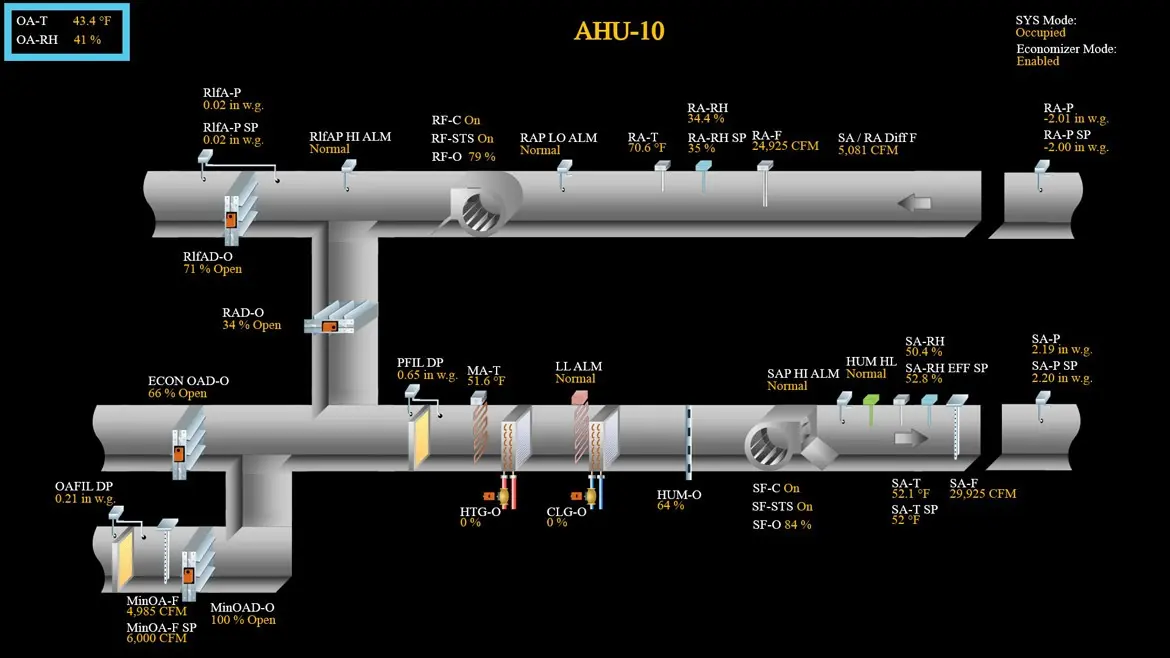
- Damper States: The economizer outdoor air damper (ECON OAD-O) was modulated open to roughly 66%, drawing in outdoor air. The return air damper (RAD-O) modulated inversely to balance the system.
- Airflow Dynamics: Although the duct-mounted minimum outdoor airflow measuring station (MinOA-F) registered a reading slightly below its setpoint due to sensor placement, the building was safely receiving more than sufficient collective outdoor air through dual intake paths.
- Fan Behaviors: The supply fan managed space delivery requirements, while the return fan maintained stable return air static pressure (RA-P SP), allowing the operating room return VAV boxes to precisely control their respective airflows.
Phase 2: Disabling the Economizer
Anticipating potential control anomalies based on prior system behaviors, the temperature controls contractor warned the engineering team that the unit would likely fault out once the economizer was manually disabled. To gather empirical data for future design recommendations, the engineering team opened the Building Automation System (BAS) programming interface to monitor real-time inputs and outputs, then switched the economizer off.
Phase 3: The Unintended Transition to Recirculation
Immediately following the deactivation of the economizer, the AHU entered an unstable transition state:

- Damper Closure: The return air damper swung fully open, while the economizer outdoor air damper snapped fully closed. Simultaneously, the relief air damper shut completely—an unexpected shift driven by fluctuating plenum pressures, ambient wind vectors, and building envelope resistance.
- The Control Loop Conflict: Because the outdoor airflow reading (MinOA-F) temporarily registered higher than its defined setpoint (MinOA-F SP), the minimum outdoor air damper controller (MinOAD-O) began systematically closing down the minimum outdoor air intake.
Phase 4: The Feedback Loop and System Collapse
As the minimum outdoor air path restricted, the supply fan was forced to pull a greater share of its airflow through the return air path.
- VAV Box Response: This sudden surge of induced airflow passed through the return air VAV boxes serving the operating rooms. Their integrated airflow sensors detected the anomaly and rapidly modulated their internal dampers closed to maintain their specific airflow setpoints.
- Pressure Starvation: With the return VAV dampers restricting flow, return duct static pressure plummeted. The return fan attempted to compensate by slowing down, which in turn forced the powerful supply fan to pull even harder against the closing minimum outdoor air damper.
- The Safety Trip: The minimum outdoor air damper closed further, driving the return fan down to its absolute minimum speed. Operating as a free-spinning bottleneck, the return fan was completely overpowered by the supply fan. Return duct static pressure dropped so severely and rapidly that the return air static safety switch tripped, immediately shutting down the AHU.
Supporting Data and System Architecture
The mechanics of the AHU recirculating mode death spiral are rooted in uncoordinated sensor readings and a lack of protective control logic limits.
| Operational Parameter | Normal Economizer Mode (Fig. 1) | Expected Minimum OA Mode (Fig. 2) | Actual Failure State (Fig. 4) |
|---|---|---|---|
| Economizer OAD | Open (~66%) | Closed (0%) | Closed (0%) |
| Return Air Damper | Modulating inversely | Modulating | Fully Open |
| Relief Air Damper | Modulating to maintain pressure | Slightly Open | Fully Closed (Unintended) |
| Minimum OA Damper | Modulating | Regulating setpoint | Closing toward zero |
| Return Fan Speed | Stable (Maintaining RA-P) | Stable | Bottomed out at Minimum Speed |
| System Status | Operating normally | Operational (Theoretical) | Tripped (RAP LO ALARM) |
Vulnerabilities to Future Balancing
A critical takeaway from Case Study 4 is that the system remained inherently vulnerable to routine maintenance and Test, Adjust, and Balance (TAB) procedures.
If a TAB technician recalibrates the operating room return VAV boxes in the future to fine-tune space pressurization, they frequently alter airflow setpoints. If the collective difference between the supply VAV box setpoints and return VAV box setpoints exceeds the minimum outdoor airflow setpoint (MinOA-F SP), the AHU will automatically tumble into the recirculating mode death spiral—even if every airflow measuring station in the building is calibrated to absolute perfection.

Official Responses and Engineering Solutions
Faced with mounting evidence from multiple hospital installations plagued by similar control logic oversights, the engineering team formulated a robust mitigation strategy.
Because the facility relies on decentralized return air VAV boxes rather than a traditional return fan airflow-tracking configuration, the control sequence required specialized guardrails to prevent uncoordinated sensor drift from dragging the unit into a 100% recirculating state.
The proposed and accepted engineering remediation involved:
- Implementing Low-Limit Interlocks: Introducing a minimum outdoor airflow low limit (Min OAD Low Limit) into the programming sequence. This logic overrides damper modulation to ensure the minimum outdoor air damper can never fully close when the unit is active, regardless of erratic readings from downstream airflow measuring stations.
- Sensor Decoupling and Cross-Validation: Modifying how the BAS evaluates pressure differentials across relief and return plenums, preventing wind-induced or building pressure spikes from slamming relief dampers shut.
- Sequence Hardening: Ensuring that if airflow measuring stations drift out of calibration over time, software interlocks prevent the supply and return fans from entering a destructive tug-of-war.
Implications for Facility Managers and HVAC Designers
The findings from Case Study 4 carry profound implications for the design, commissioning, and long-term maintenance of critical environment HVAC systems across the healthcare sector and beyond.

1. Safety Hazards Beyond Energy Waste
While inefficient energy use is a standard concern in HVAC design, the recirculating mode death spiral presents an acute structural safety hazard. In this instance, the rapid drop in return duct static pressure tripped a safety switch. However, if safety interlocks fail, lag, or are overridden by maintenance personnel during troubleshooting, the extreme negative pressure generated by a large supply fan overpowering a stalled return fan can cause substantial ductwork collapse, posing severe safety risks to building occupants and infrastructure.
2. The Fallacy of "Perfect Sensors"
HVAC controls engineering often assumes that if sensors are calibrated during installation, the system will remain stable. Case studies from the Hawke Institute consistently prove otherwise. Dust accumulation, velocity profile shifts, and sensor drift inevitably create uncoordinated readings between supply, return, and outdoor airflow measuring stations. Sequences of operation must be written with the assumption that sensors will drift, incorporating robust software guardrails to handle erroneous data gracefully.
3. A Continuing Industry Trend
According to facility systems analysts, very few standard AHU sequences of operation are naturally immune to the recirculating mode death spiral. Because every building layout, duct configuration, and pressure regime is unique, customized logic modifications are routinely required during commissioning to harden system robustness.
As this investigative series continues next month, facility engineers will examine an entirely different AHU sequence of operation from a separate hospital facility that similarly fell victim to this elusive control paradox—highlighting an industry-wide need for standardized, foolproof software baselines in critical-care ventilation design.
