

By Editorial Staff
Published: August 29, 2026
In a move echoing last year’s controversial cartographic disputes, the White House has issued a presidential executive order renaming Lake Ontario as "Lake America." The decree arrives squarely in the middle of a deepening trade war with Canada, instantly transforming a standard geographic designation into a high-stakes flashpoint for international diplomacy, local governance, and the tech industry.
Major digital mapping giants—including Apple, Google, and Microsoft—now face mounting pressure to determine whether they will update their platforms to reflect the federally mandated name change. Meanwhile, regional politicians, software upstarts, and millions of cross-border commuters are left grappling with the logistical and political fallout of a body of water split by an international boundary.
Main Facts
The controversy centers on a newly signed executive order from President Donald Trump officially declaring that Lake Ontario, the easternmost of the North American Great Lakes, shall henceforth be known within federal records as "Lake America."
The administration’s rationale, defense, and immediate pushback are defined by several core elements:
- The Federal Mandate: The executive order mandates that all official United States federal maps, documents, and databases update their terminology to reflect the name change, mirroring the process used last year when the administration controversially renamed the Gulf of Mexico to the "Gulf of America."
- The Geographic Names Information System (GNIS): Just as it did during the Gulf of Mexico dispute, the USGS GNIS—the official repository of domestic geographic nomenclature—is expected to adopt the change, setting the benchmark that consumer-facing tech platforms typically rely upon for standard cartography.
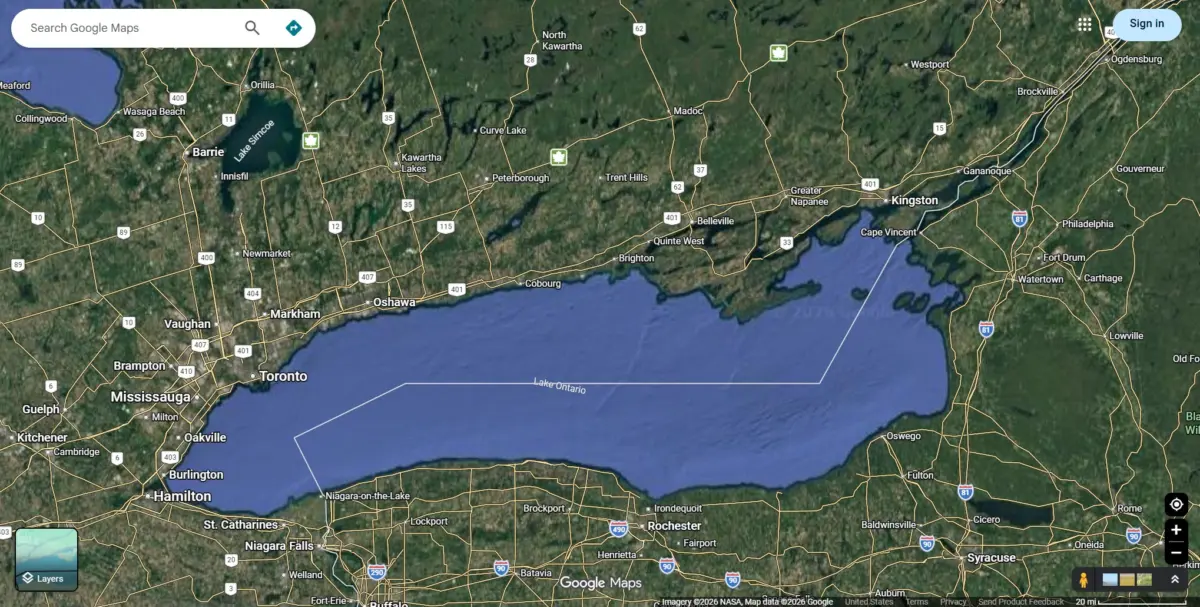
- The International Boundary Complication: Unlike the Gulf of Mexico, which is bounded entirely by the United States, Mexico, and international waters, Lake Ontario is shared directly by the United States and Canada. The international border runs straight through the middle of the lake, meaning the sovereign territory of two distinct nations converges within a single body of water.
- The Tech Industry Dilemma: Tech conglomerates like Apple (Apple Maps), Google (Google Maps), and Microsoft (Bing Maps) must decide how—or if—they will deploy the new name globally, or if they will employ localized geofencing to display "Lake America" exclusively to U.S.-based users while preserving "Lake Ontario" for Canadian audiences.
- Political and Cultural Pushback: Critics have swiftly mobilized against the order. Regional leaders, most notably New York Governor Kathy Hochul, have highlighted the disruptive impact on education, tourism, and cross-border relations, famously pointing out how the traditional mnemonic for the Great Lakes (Huron, Ontario, Michigan, Erie, Superior) is upended by the change, morphing "HOMES" into "SHAME."
Chronology
The path to "Lake America" did not materialize overnight. It represents the continuation of a deliberate geopolitical and domestic strategy regarding geographic nomenclature.
Phase 1: The Precedent of the "Gulf of America" (2025)
Late last year, President Trump signed an executive order renaming the Gulf of Mexico within federal mapping frameworks. The move initially sparked confusion among software developers and major tech firms. For several weeks, major applications maintained their legacy labels while legal and cartographic teams evaluated federal compliance standards. Eventually, after the update propagated through the Geographic Names Information System (GNIS), Apple Maps, Google Maps, and Bing Maps updated their interfaces to reflect the administration’s preferred terminology, setting a powerful precedent for executive intervention in digital mapping.
Phase 2: The Trade War Escalation and the White House Decree (August 2026)
Amid escalating economic friction and a broadening trade war with Canada, the White House revived its cartographic playbook. On August 26, 2026, the administration published an official presidential action titled "Honoring the American History of the Great Lakes and Renaming Lake Ontario as Lake America." The announcement was framed by administration officials as a reclamation of U.S. heritage, capitalizing on nationalist themes during a period of bilateral economic hostility.
Phase 3: The MapQuest Defiance and Social Media Backlash (August 27–28, 2026)
Within 24 hours of the executive order, reactions poured in from across the digital landscape. MapQuest, a long-standing pioneer in online mapping that now operates as a smaller competitor to the tech monoliths, immediately broke ranks. In a widely circulated post on the social media platform X, MapQuest declared:
"We’re not changing the name of Lake Ontario. Name it whatever you want at your leisure."
The post featured a screenshot displaying a custom, tongue-in-cheek label: "Lake Are We Doing This Again?"
Phase 4: Media Inquiry and Bureaucratic Silence (August 28–Present, 2026)
As technology journalists at outlets like CNET reached out to Apple, Google, and Microsoft for official comment, the White House doubled down on its messaging. Assistant Press Secretary Allison Schuster defended the action in an email statement, emphasizing that the majority of the lake’s volume resides within U.S. territory, while declining to answer questions regarding corporate compliance timelines or MapQuest’s public defiance.
Supporting Data and Technical Realities
To understand the weight of this executive order, one must examine the intricate mechanics of modern digital cartography. Digital maps are not static images; they are complex, database-driven spatial applications fed by official geopolitical registries, local municipal data, and international treaties.
The GNIS and Corporate Compliance
In the United States, the Geographic Names Information System (GNIS), maintained by the U.S. Geological Survey (USGS) in cooperation with the U.S. Board on Geographic Names (BGN), serves as the official repository of domestic geographic names.
When the administration successfully pushed through the renaming of the Gulf of Mexico, tech companies ultimately capitulated to maintain alignment with official U.S. federal data standards. However, legal experts note that private software companies are under no constitutional or statutory compulsion to adopt colloquial or politically motivated renaming decrees, particularly when those decrees apply to international bodies of water.
The Border Paradox
The most significant technical hurdle facing mapmakers is the International Boundary Commission’s demarcation line dividing Lake Ontario.
If Google, Apple, or Microsoft decide to comply with the federal directive, they cannot simply slap a single label across the entirety of the lake without creating severe diplomatic and navigational absurdities. Cartographers would be forced to implement granular, regionalized geofencing:

- U.S. Waters: Displaying "Lake America" for users accessing the map from American IP addresses or physical locations within New York state.
- Canadian Waters: Maintaining "Lake Ontario" for users accessing the platform from Ontario, Canada, or international jurisdictions that do not recognize the unilateral U.S. decree.
Such dynamic labeling requires complex software engineering adjustments. Furthermore, it risks alienating users who travel frequently across the Niagara River and the St. Lawrence Seaway, where map labels would perpetually shift mid-journey.
Economic and Educational Disruptions
Beyond software engineering, the renaming carries tangible downstream consequences for regional economies and educational institutions:
- Tourism and Branding: Local tourism boards on the southern shores of the lake—spanning Rochester, Buffalo, and Oswego—now face a confusing dilemma: should they update marketing materials to align with federal databases, or retain "Lake Ontario" to avoid alienating Canadian tourists and international visitors?
- Educational Curricula: As New York Governor Kathy Hochul noted, generations of American and Canadian school children have memorized the Great Lakes using the iconic mnemonic "HOMES" (Huron, Ontario, Michigan, Erie, Superior). Forcing a transition to "SHAME" or an altered acronym introduces unnecessary administrative friction into state educational standards.
Official Responses
Reactions to the "Lake America" decree have exposed deep partisan divides and highlighted the widening gulf between federal executive actions and regional governance.
The White House Perspective
Defending the administration’s stance, Assistant Press Secretary Allison Schuster emphasized the geographic dominance of the United States over the basin. In a statement provided to technology reporters, Schuster asserted:
"As the President said yesterday, the majority of the great lake’s volume sits in United States territory. Thanks to President Trump’s bold action, its name will now reflect its place in America and her heritage."
Despite this assertive posture, the administration has remained conspicuously silent regarding the diplomatic friction the move creates with Ottawa, choosing instead to frame the decision through the lens of domestic patriotism and resource sovereignty.
State and Local Pushback
Elected officials in states bordering the lake have offered scathing critiques of the executive order, viewing it as an unnecessary distraction during an already volatile trade war with Canada—America’s closest trading partner and northern neighbor.
New York Governor Kathy Hochul led the charge against the directive, releasing a series of statements and social media posts ridiculing the administrative renaming. Highlighting the absurdity of altering a shared international landmark via executive fiat, Hochul focused heavily on the cultural disruption, famously pointing out how the alteration wreaks havoc on foundational educational tools like the "HOMES" mnemonic.
Other regional lawmakers have pointed out the potential economic fallout, noting that retaliatory economic or diplomatic friction from Canadian provinces could harm local shipping, fishing, and cross-border commerce along the St. Lawrence Seaway.
Industry Defiance and Silence
The corporate response has been characterized by a mixture of public pushback and corporate caution:
- MapQuest: By deploying humor and officially refusing to alter its software nomenclature, MapQuest has positioned itself as an independent voice willing to mock federal overreach in digital design. Industry analysts note that MapQuest’s smaller market share allows it greater agility to make bold, counter-cultural statements compared to its dominant competitors.
- Apple, Google, and Microsoft: As of press time, none of the major tech titans have issued definitive timelines regarding whether they will update their mapping applications. Representatives for Apple Maps, Google Maps, and Bing Maps have declined immediate requests for comment, leaving millions of users and local businesses in limbo as engineering teams evaluate the legal, technical, and diplomatic implications of the order.
Implications
The unilateral renaming of Lake Ontario to "Lake America" transcends a mere semantic debate; it serves as a case study in the intersection of digital infrastructure, nationalism, and international relations in the 21st century.
1. The Weaponization of Digital Cartography
For decades, maps were viewed as objective, immutable reflections of physical reality. However, the rise of digital mapping platforms controlled by a handful of Silicon Valley corporations—yet heavily influenced by national governments—has turned cartography into a contested political battleground. When a government can alter a digital map via executive order, maps cease to be neutral tools of navigation and instead become instruments of state-sponsored narrative-building.
2. Fractured Global Realities
If tech companies ultimately bow to federal pressure and implement the name change for U.S. users while retaining "Lake Ontario" for Canadians, it will result in a "fractured map" phenomenon. Users in different countries will perceive entirely different geographic realities on their screens. This digital divergence threatens to undermine the universal standardization that global commerce, aviation, shipping, and emergency services rely upon.
3. Diplomatic Strain with Canada
Coming on the heels of escalating trade tariffs and protectionist economic policies, the "Lake America" decree is viewed by international observers as an unnecessary provocation directed at Ottawa. Renaming a body of water that Canada holds an equal sovereign stake in without bilateral consultation signals a deepening disregard for traditional diplomatic norms.
What Comes Next?
As software engineers at Google, Apple, and Microsoft weigh their options, the digital landscape waits for the first major platform to blink. Will the tech giants prioritize compliance with U.S. federal data repositories, or will they risk the wrath of the executive branch by preserving international norms and avoiding cross-border confusion?
Until a consensus emerges, "Lake America" exists in a bizarre purgatory: officially mandated by the White House, rejected by regional mapmakers, mocked on social media, and waiting to see whether code will bend to politics.
