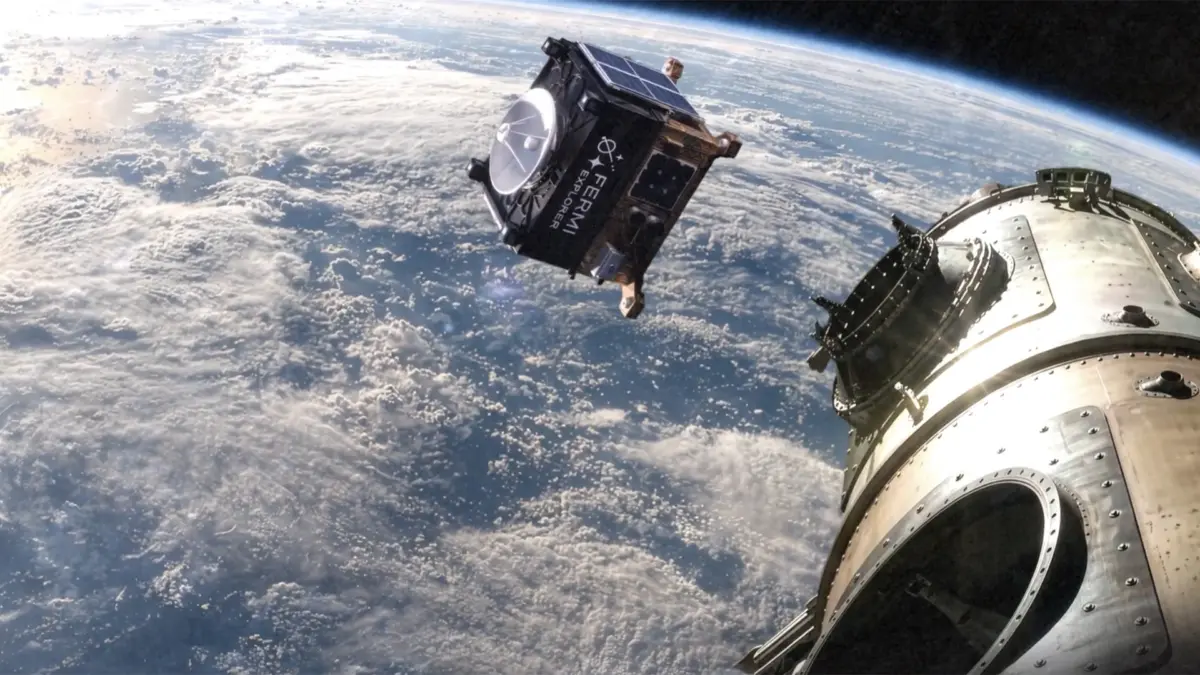
Humanity is preparing to take its most patient and symbolically profound leap into the cosmos. A coalition of forward-thinking executives, tech entrepreneurs, and scientists has officially announced plans to develop and launch the world’s first dedicated interstellar spacecraft. Slated for liftoff in 2029, the mission—aptly named the Fermi Explorer—carries an astonishing destination: Alpha Centauri, the closest star system to our own solar system, located roughly 4.3 light-years away.
There is, however, a monumental catch. Due to current technological limitations and the sheer, unfathomable distances involved, the tiny spacecraft will not reach its destination for approximately 79,800 years.
Spearheaded by Philip Johnston, Adi Oltean, and Ezra Feilden—co-founders of the space-based AI infrastructure company Starcloud—the Fermi Explorer represents a radical departure from traditional, hyper-fast, multi-billion-dollar interstellar concepts. Instead of waiting for the invention of warp drives or laser-sail networks that may or may not ever materialize, this non-profit initiative relies on existing propulsion physics, a remarkably lean budget, and a profound philosophical commitment to simply taking the first step.
1. Main Facts: The Anatomy of the Fermi Explorer Mission
At its core, the Fermi Explorer is an exercise in minimalist engineering paired with grand philosophical ambition. Rather than a massive, nuclear-powered vessel carrying complex instruments designed to beam high-resolution data back to Earth, the Fermi Explorer is designed to be as simple as it is resilient.
The Spacecraft: The physical vehicle is a diminutive 10-centimeter cube (roughly 3.9 inches on each side), weighing in at approximately 1 kilogram (2.2 pounds).
The Launch Target: Alpha Centauri, our neighboring star system.
The Timeline: Scheduled for a 2029 launch, the spacecraft is projected to finally arrive at its target approximately 79,800 years later—meaning the mission completion date stretches into a future nearly 80 millennia away.
The Cost: The non-profit group aims to fully fund, construct, and deploy the entire mission for an estimated $15 million, utilizing commercial launch providers like SpaceX to hitch a ride into Earth’s orbit as a secondary payload.
The Builders: The project is led by Starcloud co-founders Philip Johnston, Adi Oltean, and Ezra Feilden, leveraging their deep industry experience in aerospace logistics, computation, and unconventional space architectures.
The team describes the mission with charmingly blunt realism: it is the technological equivalent of picking up a heavy rock in your backyard, throwing it as hard as you can toward Alpha Centauri, and walking away. Yet, beneath the simplicity of the design lies a rigorous, calculated astrodynamic journey designed to squeeze every ounce of velocity out of the inner solar system.
2. Chronology: From Drawing Board to Deep Space
Getting an object out of the solar system using conventional chemical or ion propulsion without an astronomical fuel budget requires exploiting the mechanics of the solar system itself. The journey of the Fermi Explorer will not be a straight shot; rather, it is a choreographed multi-decade dance with our sun.
Phase 1: Development and Groundwork (2025–2028)
Following its public announcement, the non-profit team behind the Fermi Explorer is focusing heavily on structural testing, thermal analysis, and radiation hardening. Because the electronics will need to survive decades of deep-space exposure long after power systems have degraded, component durability is paramount. Simultaneously, negotiations with commercial launch providers are underway to secure a rideshare slot by 2029.
Phase 2: The Solar Orbit and the Oberth Maneuver (2029–Early 2040s)
Once deployed into Earth orbit, the spacecraft will not immediately head outward. Instead, it will enter a highly elliptical orbit around the sun, a looping trajectory that will take approximately 12 years to complete.
As the spacecraft swings inward toward its closest approach to the sun, onboard boosters will fire at precisely calculated intervals. This technique, known as the Oberth maneuver, allows a spacecraft to maximize the efficiency of its propellant by burning it when gravitational potential energy is lowest and velocity is highest. By utilizing multiple orbits to build cumulative momentum through successive perihelion passes, the craft will achieve solar escape velocity.
According to the mission’s technical feasibility assessments, the Fermi Explorer will officially cross the threshold of our solar system and enter the interstellar void by the early 2040s.
Phase 3: The Long Void (2043–80,000 CE)
Once clear of the solar system’s gravitational embrace, the Fermi Explorer will maintain a steady, coasting trajectory through the interstellar medium. The exact duration, calculated dynamically via the Fermi Explorer mission calculator, pins the total transit time at 79,800 years. During this immense epoch, the spacecraft will quietly drift through the dark, completely out of communication range, serving as a silent metallic artifact of human ingenuity.
3. Supporting Data and Context: The Graveyard of Interstellar Ambitions
Humanity’s relationship with interstellar space has historically been defined by caution, extreme timescales, and staggering financial hurdles.
To date, only two human-made objects have ever crossed the boundary into interstellar space: NASA’s Voyager 1 and Voyager 2 probes. Launched in 1977, Voyager 1 officially entered interstellar space in 2012, while Voyager 2 followed in 2018. However, neither probe was intentionally sent to another star system; their trajectories were shaped by the planetary "Grand Tour" of the outer gas giants, and they are currently speeding away from our system in random directions, neither of them headed toward Alpha Centauri.
When scientists talk about intentional interstellar travel, the hurdles multiply exponentially. The most prominent recent attempt was Breakthrough Starshot, a multi-billion-dollar initiative backed by high-profile investors and scientists. Starshot proposed using ultra-powerful Earth-based lasers to propel a fleet of microscopic, sail-equipped probes ("nanocraft") to a fraction of the speed of light, theoretically reaching Alpha Centauri in roughly 20 years. However, the immense engineering challenges—ranging from laser-tracking stability to interstellar dust destruction—stalled progress, and the project quietly wound down in 2025 without ever launching a test vehicle.
In contrast to Breakthrough Starshot’s high-tech, high-cost gamble, the Fermi Explorer rejects the need for relativistic speeds. It accepts the multi-millennia crawl, radically lowering the economic barrier to entry. For a projected budget of just $15 million—roughly the cost of a single high-end corporate jet—the team is proving that an interstellar mission no longer requires the gross domestic product of a superpower.
It is also a fascinating side project for its creators. Starcloud’s primary commercial venture is far more terrestrial-adjacent: building orbital data centers designed to power artificial intelligence workloads in space. The company successfully launched an Nvidia H100 GPU into orbit aboard Starcloud-1 in 2025 and is scaling toward its first fully commercial data center, Starcloud-2, in 2027. While Starcloud-2 aims to solve immediate earthly computing bottlenecks, the Fermi Explorer looks toward an horizon that stretches far beyond any human life currently on Earth.
4. Official Responses and Philosophical Motivations: Confronting the Fermi Paradox
Why build a spacecraft that nobody alive today—nor their children, nor their grandchildren for thousands of generations—will ever see reach its destination?
The answer lies not in data collection, but in philosophy. In a statement posted to social media platform X, accompanied by a conceptual animation of hundreds of advanced alien spacecraft easily overtaking the plodding Fermi Explorer, the team laid out their rationale:
"The mission is intended to make the idea of interstellar travel real, and to encourage more people to confront one of humanity’s biggest unanswered questions when we look beyond our planet."
The mission takes its name directly from the Fermi Paradox—the famous contradiction between the high probability of extraterrestrial civilizations existing in a universe with billions of stars, and the complete lack of physical evidence or contact with them.
Astrophysicists often attempt to resolve the paradox using the concept of the Fermi Great Filter: a barrier or bottleneck so difficult to pass that intelligent life rarely, if ever, survives it long enough to expand across the stars. These filters could be biological (such as the extreme rarity of abiogenesis, where non-living chemistry transforms into living biology) or technological and sociological (such as self-destruction via nuclear warfare, climate collapse, or the psychological loss of motivation to leave a home star system).
According to the Fermi Explorer’s official documentation and FAQs, launching the mission achieves a profound symbolic victory against two specific potential Great Filters:
The physical impossibility barrier: Proving that an intelligent species can physically engineer a device capable of leaving its home star system.
The sociological apathy barrier: Proving that an intelligent species will choose to take that step, overcoming inward-looking complacency to reach out into the void.
By checking these boxes—even in the most rudimentary, slow-moving way imaginable—humanity demonstrates that the psychological and technological chains holding us to our solar system are self-imposed, and therefore breakable.
5. Implications: A Monument for the Deep Future
The Fermi Explorer is, by design, an absurd endeavor. It will take nearly 80,000 years to travel 4.3 light-years. By the time it passes Alpha Centauri, human civilization will have evolved, transformed, or perhaps vanished entirely. The languages we speak, the nations we recognize, and the digital systems we rely on today will be entirely alien concepts, preserved only in deep geological strata or automated historical archives.
Yet, that is precisely the point.
Modern society is gripped by short-termism, constantly optimizing for quarterly earnings, multi-year political cycles, and immediate technological returns. The Fermi Explorer acts as an antidote to this temporal myopia. It forces contemporary humanity to think in deep time—to plant a tree whose shade we will never sit under, cast out into an ocean we will never cross.
For a modest $15 million investment, the architects of the Fermi Explorer are challenging the fatalism of modern space exploration. They are reminding the world that the stars do not belong exclusively to the far-flung, hyper-advanced empires of science fiction. They belong to anyone stubborn enough, creative enough, and patient enough to build a 10-centimeter cube, throw it toward the dark, and dare the universe to watch it go.