

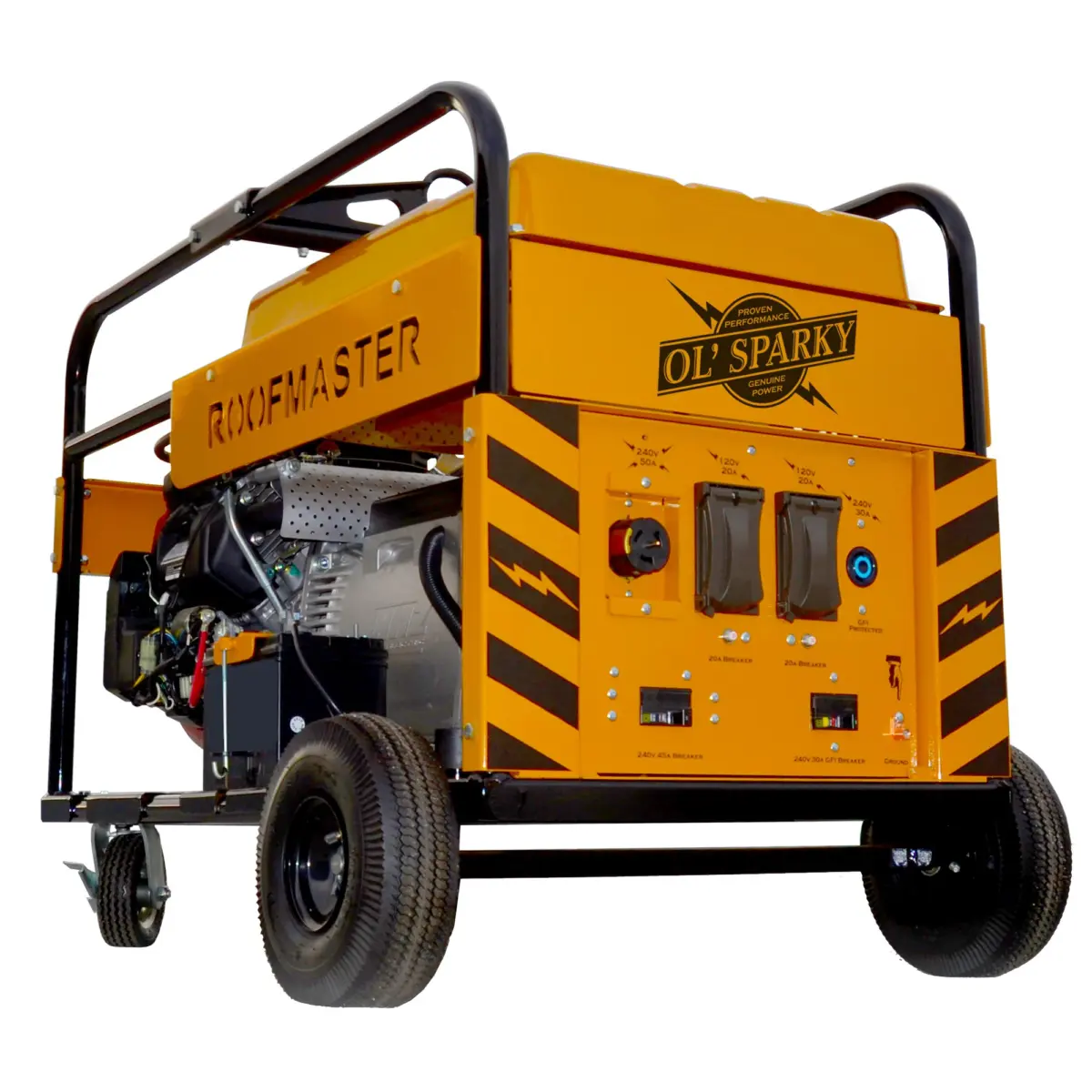
1. Main Facts: The Invisible Threat of Total Harmonic Distortion
In the industrial contracting and plastic welding sectors, a costly disconnect exists between high-end tool acquisition and power-generation infrastructure. Contractors frequently invest thousands of dollars in state-of-the-art equipment, such as Leister automatic hot-air welders, only to power them with inexpensive, consumer-grade portable generators purchased from big-box retail stores. This operational mismatch is increasingly leading to catastrophic equipment failures, costly project delays, and voided manufacturer warranties.
At the heart of this issue is an invisible electrical phenomenon known as Total Harmonic Distortion (THD).
[Pure Sine Wave (Utility Power)] ---> Ideal for Sensitive Microprocessors (<3% THD)
[Distorted Waveform (Cheap Generator)] ---> High Harmonics, Voltage Spikes (25-30% THD) ---> Component Failure
THD represents the degree to which an electrical voltage or current waveform deviates from a clean, symmetrical sinusoidal wave. Measured as a percentage, a higher THD indicates a more distorted waveform.
While rugged, mechanical tools can tolerate highly distorted power, sensitive electronic microprocessors—the brains behind modern industrial welding equipment—cannot.
According to electrical engineering standards and industrial tool manufacturers, the critical thresholds are clear:
- Consumer-Grade Generators: Portable generators commonly sold at mass-market retail outlets typically produce power with a THD range of 25% to 30%.
- Safe Electronic Threshold: To operate sensitive electronic components safely and reliably, the power supply must maintain a THD of less than 6% to 7%.
- Industrial Standard: Leading hot-air welder manufacturers specifically mandate a maximum THD of less than 6% to prevent irreversible damage to internal control boards and digital motors.
The root cause of high THD in retail generators lies in their physical construction. To maintain low retail prices, these units utilize lower-quality copper or aluminum windings within their alternators and feature rudimentary voltage regulation systems.
When paired with sensitive machinery, these generators deliver "dirty power" that causes overheating, erratic digital readings, and premature component failure.
2. Chronology: The Lifecycle of Power-Induced Equipment Failure
To understand how THD-related damage manifests on a job site, it is useful to examine the typical operational timeline of a contracting crew utilizing mismatched power equipment.
+-----------------------------------------------------------------------------+
|                                 TIMELINE                                    |
+-----------------------------------------------------------------------------+
|                                                                             |
|  [PHASE 1: Setup]                                                           |
|  High-end welder plugged into cheap 25%+ THD generator.                      |
|                                                                             |
|  [PHASE 2: Mid-Day Operations]                                              |
|  Linear tools (saws, drills) cycled on/off; voltage spikes occur.           |
|                                                                             |
|  [PHASE 3: Micro-Degradation]                                               |
|  Microprocessors overheat; control boards suffer cumulative thermal stress.  |
|                                                                             |
|  [PHASE 4: Catastrophic Failure]                                            |
|  Welder control board burns out mid-project; immediate downtime occurs.     |
|                                                                             |
+-----------------------------------------------------------------------------+
Phase 1: Initial Deployment and False Security
A contractor purchases a top-tier automatic hot-air welder for commercial roofing or geomembrane installation. To power the unit on-site, the team deploys a standard 10,000-watt open-frame portable generator bought from a local home improvement center.
Upon startup, the welder powers on, the digital display lights up, and the heating element begins to warm. To the operators, the system appears fully functional, creating a false sense of security.
Phase 2: The Introduction of Mixed Loads
As the workday progresses, other crew members plug auxiliary tools into the same generator. A worker connects a sawzall to cut flashing, another plugs in a screw gun, and a battery charging station is connected to charge cordless tool batteries.
Each time these auxiliary tools are switched on and off, they draw rapid, inconsistent surges of electrical current. Because the generator lacks sophisticated load management and high-quality alternator windings, its output voltage fluctuates wildly, compounding the already high baseline THD.
Phase 3: Silent Micro-Degradation
Inside the hot-air welder, the sensitive microprocessors, sensors, and control boards are subjected to continuous electrical noise and voltage spikes. While the welder continues to run, its internal components begin to overheat.
The harmonic frequencies force the electronic filters and capacitors to dissipate excess energy as heat. This process of micro-degradation occurs silently and invisibly over days or weeks, gradually wearing down the silicon wafers and solder joints on the circuit boards.
Phase 4: Errant Behavior and System Failure
The first physical symptoms of damage appear. The welder’s digital temperature display may flicker or show erratic temperature swings. The drive motor might stutter or struggle to maintain a constant speed, leading to inconsistent weld quality.
Eventually, the threshold of thermal and electrical tolerance is breached. The welder’s main control board suffers a catastrophic short circuit, rendering the machine completely inoperable mid-project.
3. Supporting Data: The Physics of Distorted Waveforms and Load Dynamics
To understand why THD causes such severe damage, we must look at the distinction between different types of electrical loads and how they interact with a generator’s alternator.
Linear vs. Non-Linear Loads
Electrical loads are broadly categorized into two types:
| Load Type | Description | Common Examples | Impact on Power Quality |
|---|---|---|---|
| Linear Loads | Current draw is directly proportional to the applied voltage. The waveform remains clean. | Incandescent lights, resistive heaters, basic electric motors (drills, saws). | Minimal distortion, but switching them on/off causes temporary voltage sags/surges. |
| Non-Linear | Current is drawn in abrupt pulses rather than a smooth sinusoidal wave. | Computers, LED drivers, variable speed drives, electronic hot-air welders. | Generates harmonic currents that feed back into the system, increasing THD. |
When a non-linear load (such as a Leister digital welder) is connected to a generator that already has high baseline THD, the two systems degrade each other’s performance.
Furthermore, if linear tools with high starting currents (like a heavy-duty sawzall) are operated on the same circuit, the resulting voltage dips and surges force the welder’s sensitive power supply to work twice as hard to stabilize the incoming power.
Linear Load (Resistive/Inductive)      Non-Linear Load (Electronic)
      Voltage                                Voltage
      ^                                      ^
     /      /                             /      /
    /      /                             /      /
---/------/-------->                 ---/------/-------->
  /       V                             /       V
 Current                                Current (Pulses)
      ^                                      ^
     /      /                             |||     |||
    /      /                              |||     |||
---/------/-------->                 ---/-|||----|||------>
  /       V                             /  |||   V  |||
The Role of Alternator Windings
In high-end generators, the alternator is engineered with a high "pitch factor" (often 2/3 pitch) and premium copper windings. This design specifically eliminates the third harmonic (180 Hz in a 60 Hz system), which is the primary driver of voltage distortion.
In contrast, budget generators utilize cheaper, full-pitch windings and lower-grade steel laminations, which naturally produce a highly distorted output wave under load.
Cable Impedance and Voltage Drops
The problem of high THD is often exacerbated by poor on-site power distribution. When long, undersized extension cords are used, the electrical impedance of the line increases. This impedance:
- Causes a significant voltage drop over distance.
- Distorts the voltage waveform further, increasing the THD at the tool’s plug.
- Restricts the current flow required by the welder during high-demand heating cycles.
4. Official Responses: Manufacturer Standards and Industry Expert Guidance
The industrial manufacturing sector has taken a firm stance on power quality requirements. Manufacturers of high-precision tools have updated their operating manuals and warranty policies to explicitly address generator power quality.
Manufacturer Specifications and Warranty Exclusions
Leister and other major hot-air welder manufacturers explicitly state in their technical documentation that power sources must meet stringent quality standards. Ryen Van Grol, a seasoned Territory Sales Manager in the industrial equipment sector, emphasizes that this is not a sales tactic but a fundamental engineering reality:
"I will start by saying that Total Harmonic Distortion (THD) is a REAL thing; this is not a sales pitch trying to get a customer to buy additional equipment! The acceptable percentage for THD when running equipment with electronic components should always be less than 6-7%."
Van Grol warns that relying on cheap generators is a direct threat to capital investments:
"Most hot air welder manufacturers recommend that all portable generators have a maximum THD of less than 6% to avoid any likely damage to the electronics… My advice would be if you are willing to spend good money for top-of-the-line equipment, protect your investment by purchasing the appropriate generator."
Importantly, when a damaged tool is sent to an authorized service center for repair, technicians can often diagnose power-quality failures. If the diagnostic logs reveal that the onboard microprocessor was subjected to chronic over-voltage, under-voltage, or harmonic overheating, the manufacturer reserves the right to void the warranty, leaving the contractor with a repair bill that can easily reach thousands of dollars.
+-------------------------------------------------------------+
|               POWER QUALITY CHECKLIST FOR FIELD TEAMS       |
+-------------------------------------------------------------+
|  [ ] Verify Generator THD: Must be <6% (Check manual/spec)  |
|  [ ] Isolate Welder Power: Dedicated generator for welder   |
|  [ ] Zero Mixed Loads: No saws, drills, or radios on same line|
|  [ ] Inspect Cords: Heavy-duty, outdoor-rated, minimal run   |
|  [ ] Confirm Connections: Tight, dry, locking plugs preferred|
+-------------------------------------------------------------+
The Spec Sheet Omission
A major challenge for contractors is that budget generator manufacturers rarely publicize their THD ratings. While premium brands (such as Honda’s EU series or Generac’s inverter line) proudly advertise "Clean Power" with less than 3% or 5% THD, low-cost brands often omit this metric from their retail spec sheets.
Industry experts agree: if a generator’s technical specifications do not explicitly state its THD rating, it should be assumed to be 20% or higher, making it entirely unsuitable for electronic equipment.
5. Implications: Financial, Operational, and Strategic Consequences
The practice of pairing high-end industrial tools with low-grade power sources has far-reaching consequences that extend beyond a single broken circuit board.
The True Cost of Downtime
In commercial roofing, civil engineering, and geomembrane lining, project timelines are highly sensitive to weather conditions. If an automatic welder fails on a roof or in a containment pit, operations grind to a halt. The financial impact of this downtime includes:
- Labor Costs: Crew members remain idle while waiting for a replacement tool or generator.
- Liquidated Damages: Many commercial contracts impose stiff financial penalties for missed deadlines.
- Shipping Fees: Expeditious shipping of replacement tools or parts to remote job sites can cost hundreds of dollars.
- Reputational Damage: Unreliable operations can ruin a contractor’s relationship with general contractors and clients.
The Financial Equation
To illustrate the financial risk, consider the following comparison:
Scenario A: The "Budget" Approach
High-End Welder:           $7,500
Cheap Retail Generator:    $800
Control Board Repair:      $1,800  (Out of warranty due to THD damage)
1 Day of Lost Labor:       $2,400
---------------------------------
Total Cost:                $12,500 + Project Delay

Scenario B: The Professional Approach
High-End Welder:           $7,500
Inverter/Clean Generator:  $2,500  (<3% THD)
Repair Costs:              $0      (Equipment runs reliably)
Lost Labor:                $0
---------------------------------
Total Cost:                $10,000 + On-Time Delivery
As the data shows, trying to save $1,700 on a generator can easily result in thousands of dollars in unexpected expenses, completely wiping out any initial savings.
Strategic Recommendations for Contractors
To protect their investments and ensure seamless job-site execution, contracting firms should implement the following operational standards:
- Enforce Fleet Standardization: Audit all active job sites and phase out open-frame, high-THD generators. Replace them with high-quality inverter generators or commercial-grade units equipped with clean-power alternators and Automatic Voltage Regulators (AVR).
- Establish "Dedicated Power" Protocols: Instruct field supervisors to isolate sensitive electronic welders on their own dedicated generators. Never allow high-surge tools (saws, drills, compressors) to run on the same power plant as an automatic welder.
- Implement Rigid Cable Management: Use only heavy-duty, outdoor-rated extension cords of appropriate gauge (e.g., 10 AWG or 12 AWG) and limit the length of runs to prevent voltage drop. Ensure all electrical connections are clean, tight, and dry.
- Educate Estimators and Project Managers: When bidding on projects, ensure that the cost of proper power generation equipment is factored into the equipment budget. Treat clean power as a non-negotiable project requirement, not an optional luxury.
By understanding the physics of power quality and respecting the technical limitations of modern electronics, contractors can eliminate a major source of equipment failure, protect their warranties, and secure their bottom line.
