

By Industry News Service
While the residential sector navigates the complex headwinds of shifting federal tax policies and the sunsetting of key consumer credits, the commercial geothermal HVAC market is experiencing an unprecedented wave of momentum. Bolstered by long-term federal backing through the Inflation Reduction Act (IRA)—with incentives secured through 2035—commercial developers, engineers, and HVAC contractors are driving the technology into ambitious new domains.
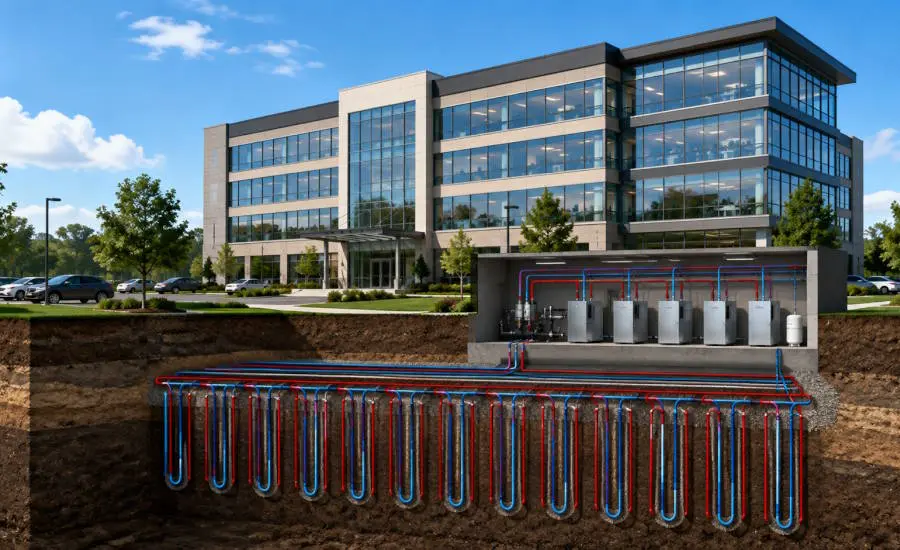
From sprawling district-style community networks and climate-controlled distribution hubs to high-density multifamily complexes and energy-intensive data centers, commercial geothermal energy has evolved from a niche, standalone alternative into a mainstream powerhouse of modern architectural engineering.
Industry leaders point to a confluence of favorable regulatory frameworks, technological scaling, and pressing environmental and thermal demands as the primary catalysts for this sustained upswing. As developers look for resilient, highly efficient mechanical systems capable of cutting operating carbon and insulating projects from utility volatility, commercial geothermal is proving to be a cornerstone of the future built environment.
Main Facts: The State of Commercial Geothermal
The commercial geothermal landscape is defined by robust financial backing, shifting applications, and a changing technological toolkit. While residential adoption has hit friction due to expiring consumer-facing federal incentives, the commercial pipeline remains robust and well-funded.
- Extended Federal Support: Key tax incentives established under the Inflation Reduction Act remain securely in place until 2035, providing the long-term regulatory certainty developers and financial backers require to greenlight capital-intensive infrastructure projects.
- Radical Incentive Expansion: Prior to 2023, commercial geothermal installations typically qualified for a modest 10% tax credit. Under current legislative structures, baseline incentives range from 30% to as high as 50%, dramatically lowering project cost barriers and accelerating return-on-investment (ROI) timelines.
- Emerging Sectors: Traditional commercial markets—such as office buildings, K-12 schools, and universities—are now being augmented by explosive growth in e-commerce distribution centers, high-end condominiums, and modern data centers.
- Domestic Manufacturing Resilience: Supply chain stability and tariff mitigation have become crucial factors for contractors. Prominent manufacturers, including ClimateMaster, have consolidated their production lines domestically—such as at their primary facility in Oklahoma City—offering contractors a distinct advantage in navigating global supply uncertainties.
Chronology: The Evolution of Commercial Geothermal Incentives and Scale
To understand how the commercial geothermal sector reached its current stride, it is necessary to examine the historical trajectory of policy, market adoption, and engineering evolution over the past decade.
Pre-2023: The 10% Era and Fragmented Markets
For years, geothermal energy struggled for widespread commercial dominance outside of specialized institutional settings like universities and municipal buildings. Federal tax credits for commercial installations sat stubbornly at a baseline of 10%. Without substantial financial offsets, convincing developers to take on the upfront capital costs of drilling vertical loop fields and integrating complex water-source heat pump systems required extensive amortization projections. Projects took years to materialize, and the market remained primarily regional, dependent on early-adopter clients and forward-thinking engineering firms.
2022–2023: The Legislative Turning Point
The passage of the Inflation Reduction Act marked a watershed moment for the renewable heating and cooling industry. By restructuring clean energy tax credits with robust prevailing wage and apprenticeship bonuses, the legislation elevated commercial geothermal incentives to a baseline of 30%, with potential escalators reaching up to 50% for projects meeting specific domestic content and location criteria. Crucially, the legislation was designed with a multi-year runway, giving the engineering and contracting community the regulatory runway needed to scale up infrastructure, invest in heavy drilling equipment, and train specialized labor forces.
2024–2026: District-Scale Integration and New Frontiers
Armed with predictable financial incentives, developers began to rethink the physical scale of geothermal installations. Moving away from single-building loops, the market entered an era of district-scale, community-shared networked geothermal systems. Concurrently, rapid economic shifts—such as the e-commerce boom and the artificial intelligence data surge—pushed commercial geothermal into heavy industrial distribution facilities and data processing plants. Today, the market stands on the cusp of widespread mainstream adoption, backed by a mature supply chain and a specialized contractor network.
Supporting Data: Market Metrics and Technical Realities
The growth of commercial geothermal is underscored by striking metrics regarding energy consumption, financial payback, and thermal adaptability.
The Data Center Energy Crisis
The explosive proliferation of data centers across the United States has strained local electrical grids and sparked fierce community pushback. According to data from the Department of Energy’s Geothermal Technologies Office (GTO), total U.S. data center electricity consumption more than doubled in a five-year span, climbing from 1.9% in 2018 to 4.4% in 2023. Projections indicate that consumption will skyrocket to an astonishing 12% by 2028.
As local municipalities increasingly halt, protest, or outright ban new data center constructions due to excessive fossil-fuel-reliant power draws, developers are turning to geothermal energy as an innovative thermal management solution to drastically reduce grid reliance for cooling.
Exceptional Payback Periods
Despite the initial capital expenditure associated with subsurface drilling, the long-term operational savings are profound. Contractors specializing in commercial geothermal frequently report rapid amortization of upfront costs. Industry veterans note that commercial clients routinely achieve full return on investment through energy savings within a remarkably short window, with many systems realizing complete payback in just one year of operation.
Overcoming Geographic and Climatic Myths
A persistent misconception in the HVAC industry is that geothermal energy is viable only in northern latitudes or regions with consistently cold subterranean temperatures. Technical experts emphasize that geothermal loops operate effectively in virtually any climate by utilizing the earth’s stable underground thermal mass as a massive heat sink or source.
Engineers have successfully deployed high-efficiency geothermal cooling systems in extreme environments such as the Desert Southwest, where local ground temperatures can reach 84°F to 85°F. These pure cooling applications prove that closed-loop and open-loop geothermal configurations can reject heat efficiently even in the world’s hottest climates.
Official Responses and Expert Perspectives
Industry leaders and corporate executives driving the geothermal sector emphasize that the current market environment represents a once-in-a-generation alignment of policy, technology, and economic demand.
Dan Ellis, CEO of Climate Control Group, highlights the stark contrast between the residential and commercial sides of the business.
"The commercial side of the business has not changed. And there is a lot of momentum in that sector of the business so it’s on the upswing. I think it will continue to go up as there’s wider adoption," Ellis stated.
Reflecting on his years working within contracting businesses that specialized in commercial geothermal, Ellis noted the extraordinary financial performance experienced by end-users:
"We specialized in geothermal and we did a lot of commercial. It was more than half the business and all our customers were getting one-year paybacks on their systems."
Ellis attributes the unprecedented expansion of the market directly to federal policy structure and the intentional long-term timeline of the legislation:
"The whole reason for the long runway for the Inflation Reduction Act was to provide a long enough runway to develop the commercial infrastructure. Before 2023, the commercial incentives were 10%. That was it. Nothing else. Now it’s 30, 40, 50%. More people are getting involved. More infrastructure is being developed. It’s going to bring the cost of the systems down."
Addressing the evolution of building types embracing the technology, Ellis points out that the scope of applications has widened significantly:
"We are expanding our capability in the commercial marketplace. We’re reaching new sectors that we hadn’t reached. Distribution centers were one. More and more, distribution centers are wanting to maintain temperature and humidity for the comfort of the people in them."
Mike Kapps, regional sales manager with Climate Control Group, points to the technical versatility of geothermal systems as a key driver for geographic expansion outside traditional cold-weather markets:
"I’ve done geothermal applications in the desert southwest … where the ground temperature was 85 degrees. There are pure cooling applications [that] have been done with geothermal. I mean, you can do geothermal in the hottest parts of the world."
Implications: What This Means for Contractors, Developers, and the Future
The rapid maturation of the commercial geothermal market carries profound implications for the HVAC industry, commercial real estate developers, and the broader push toward decarbonized infrastructure.
Opportunities for HVAC Contractors
For commercial HVAC contractors, the expanding market translates into a steady, long-term pipeline of complex, high-value projects. Unlike quick residential equipment changeouts, commercial geothermal installations involve extensive collaboration with civil engineers, hydronic specialists, and drilling crews. Contractors who invest in training their teams on loop design, thermal conductivity testing, and advanced water-source heat pump integration will find themselves positioned at the forefront of a lucrative sector.
Furthermore, the rise of domestic manufacturing offers a distinct competitive edge. With companies like ClimateMaster consolidating product manufacturing in facilities like their Oklahoma City plant, contractors can bypass the logistical nightmares, import delays, and unpredictable tariff fluctuations associated with overseas supply chains. This "Made in America" advantage ensures predictable pricing and reliable equipment delivery schedules for large-scale developments.
Transforming Urban and Suburban Landscapes
The shift toward district-style network systems is fundamentally altering how communities think about utility infrastructure. By interconnecting geothermal loops across college campuses, mixed-use commercial districts, and high-density urban neighborhoods, developers can share thermal loads dynamically. A building requiring heavy cooling can reject its excess heat into the shared loop, where another building requiring space heating can draw it out. This thermal balancing act maximizes system efficiency on a macro scale.
Solving the Distribution and Humidity Challenge
In the booming e-commerce and logistics sector, temperature and humidity control are paramount. Ellis points out an under-recognized challenge unique to modern distribution hubs: the vulnerability of corrugated cardboard packaging.
"One under-recognized issue with distribution centers is how the amount of cardboard affects comfort. When natural ventilation takes place, that brings in humidity and cardboard gets soft. That is not good for product quality. This means many opportunities for HVAC geothermal contractors."
By implementing precise, geothermal-driven climate control systems in distribution warehouses, operators not only ensure human comfort and worker retention but also safeguard inventory integrity against humidity degradation.
A Viable Path for Multifamily and Condominiums
Historically, multifamily geothermal applications were largely restricted to rental apartment complexes where central ownership could absorb capital expenses. Today, thanks to improved financial incentives and flexible modular equipment configurations, geothermal is becoming a highly attractive, premium option for high-end residential condominiums. Homeowners and associations are increasingly prioritizing low carbon footprints, quiet operations, and significantly reduced monthly utility bills.
Conclusion: A Long-Term Runway for Growth
As the United States continues to grapple with the dual challenges of grid modernization and corporate decarbonization, commercial geothermal energy stands out as a proven, highly efficient, and heavily subsidized solution. Backed by federal tax incentives extending through 2035, an expanding repertoire of building applications—from vast distribution hubs and data centers to urban campus networks—and a resilient domestic manufacturing base, the commercial geothermal sector has solidified its status as an indispensable pillar of modern HVAC engineering. For contractors and developers alike, the underground is no longer an unknown frontier, but the foundation of tomorrow’s sustainable economy.
