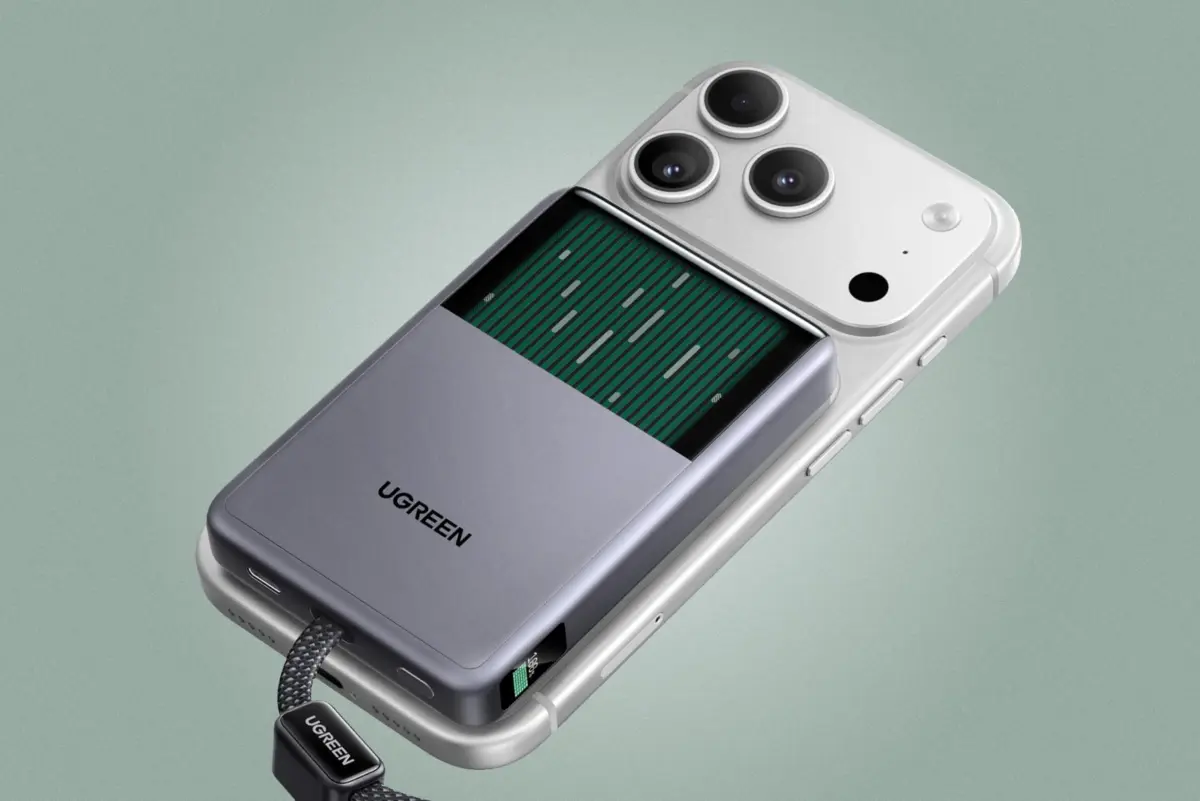
In the fast-paced world of mobile accessories, manufacturers are constantly seeking innovative ways to stand out in a saturated market. While power banks have traditionally relied on passive heat dissipation methods—such as aluminum casings, graphite sheets, and basic thermal pads—thermal throttling and excessive heat generation remain persistent issues, particularly during high-wattage wireless charging.
Enter Ugreen, a prominent name in consumer electronics and charging solutions, which has officially shaken up the accessory landscape. The company has launched the MagFlow Pro Qi2 25W Magnetic Power Bank, a device that introduces a feature once reserved for high-end gaming PCs and professional-grade laptops: active liquid cooling.
Available starting today for $149.99, the MagFlow Pro sits comfortably at the absolute premium end of the portable charger spectrum, especially considering its modest 10,000mAh capacity. However, Ugreen is betting that tech enthusiasts, early adopters, and power users will gladly pay a premium for what it claims is the world’s first liquid-cooling system integrated into a wireless-charging power bank.
1. Main Facts: What is the Ugreen MagFlow Pro?
The Ugreen MagFlow Pro is a 10,000mAh magnetic wireless power bank designed primarily for modern smartphones equipped with MagSafe or Qi2 compatibility. However, its headlining feature is its proprietary CryoPulse technology, an active liquid-cooling system engineered to manage thermal output during high-speed energy transfer.
Key Specifications and Features:
Capacity: 10,000mAh (sufficient for roughly 1.5 to 2 full smartphone charges, depending on the device).
Cooling System: "CryoPulse" active liquid-cooling featuring a microscopic internal micro-pump and a visible coolant reservoir dubbed the "Cyber Window."
Wireless Charging: Qi2.2-compatible magnetic wireless charging pad capable of delivering up to 25W of power.
Wired Output: Up to 45W max output delivered via an integrated USB-C cable lanyard or an auxiliary USB-C port.
Price: $149.99 USD, available via Ugreen’s official storefront and major online retailers like Amazon.
Despite its relatively high price-per-milliamp-hour ratio, the inclusion of a closed-loop liquid cooling circuit, physical thermal separation design, and rapid wired capabilities reposition the traditional power bank from a simple brick of lithium-ion cells into an advanced piece of consumer tech hardware.
2. Chronology: The Evolution of Thermal Management in Mobile Power
To understand why the MagFlow Pro represents a milestone in accessory engineering, it helps to examine how the portable power market has evolved over the past decade.
Early Days: Passive Safety and Basic Cells (2010–2018)
In the early era of external batteries, focus was placed almost exclusively on capacity and port safety. Standard USB-A outputs governed the landscape, and power banks were bulky, slow, and prone to gradual degradation. Heat management was entirely passive; manufacturers relied on the ambient air and simple plastic or aluminum outer shells to bleed off excess thermal energy. Fast-charging standards like Qualcomm Quick Charge began pushing higher wattages, leading to noticeable warmth during operation, but active cooling was deemed unnecessary for pocket-sized devices.
The Wireless Shift and MagSafe Era (2020–2024)
Apple’s introduction of MagSafe in 2020 popularized magnetic wireless alignment for mobile devices, soon followed by the development of the open Qi2 standard. While magnetic wireless charging offered unmatched convenience, it introduced a significant physics problem: energy loss through inductive heat transfer.
When power is transferred wirelessly, a portion of that energy is inevitably converted into heat rather than electricity. This thermal buildup causes smartphones to throttle their charging speeds to protect their internal lithium-ion batteries. Consequently, users frequently experienced lukewarm or hot phones that stopped charging mid-commute due to thermal protection safeguards.
The CryoPulse Breakthrough (2026)
Recognizing that wireless speeds were being bottlenecked by thermal constraints, Ugreen’s engineering teams spent years conceptualizing a miniature thermal loop. By miniaturizing liquid-cooling pumps traditionally found in desktop computers, the company successfully integrated a functional water block and pump into a form factor small enough to snap onto the back of a smartphone. The result is the MagFlow Pro, marking a structural shift from passive cooling to active liquid circulation in mobile power accessories.
3. Supporting Data: Breaking Down the Tech and Economics
A deeper look at the internal components and financial metrics of the MagFlow Pro reveals both impressive engineering choices and stark market positioning realities.
How CryoPulse Works
Inside the chassis of the MagFlow Pro lies a micro-pump system. This pump continuously circulates a specialized dielectric coolant through micro-channels positioned directly beneath the Qi2.2 wireless charging coil.
Heat Transfer: As the coil generates heat during the inductive charging process, the liquid absorbs the thermal energy and carries it away from the primary contact zones.
The Cyber Window: To reassure users that the system is active—and to lean into the aesthetic preferences of modern tech consumers—Ugreen has included a transparent panel on the front face of the device. Users can physically watch the fluid move through the circuit.
Secondary Thermal Defenses: The liquid loop does not work alone. It is supplemented by sheets of high-conductivity copper foil and an internal structural layout that physically separates the battery cells from the high-temperature wireless charging components.
The Cost-to-Capacity Equation
Priced at $149.99 for a 10,000mAh cell, the MagFlow Pro occupies a unique financial tier. Traditional 10,000mAh magnetic power banks—even those featuring premium builds and Qi2 certification—typically retail between $40 and $70.
Feature Category
Standard 10,000mAh Power Bank
Ugreen MagFlow Pro
Average Price
$45 – $65
$149.99
Cooling Method
Passive (Air, Aluminum, Graphite)
Active (Micro-pump liquid cooling)
Max Wireless Output
15W (Standard Qi2)
Up to 25W (Proprietary/Optimized Qi2.2)
Max Wired Output
20W – 30W
Up to 45W
Extra Hardware
Basic USB-C cable included
Integrated USB-C cable lanyard
This data illustrates that buyers are paying roughly a 100% markup over standard premium power banks. The additional cost directly subsidizes the R&D, manufacturing complexity, and miniaturized hardware required to implement liquid cooling in a handheld enclosure.
4. Official Responses and Industry Context
Ugreen’s launch has naturally drawn attention from across the consumer tech landscape, sparking conversations about whether liquid cooling will become the industry standard for high-wattage mobile accessories.
In promotional statements accompanying the launch, Ugreen representatives emphasized that the primary motivation behind CryoPulse technology was not merely marketing novelty, but longevity and safety.
"High temperatures are the silent killer of both portable power banks and modern smartphones," a Ugreen product spokesperson noted during the initial product briefing. "By actively drawing thermal energy away from the charging interface, we not only sustain higher power delivery—up to 25W wirelessly—but we drastically reduce the thermal stress that degrades lithium-ion chemistry over hundreds of charge cycles."
Industry analysts have responded with a mix of fascination and caution. While hardware reviewers have praised the novelty and aesthetic appeal of the "Cyber Window" and the clever dual-purpose USB-C cable lanyard, some have questioned whether the average consumer is willing to pay $150 for a 10,000mAh battery simply to keep their phone cool.
Competitors in the fast-charging space—such as Anker, Baseus, and Sharge—have increasingly leaned into active air-cooling (utilizing tiny, high-RPM cooling fans) for desktop charging stations and high-capacity power banks. Ugreen’s pivot toward liquid cooling represents an alternative philosophical approach: silent operation over forced-air ventilation, leveraging fluid dynamics instead of mechanical fans.
5. Implications: What the MagFlow Pro Means for the Future of Mobile Charging
The release of the Ugreen MagFlow Pro serves as a bellwether for the mobile accessories market. As smartphones continue to demand higher input wattages to minimize tethered time, thermal management has transitioned from a backend engineering detail into a frontline consumer feature.
1. The Normalization of Active Cooling in Mobile Accessories
For years, active cooling was strictly associated with high-performance gaming phones like the ASUS ROG Phone series, which often featured clip-on external fan attachments. Ugreen’s implementation proves that advanced thermal solutions can be successfully shrunk down and commercialized for everyday accessory ecosystems. If the MagFlow Pro proves commercially viable, expect rival manufacturers to introduce their own iterations of liquid-cooled or advanced active-cooled power solutions.
2. Battery Longevity Benefits
The hidden value proposition of the MagFlow Pro lies in its potential to extend battery health. High heat during fast wireless charging is a primary catalyst for battery degradation in modern smartphones, leading to diminished daily battery life within 12 to 18 months of device usage. By maintaining a lower operating temperature during wireless charging sessions, devices paired with the MagFlow Pro may experience reduced chemical wear over time.
3. The Shift Toward Premium, Niche Hardware
At $149.99, Ugreen is carving out a ultra-premium tier that bridges the gap between everyday utility tools and enthusiast-grade gadgets. Much like mechanical keyboards or custom-loop PC builds, the MagFlow Pro appeals to consumers who appreciate over-engineered solutions, transparent industrial designs ("cyber aesthetics"), and bleeding-edge specifications.
Final Thoughts
Whether the Ugreen MagFlow Pro Qi2 25W Magnetic Power Bank becomes a mainstream success or remains a fascinating niche product for tech enthusiasts, it successfully pushes the envelope of what portable chargers can achieve. By solving one of wireless charging’s most stubborn physical limitations through miniature liquid cooling, Ugreen has set a new benchmark for thermal engineering in the mobile accessory space.