

By the Pro Tool Reviews Editorial Team
Main Facts: The Great RPM Debate in Cordless Cutting
When evaluating the latest generation of heavy-duty cordless circular saws, a noticeable disparity emerges on specification sheets. A deep dive into recent head-to-head testing data collected by lead tester Tom reveals a wide range of no-load revolutions per minute (RPM) ratings across the industry’s most popular brands. This variation immediately begs a fundamental question for professional contractors, carpenters, and serious woodworkers: How much do RPMs actually matter when it comes to real-world cutting performance?
Conventional math suggests that higher blade speeds equal faster cuts. However, rigorous, controlled testing demonstrates that raw speed alone tells only half the story. While no-load RPM sets the theoretical baseline, a saw’s ability to maintain that speed under heavy friction—governed entirely by its motor’s torque—is the true engine of job-site productivity.
Ultimately, while top-tier manufacturers like Milwaukee and Metabo HPT dominate the leaderboard with high RPMs and immense torque, even lower-ranking models in professional lineups easily outpace legacy 15-amp corded saws, fundamentally shifting how trade professionals should view power tool specifications.
Chronology: Putting Circular Saws to the Test
To understand how speed interacts with actual cutting power, the Pro Tool Reviews testing team established a rigorous, repeatable methodology designed to strip away human error and isolate mechanical performance.
Phase 1: Designing the Test Rig
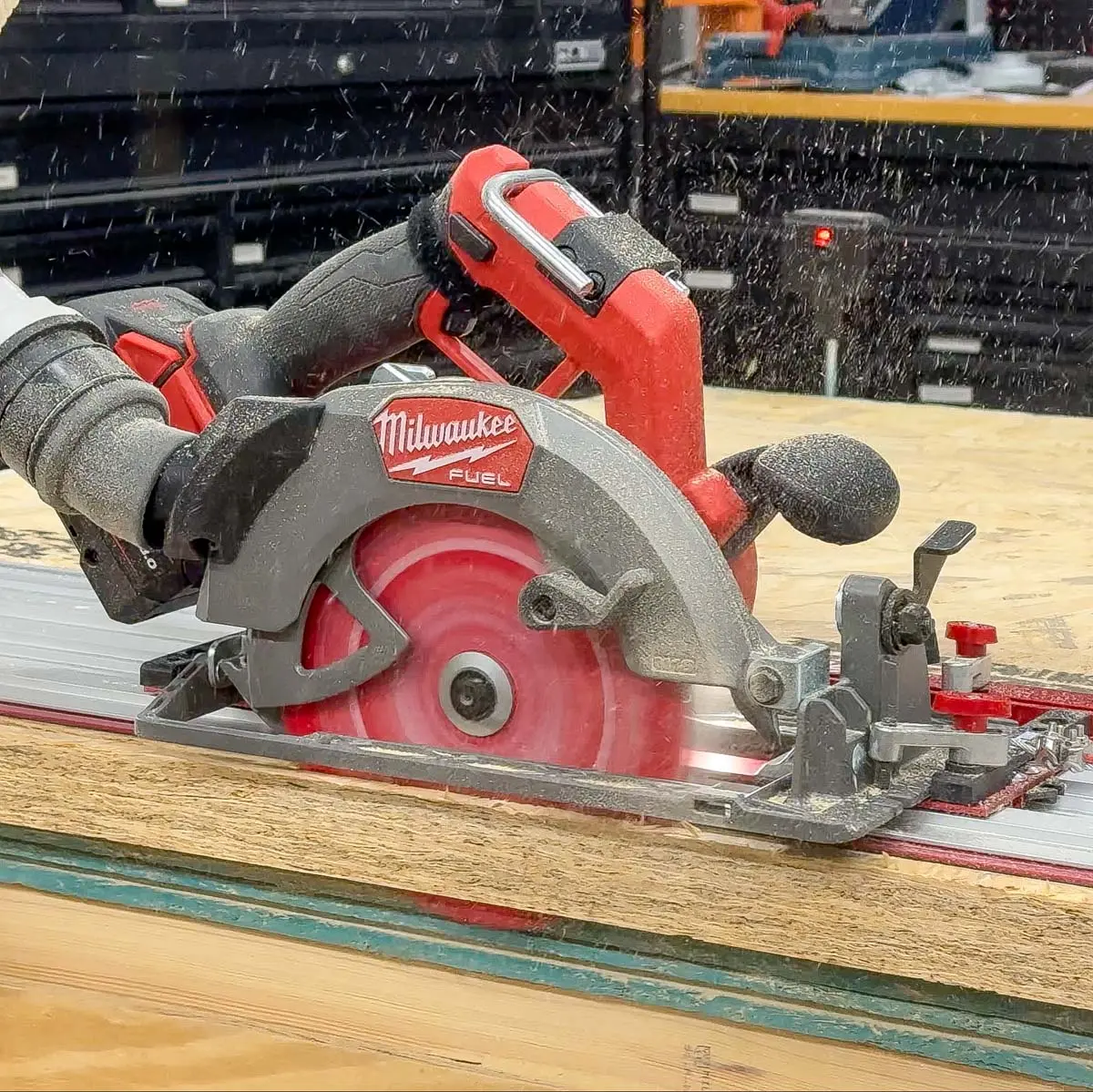
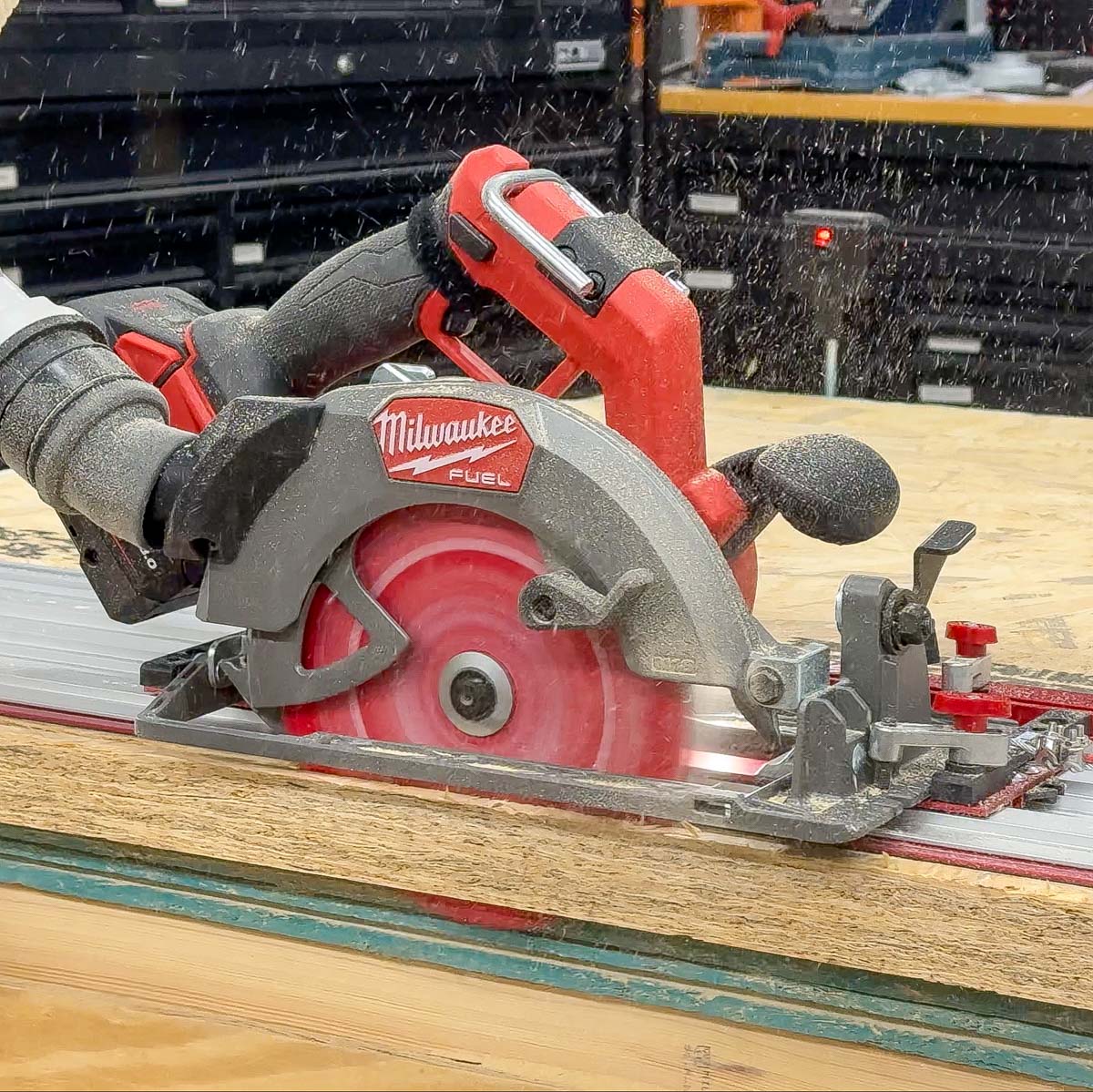
Rather than relying on freehand cuts—which introduce variables like hand pressure, feed rate, and user fatigue—tester Tom engineered a specialized testing rig.
- The Setup: Each participating cordless circular saw was securely mounted onto a standardized sled and track system.
- The Drive: Instead of a human pushing the tool, a consistent 10-pound weight pulled the sled forward, ensuring uniform downward and forward pressure across every single test.
Phase 2: Simulating Job-Site Stress
The material chosen for the evaluation was two stacked sheets of 3/4-inch OSB (Oriented Strand Board) subfloor. This specific material selection served a precise purpose:
- It creates significant motor drag and thermal stress.
- It accurately mirrors demanding field applications without fully burying or choking the blade, providing a realistic stress test for a professional-grade saw.
Phase 3: Laser-Triggered Timing
To eliminate the human reaction-lag inherent in handheld stopwatches, the team implemented a precision laser-triggered timing system. Because of the physical placement required for the laser sensors, the test course was mapped to a standardized 7-foot rip cut (just shy of a full 8-foot sheet). Every saw was pushed through multiple passes, and the fastest recorded time for each model was officially logged.
Supporting Data: Head-to-Head Performance Results
The results of the 7-foot OSB rip-cut test challenge several long-held assumptions about how RPM ratings translate into speed. Below is the complete performance breakdown of the 12 popular cordless circular saws tested, paired with their manufacturer-rated no-load speeds:
| Circular Saw Model | Fastest 7-Foot Rip Time | Rated No-Load RPM |
|---|---|---|
| Milwaukee 2834 | 9.76 seconds | 6000 RPM |
| Metabo HPT C3607DB | 10.10 seconds | 6000 RPM |
| Flex FX2141 | 13.35 seconds | 5800 RPM |
| Makita GSH01 | 13.53 seconds | 6000 RPM |
| Hilti SC 30WR-22 | 13.75 seconds | 4700 RPM |
| Ryobi PBLCS302 | 14.10 seconds | 5000 RPM |
| Kobalt KXCS 124B-03 | 14.87 seconds | 5500 RPM |
| DeWalt DCS578 | 15.53 seconds | 5800 RPM |
| Skil CR5440B-00 | 16.70 seconds | 5300 RPM |
| Craftsman CMCS551 | 17.67 seconds | 5000 RPM |
| Ridgid R8657 | 18.72 seconds | 5400 RPM |
| Bosch GKS18V-25N | 19.64 seconds | 5000 RPM |
Official Industry Insights and Analysis
A closer examination of the data reveals fascinating anomalies that dismantle the idea that "higher RPM always equals faster cutting." Two primary analytical concepts emerge from the findings: Speed vs. Torque Dynamics and The Specification Sheet Problem.
Speed Plus Torque: The Real Cutting Equation
Naturally, RPMs matter to a degree—a stationary blade cannot cut wood. To put it in extreme terms, a saw operating at 1 RPM would make virtually zero headway. Therefore, a baseline operational velocity is mandatory.
The math behind tooth engagement also seems to support high RPMs:
- A standard 24-tooth framing blade engages the material 24 times for every complete revolution.
- At 5000 RPM, those teeth strike and clear material 120,000 times per minute ($5,000 times 24$).
- At 5800 RPM, the tooth-strike frequency leaps to 139,200 times per minute—a theoretical 16% increase in cutting frequency.
However, the field test data tells a more nuanced story. Hilti’s entry (SC 30WR-22) featured the lowest no-load speed in the entire group at 4700 RPM, yet it punched above its weight class to secure 5th place overall with a time of 13.75 seconds. Conversely, saws like the Kobalt KXCS and DeWalt DCS578 boasted high no-load speeds (5500 and 5800 RPM, respectively) but trailed behind competitors with lower nominal ratings.
Why does this happen?
Just as power tool experts observe with cordless drills and impact drivers, torque is the counter-balance to speed. While high RPMs allow a saw to scream through light, thin stock effortlessly, entering dense material like double-layered OSB creates immense friction.
When a saw lacks sufficient torque, its blade speed plummets under load. Therefore, actual blade speed under load—dictated by motor torque—is far more indicative of real-world productivity than advertised no-load RPM.
The Spec Sheet Dilemma
For categories like drills, impact drivers, and impact wrenches, manufacturers routinely publish maximum torque figures (measured in inch-pounds or foot-pounds), giving buyers a quantitative metric for comparison.
Unfortunately, circular saws lack a standardized, universally accepted torque specification across the industry. While some brands—such as DeWalt—have occasionally published power output ratings in watts, this is not an industry-wide practice. Consequently, consumers are left trying to judge a saw’s under-load performance using only its empty-air no-load RPM speed. This lack of standardization is not due to manufacturer negligence, but rather the immense technical challenge of testing circular saw torque under load in a reliable, repeatable way.
Implications: What This Means for Professional Tradespeople
For contractors and carpenters investing hard-earned capital into battery platforms, interpreting these findings requires a shift in purchasing strategy. Based on comprehensive testing and field observations, trade professionals should consider three key takeaways:
1. Buy Into the Ecosystem, Not Just the Tool
A single high-performing circular saw should never dictate your entire cordless lineup. Modern professional battery platforms (whether 18V, 20V, or multi-voltage systems like 36V/40V) must be evaluated on their breadth. A comprehensive platform that powers your drills, nailers, lights, and specialty tools reliably is ultimately more valuable than owning a marginally faster circular saw that locks you into an inferior ecosystem.
2. Invest in Flagship Models
When selecting a circular saw within your chosen brand ecosystem, look toward the top tier of their catalog. While flagship models command a higher price tag, they invariably feature superior brushless motors, advanced electronic overload protection, and higher torque delivery. Whether you prefer a standard baseplate or a track-saw-compatible shoe, buying the brand’s premier cutting tool ensures you get peak thermal efficiency and cutting speed.
3. Cordless Has Officially Conquered Corded
Perhaps the most crucial takeaway for modern construction professionals is that almost every major Pro-grade cordless circular saw now outperforms legacy 15-amp corded saws.
Even if a specific brand’s flagship model lagged slightly behind Milwaukee or Metabo HPT in our controlled tests—such as DeWalt’s respectable showing—the sheer convenience of untethered operation combined with modern lithium-ion power delivery provides undeniable, real-world productivity gains over dragging extension cords across a muddy job site.
What has your personal experience on the job site taught you about saw speeds and motor power? Do you prioritize high RPMs or heavy torque? Let us know your thoughts in the comments below!
