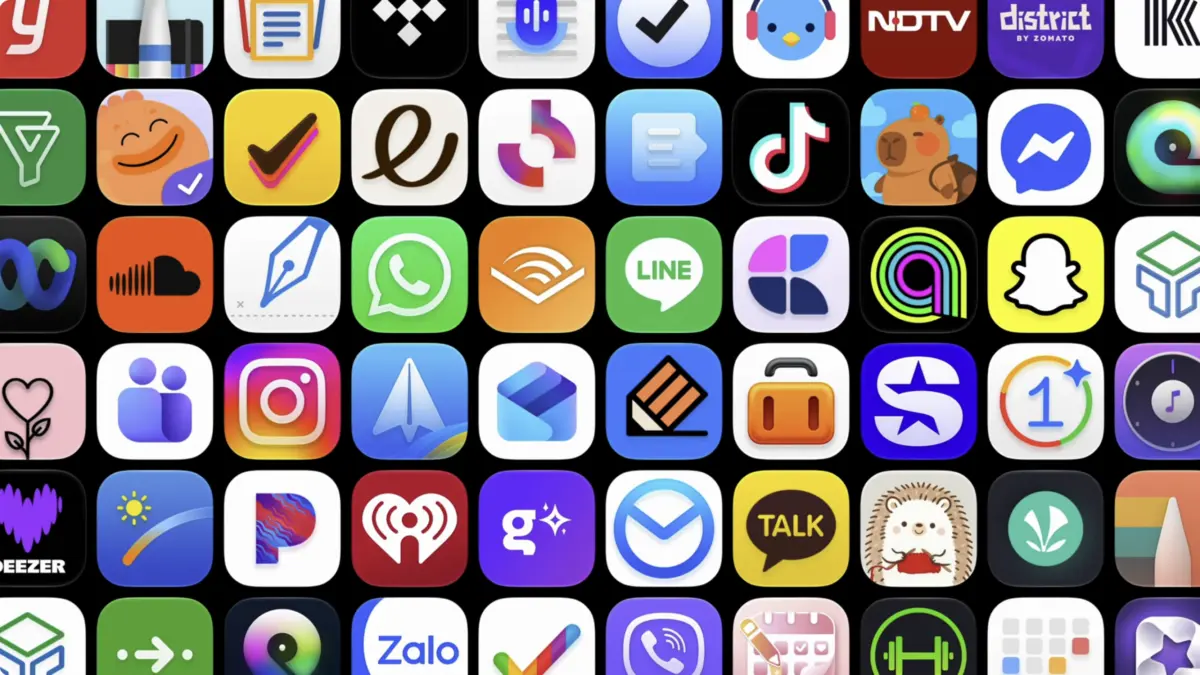
Apple’s long-awaited annual September special event brought a tsunami of hardware and software announcements, but beneath the glossy exterior of new iPhones and foldables lay a quieter, more profound revolution: the maturation of Siri AI. Apple dedicated a substantial portion of its keynote to detailing the sweeping capabilities of its next-generation digital assistant, emphasizing a feature that bridges the gap between Apple’s proprietary ecosystem and third-party developers: deep, context-aware app integration.
During the keynote, Apple highlighted that Siri AI “already works seamlessly with over 300,000 apps.” Among the third-party platforms singled out for demonstration was Stuff, a popular cross-device productivity application designed for iPhone, iPad, and Mac.
The demonstration showcased Siri’s newfound ability to parse visual on-screen context, cross-reference it with broad-world knowledge, and execute complex, multi-step actions inside third-party apps. For instance, a user viewing a recipe on their screen can command Siri to analyze the ingredients, cross-reference them with what is missing, and automatically update a grocery list inside the Stuff app—all without the user manually opening the application or typing a single word.
Beyond Stuff, Apple confirmed that Siri AI’s expanded application programming interface (API) architecture seamlessly connects with a robust suite of mainstream and niche third-party tools, including Audible, WhatsApp, Outlook, Notability, and Tripsy. This ecosystem-wide rollout coincides with the debut of Apple’s most ambitious hardware lineup to date, including the groundbreaking foldable iPhone Duo, the flagship iPhone 18 Pro and Pro Max, the Apple Watch Series 12, the Apple Watch Ultra 4, and the AirPods 5.
Chronology
To fully understand how Apple arrived at this milestone of AI-driven third-party integration, it is necessary to trace the timeline of Siri’s evolution, the development of productivity tools like Stuff, and the sequence of events that unfolded during the September showcase.
The Long Road to Conversational Context (2011–2023)
October 2011: Apple introduces Siri alongside the iPhone 4S as a groundbreaking voice-controlled assistant. Initially, its capabilities are largely siloed, handling basic tasks like setting alarms, sending text messages, and performing simple web searches.
2016–2019: Recognizing the need for expansion, Apple opens SiriKit to developers, allowing basic third-party integrations for ride-sharing, messaging, and payments. However, user experiences remain clunky, often requiring exact phrasing and rigid command structures.
2024–2025: As generative artificial intelligence reshapes the tech landscape, Apple pivots toward on-device foundational models and advanced context awareness, laying the groundwork for a complete overhaul of its operating systems.
The Hardware and Software Buildup (Spring–Summer 2026)
May–July 2026: Rumors swirl across the tech industry regarding Apple’s upcoming "Apple Intelligence" framework, with developers receiving early beta SDKs allowing deep, native interaction between large language models (LLMs) and local app databases.
Late August 2026: Productivity apps like Stuff optimize their software architectures to leverage Apple’s new visual parsing and natural language processing APIs, preparing for systemic integration ahead of the autumn hardware cycle.
The September Keynote Unveiling (Wednesday, September Event)
The Opening Showcase: Apple kicks off its annual September event by revealing its hardware crown jewels: the foldable iPhone Duo and the highly anticipated iPhone 18 Pro and Pro Max.
The AI Deep Dive: Mid-way through the presentation, engineering executives transition to software, detailing the capabilities of Siri AI. Apple demonstrates on-screen contextual awareness, showing how Siri interacts natively with over 300,000 apps.
The Stuff Spotlight: Apple explicitly highlights the productivity app Stuff, demonstrating how voice and visual cues can dynamically build organized to-do lists, grocery items, and deadlines.
Hardware Ecosystem Expansion: The event concludes with the unveiling of the Apple Watch Series 12, Apple Watch Ultra 4, and AirPods 5, all engineered with low-latency hardware links to process Siri AI commands locally and via the cloud.
Supporting Data
The integration of Siri AI with third-party applications is underpinned by a robust set of features, pricing structures, and ecosystem metrics that highlight the utility of apps like Stuff in the modern mobile workflow.
Inside the "Stuff" App Ecosystem
Core Functionality: Stuff is a multi-platform productivity tool built for Apple ecosystems (iPhone, iPad, and Mac) that transforms unstructured thoughts, voice commands, and physical notes into actionable to-do lists, deadlines, and project plans.
Listen Mode: Powered by Siri AI compatibility, Listen Mode allows users to speak freely. The app recognizes tasks, action items, and calendar dates from natural speech, compiles them into a structured list, and prompts the user for a final review before saving.
Scan Mode & Handwriting Recognition: Utilizing the advanced camera systems found on devices like the iPhone 18 Pro, Stuff can scan handwritten notes—whether formatted as bullet points or dense paragraphs. The app’s OCR (Optical Character Recognition) engine isolates actionable items, automatically flagging time-sensitive words such as "today" or "next week" to assign intelligent deadlines.
Collaboration Metrics:
Free Version: Allows collaboration with up to 5 users simultaneously.
Paid Tier ($3/month or $30/year): Expands group collaboration to up to 25 people, while unlocking advanced features like Listen Mode and Scan Mode. Real-time editing ensures all participants can make simultaneous updates to shared vacation plans, birthday lists, or grocery runs.
The Broader Siri AI Ecosystem
App Compatibility Scope: Over 300,000 third-party apps feature out-of-the-box integration with the updated Siri architecture.
Key Partner Apps Mentioned: Audible (audiobook management), WhatsApp (messaging and media control), Outlook (enterprise communication), Notability (digital note-taking), and Tripsy (travel and itinerary planning).
Hardware Compatibility Matrix: Siri AI capabilities are deeply integrated across the newly announced iPhone Duo, iPhone 18 Pro/Pro Max, Apple Watch Series 12, Apple Watch Ultra 4, and AirPods 5, utilizing a hybrid of on-device neural processing units (NPUs) and secure cloud infrastructure.
Official Responses
Apple’s executive team and the developers behind the newly spotlighted applications have shared detailed perspectives on what this massive integration means for the future of consumer technology.
During the September event, Apple’s presentation emphasized user-centric agency and contextual fluidity:
"You can let Siri see what you see, and combine it with up-to-date broad-world knowledge to answer your questions. Add the rest of the ingredients I’ll need to my grocery list, and Siri can take action in the apps you already use, including third-party apps like Stuff."
The development team behind Stuff released an official statement via their web portal detailing how natural language processing changes task management:
"Stuff will recognize tasks and dates from your speech and present them as a list. You can review and edit the tasks before saving them."
Industry analysts watching the keynote noted that Apple’s decision to elevate smaller, highly specialized indie productivity apps like Stuff—alongside enterprise giants like Microsoft Outlook and Meta’s WhatsApp—signals a democratized approach to its AI ecosystem. Rather than forcing users into native Apple applications like Reminders or Notes, Apple is positioning Siri as a universal orchestrator capable of running third-party software with the same frictionless ease as its own proprietary tools.
Implications
The integration of Siri AI with over 300,000 third-party applications, highlighted by the integration of tools like Stuff, carries profound implications for mobile software development, user privacy, and the competitive landscape of artificial intelligence.
1. The Death of App-Siloing
For years, mobile operating systems suffered from functional isolation: opening an app, navigating its UI, typing data manually, and closing it before moving to the next task. With Siri’s ability to "see what you see" and manipulate third-party databases via natural language commands, the traditional application interface is shifting into the background. Users no longer interact with discrete pieces of software; instead, they interact with an AI layer that orchestrates backend actions across multiple programs simultaneously.
2. A Boon for Independent Developers
When Apple singles out a boutique productivity app like Stuff during a global keynote watched by millions, it provides a massive market validation. Historically, platform owners have been accused of crushing third-party developers by building native clones of popular app store utilities (often referred to as "Sherlocking"). By opening Siri AI to third-party apps and showcasing them side-by-side with industry heavyweights, Apple is signaling a collaborative ecosystem model where specialized utilities can thrive by plugging directly into the core operating system’s intelligence layer.
3. Productivity and Workflow Evolution
Features like Stuff’s Listen Mode and Scan Mode—combined with Siri’s advanced contextual reasoning—fundamentally alter how humans capture thoughts. The friction of organization is dramatically reduced. Whether a user is scribbling grocery items on a napkin, dictating a stream-of-consciousness plan while driving with AirPods 5, or reviewing complex itineraries on an iPhone Duo, the AI bridges the gap between raw thought and structured execution.
4. Privacy and Security Challenges
As Siri gains the ability to "see what you see" across personal messaging apps (WhatsApp), work communication tools (Outlook), and personal task lists (Stuff), user privacy remains a paramount concern. Apple’s architectural reliance on on-device processing via localized neural engines, backed by secure cloud computing guarantees, will face intense scrutiny from security researchers and privacy advocates. Ensuring that third-party apps adhere to strict data-handling guidelines while exposing deep API hooks to Apple Intelligence will be the defining challenge for Cupertino in the years ahead.
Ultimately, the September event marks a turning point. Siri is no longer a novelty voice assistant asking about the weather or setting kitchen timers; it has evolved into the operating system’s connective tissue, transforming every compatible third-party app on the iPhone, iPad, and Mac into an active participant in an intelligent, unified digital life.