

Executive Summary: Main Facts and Introduction
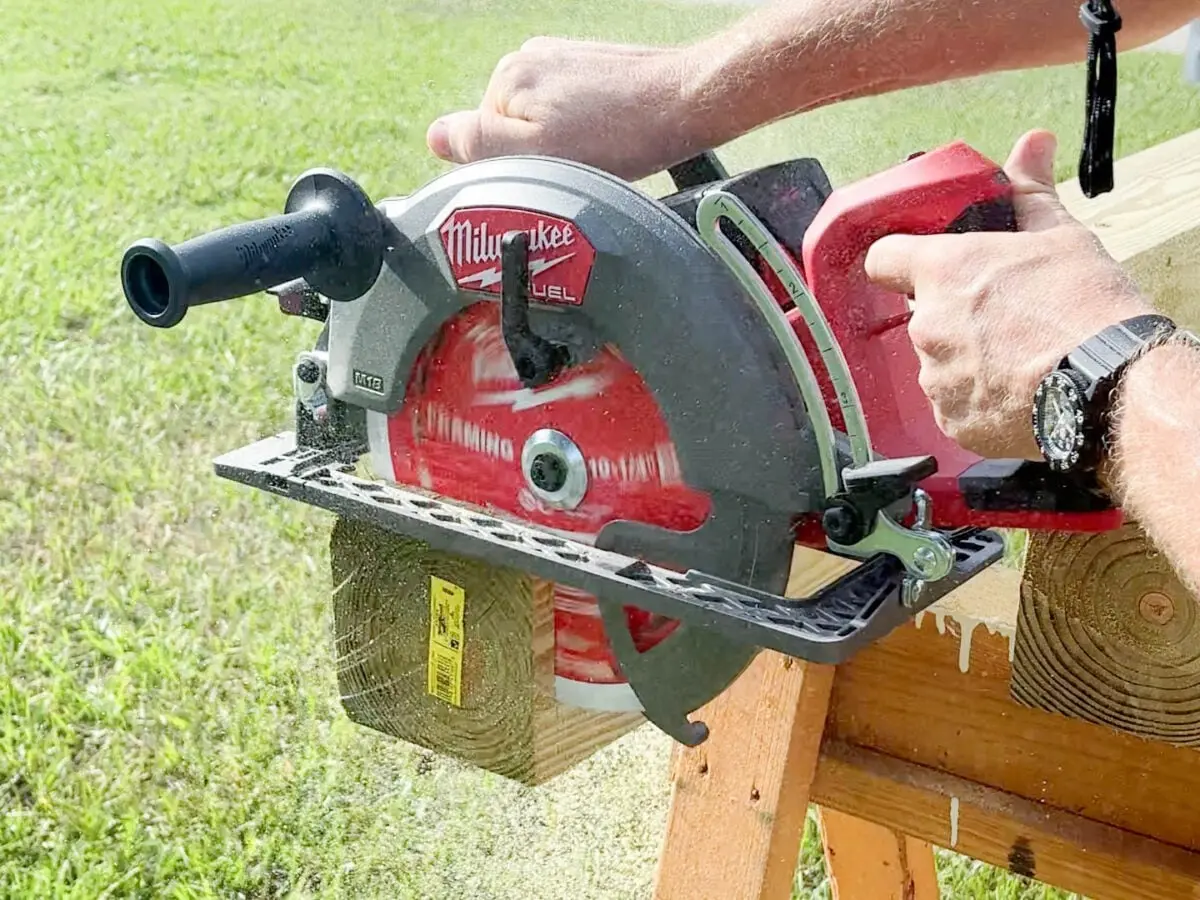
For professional contractors, framers, and timber-framing specialists, the limitations of standard circular saws have long presented an operational bottleneck. When dealing with oversized lumber, heavy-duty structural beams, and thick posts, a conventional 7 1/4-inch circular saw simply falls short. Enter the Milwaukee M18 Fuel 10 1/4-Inch Circular Saw (Model 3026)—a heavy-hitting, cordless solution engineered specifically for professionals who routinely tackle oversized materials and demand uncompromising performance without being tethered to a generator or cord.
Designed to bridge the gap between heavy corded industrial saws and the freedom of cordless operation, the Milwaukee 3026 leverages the brand’s advanced M18 Fuel ecosystem and high-output battery technology. However, stepping up to a 10 1/4-inch blade format inevitably introduces design compromises, including increased weight, a larger physical footprint, and a lower no-load RPM compared to its smaller siblings.
To determine whether this specialized tool justifies its premium price tag and heft, industry experts put the Milwaukee 3026 through rigorous, real-world testing—ranging from complex pergola construction using thick pressure-treated beams to high-volume cuts on standard and oversized dimensional lumber. This review breaks down the saw’s speed, power, ergonomics, dust collection, pricing, and overall market implications.
Chronology and Field Testing: Putting the Milwaukee 3026 to the Test
The development of the Milwaukee 3026 represents the ongoing evolution of cordless jobsite technology, pushing the boundaries of what battery-powered platforms can achieve in heavy-duty demolition and timber framing. Field testing of the saw highlighted its practical capabilities in actual construction environments.
The Pergola Build: Real-World Timber Cutting
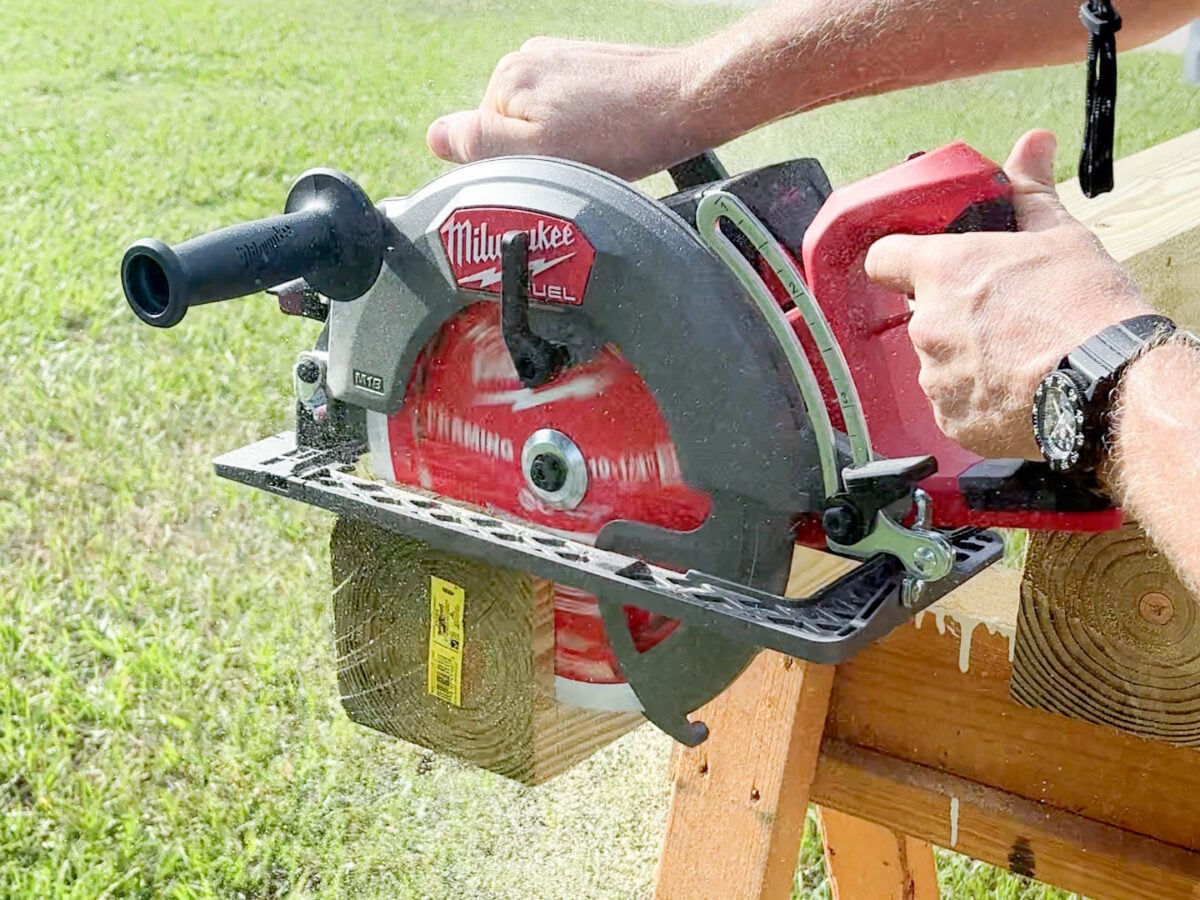
In recent field evaluations, in-house industry experts put the Milwaukee 3026 through a demanding stress test while constructing a custom outdoor pergola. Working alongside professional builders, testers utilized the saw on heavy 6×6 pressure-treated timber beams. Because a 6×6 beam measures 5 1/2 inches in thickness, even a 10 1/4-inch blade requires a two-pass technique to complete the severance cleanly.
Despite the thick material, the Milwaukee 3026 sailed effortlessly through the pressure-treated wood. Unlike smaller saws that bog down, overheat, or wander when their blades are fully buried in dense material, the 3026 maintained consistent torque, leaving behind a smooth, highly accurate cut with minimal splintering.
The test highlighted a pivotal operational question: When does it make sense to deploy a heavy 10 1/4-inch saw instead of a lighter, more agile 7 1/4-inch model? According to field operators, the answer comes down to precision and efficiency. First, standard 7 1/4-inch saws cannot clear 5 1/2-inch material, even with a flip-and-cut method. Second, even on 4×4 lumber—which the 3026 can slice through in a single, continuous pass—making a single cut drastically reduces layout errors. Matching up two separate passes with a smaller saw almost always introduces minor alignment discrepancies, whereas a single-pass cut ensures structural accuracy and clean aesthetic lines for deck, fence, and dock builders.
Power, Performance, and Supporting Data
Underneath its robust exterior, the Milwaukee 3026 is engineered with purpose-built components designed to optimize torque over raw rotational speed.
Brushless Motor and Speed Specifications
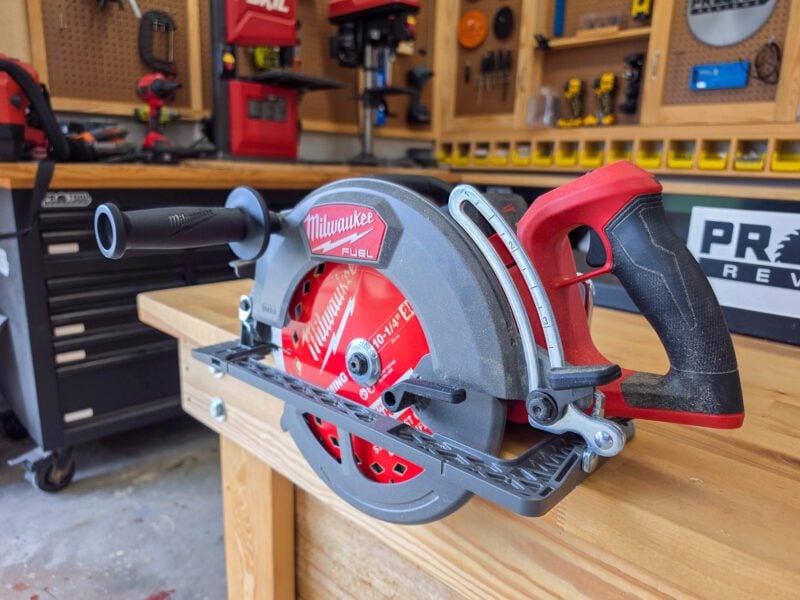
Driven by an advanced Milwaukee brushless motor, the 3026 delivers a top no-load speed of 3,250 RPM. While this figure may appear modest when compared to Milwaukee’s legacy corded 10 1/4-inch saws (which top out at a scorching 5,200 RPM), the cordless motor has been intentionally tuned for high torque. This ensures the saw powers through dense grain structures and engineered lumber without stalling.
The saw offers impressive cutting depths:
- At 90°: Maximum cutting depth of 3-13/16 inches.
- At 45°: Maximum cutting depth of 2-3/4 inches.
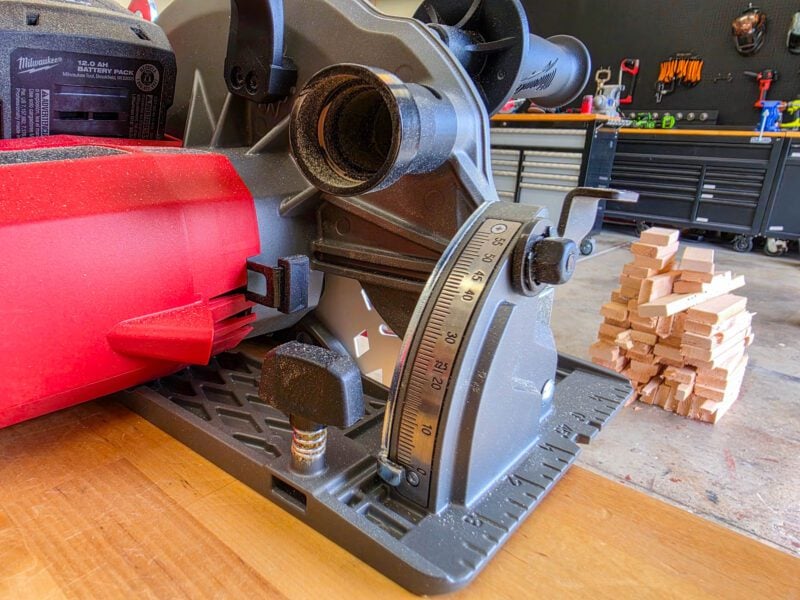
- Max Bevel: Up to 57 degrees, featuring positive stops at strategic increments of 22.5 degrees and 45 degrees.
Runtime and Battery Integration
Runtime is often the primary concern for professionals transitioning high-draw tools to cordless platforms. Milwaukee addresses this challenge by pairing the saw with its high-capacity 12.0Ah Forge battery. According to manufacturer claims, users can execute up to 250 cuts in standard 4×4 lumber on a single charge of the kitted 12.0Ah Forge battery, easily providing enough endurance for a full, uninterrupted shift on the jobsite.
Dust Collection System
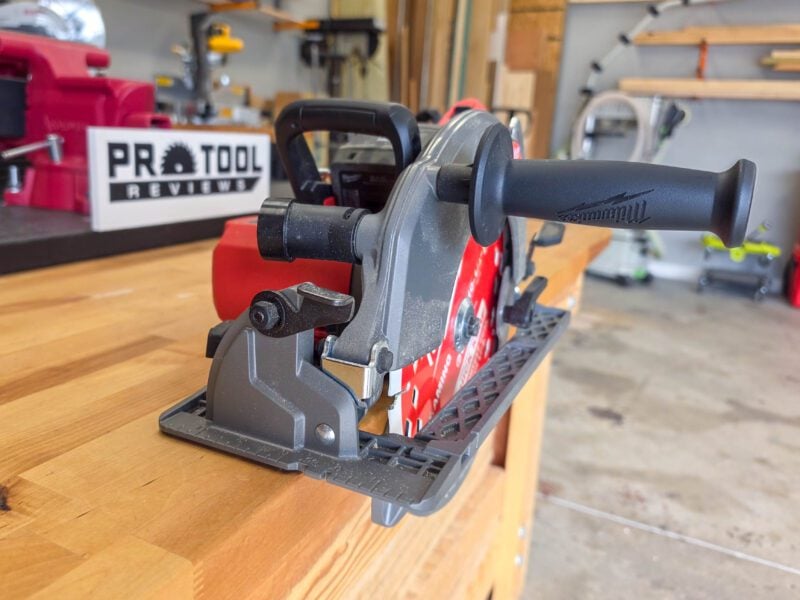
Jobsite safety and cleanliness are paramount. Milwaukee integrated a dust collection mechanism identical to the one featured on its latest M18 Fuel Rear Handle Circular Saw. Positioned strategically on the front of the upper blade guard, the port evacuates wood chips precisely as the blade kicks them up. This forward-facing design prevents clogging, keeps the cut line visible, and mirrors the effective dust-management aesthetics found in elite inline saws on the market.
Design, Ergonomics, and Specifications
Ergonomic Profile and Handling
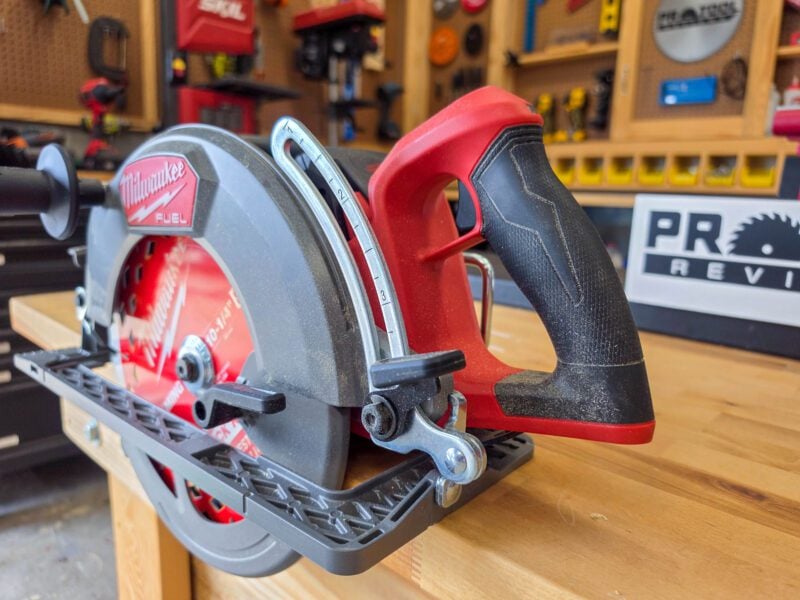
At first glance, the profile of the Milwaukee 3026 heavily resembles the M18 Fuel 7 1/4-Inch Rear Handle Circular Saw (Model 2931), albeit scaled up significantly to accommodate the larger housing and blade. The primary grip, adjustment levers, and motor housing maintain a familiar feel for existing Milwaukee users. However, recognizing the immense leverage required to control a saw of this magnitude, engineers added a robust auxiliary handle to the side of the upper blade guard. This secondary grip is crucial for guiding the tool securely through challenging, binding cuts.
Working Weight
Unsurprisingly, power and capacity carry a weight penalty.
- Bare Tool Weight: 11.90 pounds.
- Working Weight (with 12.0Ah Forge Battery): 15.25 pounds.
While this makes the 3026 roughly 3 pounds heavier than the 7 1/4-inch rear-handle model (2931), the multi-handle configuration distributes the weight effectively, keeping the saw remarkably balanced and manageable during extended overhead or cross-cutting tasks.
Depth and Bevel Adjustments
The bevel adjustment system allows for cuts up to 57 degrees, complemented by positive stops at 22.5° and 45°. While the depth adjustment mechanism lacks the mechanical detents found on some smaller models, it features clearly stamped, highly legible depth markings directly onto the guide, eliminating guesswork when setting cutting depths on the fly.
Comparative Analysis: Model 3026 vs. Model 2931
To fully understand where the 10 1/4-inch saw fits into a professional contractor’s toolkit, it is helpful to evaluate it side-by-side with Milwaukee’s premier 7 1/4-inch rear-handle saw.
| Feature | M18 Fuel 10 1/4-Inch Saw (Model 3026) | M18 Fuel 7 1/4-Inch Saw (Model 2931) |
|---|---|---|
| No-Load Speed | 3,250 RPM | 6,000 RPM |
| Max Cut Depth | 3-13/16 inches | 2-5/8 inches |
| Max Bevel | 57° | 53° |
| Blade Diameter | 10-1/4 inches | 7-1/4 inches |
| Arbor Size | 5/8 inch | 5/8 inch |
| One-Key Compatible | No | Yes |
| Working Weight | 15.25 lbs | 12.30 lbs |
| Kit Price | $599 (w/ 12.0Ah Forge) | $449 (w/ 12.0Ah Forge) |
Strategic Tool Selection
Rather than viewing these saws as competing products, professional contractors should view them as complementary assets.
- The 7 1/4-Inch Saw (2931): Offers higher rotational speed, a lighter chassis (12.30 lbs), a lower price point ($449 kitted), and superior agility for everyday framing, sheet goods, and standard dimensional lumber.
- The 10 1/4-Inch Saw (3026): Offers massive cutting capacity, high torque, and single-pass capability for 4x material and thick timbers, albeit at a higher cost ($599 kitted) and heavier weight (15.25 lbs).
Pricing, Availability, and Warranty
The Milwaukee M18 Fuel 10 1/4-Inch Circular Saw is available through authorized industrial distributors and tool dealers in two distinct configurations:
- Bare Tool (Model 3026-20): Retails for $429, ideal for contractors already deeply invested in the M18 battery ecosystem who possess high-capacity batteries.
- Kit Configuration: Retails for $599, which includes the saw, a high-output 12.0Ah Forge battery, a single-bay rapid charger, and a heavy-duty storage bag.
Milwaukee backs this industrial-grade tool with a 5-year limited tool warranty, alongside a 3-year limited warranty covering the battery and charger, reinforcing its commitment to jobsite durability.
Implications and Final Verdict: Should You Buy It?
Industry Implications
The introduction of high-performance, large-capacity cordless saws like the Milwaukee 3026 signals a definitive shift in heavy commercial and residential construction. As battery technology—exemplified by Milwaukee’s Forge cells—continues to evolve, the historical performance gap between corded gas-station-generator setups and cordless jobsite tools is vanishing. Contractors can now execute heavy timber framing in remote locations or on active, power-restricted sites without managing cumbersome extension cords or noisy generators.
Final Recommendation
The Milwaukee M18 Fuel 10 1/4-Inch Circular Saw is a specialized, purpose-built instrument. If your daily workflow involves heavy framing, dock building, timber construction, or frequent cutting of 4×4 and oversized lumber, the time saved by making clean, single-pass cuts easily justifies the $150 price premium over standard 7 1/4-inch kits.
Conversely, if your crew only encounters thick lumber on rare occasions, investing in a dedicated 10 1/4-inch saw may represent an unnecessary expense and an unwarranted weight penalty. For the specialized professional, however, the Milwaukee 3026 delivers unmatched capacity, robust torque, and the cordless freedom required to conquer the heaviest jobsites.
