


Introduction: Bridging the Gap in Cordless Fastening
In the demanding world of professional mechanics, automotive repair, and heavy equipment maintenance, the tools in a technician’s arsenal must continually evolve to meet conflicting demands. Technicians frequently encounter fasteners tucked away in frustratingly confined spaces—areas where a traditional pistol-grip impact wrench is simply too bulky to maneuver, yet standard manual ratchets lack the necessary torque to break loose stubborn, rusted, or heavily torqued bolts.
Enter the right-angle impact wrench: a specialized tool class that occupies a unique and critical middle ground in the cordless power tool market. These tools deliver significantly more muscle than standard manual or cordless ratchets while offering the spatial clearance required to navigate cramped engine bays, dense suspension assemblies, and industrial machinery.
Makita’s entry into this specialized category, the 18V LXT XLT03 right-angle impact wrench, aims to redefine expectations. Combining an efficient brushless motor, impressive speed ratings, and intuitive electronic controls, the XLT03 pushes the concept of the 90-degree impact tool to new heights. We spent extensive time putting the Makita XLT03 through rigorous testing under pressure to evaluate its performance, ergonomics, and overall value, helping you determine whether it deserves a permanent home in your professional toolbox.
Main Facts: The Anatomy of the Makita XLT03
Before diving into hands-on testing and performance metrics, it is essential to understand the core specifications and engineering philosophy behind the Makita 18V LXT XLT03.
Unlike a standard cordless ratchet—which relies on mechanical gears that can be damaged when manually loaded or heavily impacted—the XLT03 is a true 90-degree impact wrench. This means it utilizes a heavy-duty impact mechanism housed within a compact head to hammer fasteners loose or drive them tight.
Core Technical Specifications:
- Motor Type: Brushless
- Anvil Size: 3/8-inch (Also available in a 1/2-inch friction ring and pin detent anvil configuration)
- No-Load Speed (RPM): Up to 3,200 RPM across three selectable modes
- Impact Rate (IPM): Up to 4,000 IPM
- Fastening Torque: 250 ft-lbs
- Breakaway Torque: 390 ft-lbs
- Bare Tool Weight: 3.25 lbs
- Weight with 2.0Ah Battery: 4.0 lbs
- Weight with 5.0Ah Battery: 4.61 lbs
- Head Dimensions: 2.2 inches wide, 3.1 inches deep (including the anvil)
- Retail Price: $279.00 (Bare tool)
- Warranty: 3-year limited warranty
Speed and Power Analysis: Crushing Expectations
At the heart of the Makita XLT03 is an advanced brushless motor designed to maximize energy efficiency and operational lifespan. This motor drives a 3/8-inch anvil, yielding up to 3,200 RPM and a maximum impact rate of 4,000 IPM. More importantly, it churns out an impressive 250 ft-lbs of fastening torque and a staggering 390 ft-lbs of breakaway torque. For automotive technicians and industrial mechanics, these figures mean that everything from routine lug nuts to frozen, corrosion-locked suspension bolts are well within the tool’s operational capabilities.

To better understand how the Makita XLT03 stacks up against competing industry solutions, we can examine its multi-mode performance profile side-by-side with a prominent competitor in the compact right-angle space, the Milwaukee M12 FUEL (Model 2564).
Performance Mode Comparison Table
| Metric | Makita 18V LXT XLT03 | Milwaukee M12 FUEL (2564) |
|---|---|---|
| Speed – Mode 1 | 1,000 RPM | 1,550 RPM |
| Speed – Mode 2 | 1,500 RPM | 2,300 RPM |
| Speed – Mode 3 | 3,200 RPM | 3,000 RPM |
| Impact Rate – Mode 1 | 1,800 IPM | 1,350 IPM |
| Impact Rate – Mode 2 | 2,800 IPM | 2,700 IPM |
| Impact Rate – Mode 3 | 4,000 IPM | 3,600 IPM |
An intriguing takeaway from these specifications is that Makita’s speed and impact rate numbers actually outpace many mid-torque pistol-grip impact wrenches currently on the market. While its absolute torque figures remain tailored to its compact right-angle class, the elevated speed ratings prove exceptionally valuable when rapidly spinning out long threaded bolts or working at awkward, non-linear angles where continuous trigger pulls are difficult to maintain.
Chronology of Testing: Putting the XLT03 Under Pressure
To evaluate how these engineering specs translate to real-world performance, we subjected the Makita XLT03 to a standardized, high-stress testing protocol designed to push impact tools to their limits.
The Test Setup
We utilized our shop’s specialized bolt-break rig. To simulate a demanding, real-world application, we secured a series of 1 1/2-inch semi-truck lug nuts onto the rig and torqued them precisely to 250 ft-lbs using a Gearwrench Electronic Torque Wrench. Our primary objective was to time how rapidly the XLT03 could systematically loosen all eight fasteners.
While heavy-duty semi-truck lugs are not the everyday intended application for a compact right-angle tool, this extreme test served a vital purpose: it allowed us to evaluate the tool’s sustained power delivery, thermal management, vibration characteristics, and overall mechanical endurance under severe resistance.
Execution and Results
When triggered, the XLT03 immediately went to work, hammering through the heavily torqued fasteners. The tool completed the eight-nut removal test with a total cumulative time of 46.63 seconds. This breaks down to an average of just 5.83 seconds per nut.
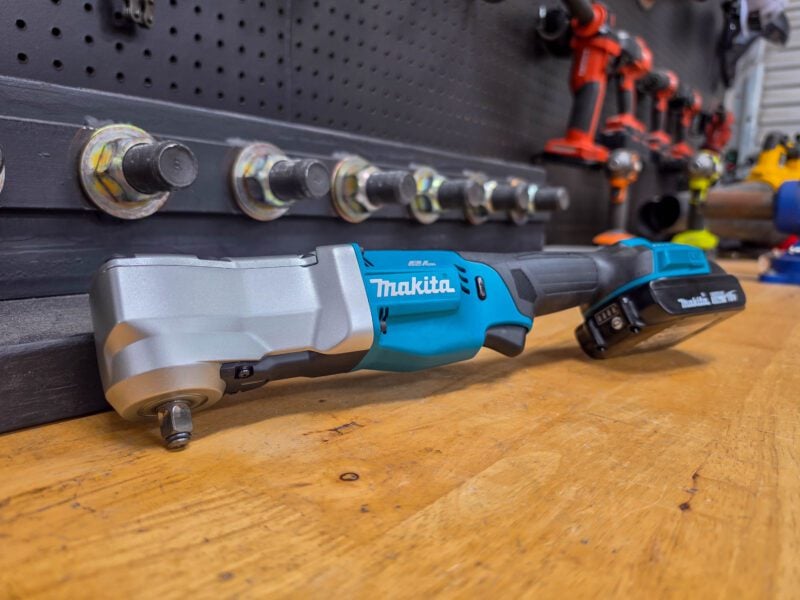
For a right-angle tool of this class—operating outside its traditional design parameters—this performance is exceptionally respectable. While the tool is fundamentally optimized for tight spaces under the hood or complex automotive suspension overhauls, the test proved it possesses a deep reservoir of hidden strength.
During the extended burst of hammering required to clear the rig, the vibration level transmitted to the operator’s hands remained remarkably consistent with what we have experienced using Makita’s larger pistol-grip impact wrenches. The vibration is present—as is expected with any high-impact mechanism—but it is neither overwhelming nor uncomfortable. Operators can safely use the tool for extended periods without experiencing rapid hand fatigue or nerve-numbing vibration feedback.
Supporting Data and Advanced Features: The Auto-Stop Advantage
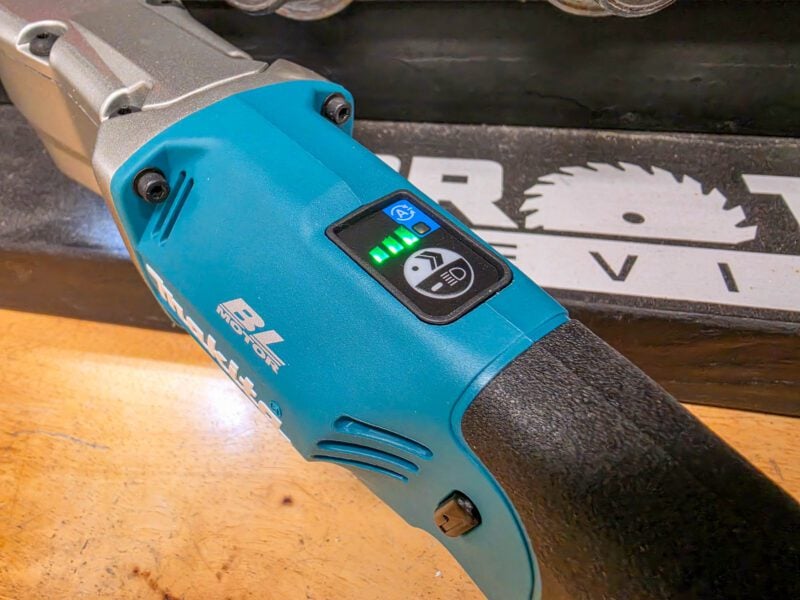
One of the standout technological inclusions on the Makita XLT03 is its dual Auto-Stop control modes. Modern cordless tool engineering has increasingly shifted toward smart electronics to prevent operator error, fastener damage, and dropped hardware in difficult-to-reach locations. Makita’s implementation on the XLT03 is among the most refined and successful we have encountered.
Understanding the Auto-Stop Modes:
- Clockwise (Tightening) Auto-Stop: When the tool is set to rotate clockwise, the impact force mirrors Mode 1. Crucially, the tool’s internal electronics automatically cut power and halt the motor the exact microsecond the anvil begins to impact. This prevents accidental over-tightening of sensitive fasteners.
- Counterclockwise (Loosening) Auto-Stop: When operating in reverse, the tool delivers full power matching Mode 3. However, the motor stops automatically the moment the impact mechanism ceases and the fastener breaks free from its threads.
In a crowded engine bay or deep within a chassis, dropping a loosened nut or bolt can turn a five-minute repair into an hour-long retrieval nightmare. Makita’s Auto-Stop modes eliminate this risk by preventing fasteners from spinning wildly out of control once unseated. They work precisely as advertised, offering unprecedented control during delicate, high-stakes mechanical tasks.
Official Responses and Ergonomic Design Notes
Beyond internal performance, the physical architecture of a right-angle tool dictates its utility. If a tool is too heavy or awkwardly balanced, its right-angle benefits are quickly negated by operator strain.
Size, Weight, and Balance
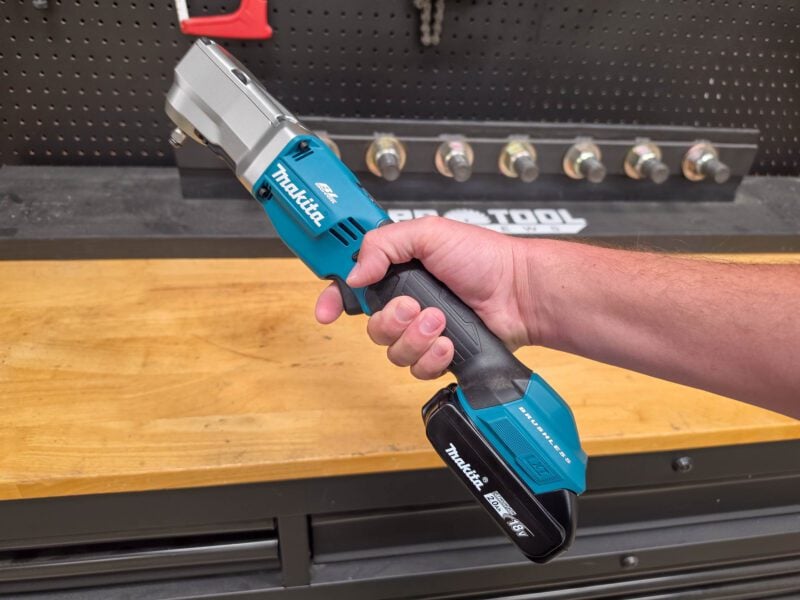
As a bare tool, the Makita XLT03 weighs in at 3.25 pounds. When paired with Makita’s compact 2.0Ah battery, total weight rises to 4.0 pounds. However, our hands-on evaluation revealed that pairing the tool with a larger 5.0Ah LXT battery brings the weight to 4.61 pounds, fundamentally improving the tool’s ergonomics.
Rather than feeling front-heavy—a common complaint with right-angle impacts where the motor housing and heavy metal head offset a small battery—the 5.0Ah battery anchors the base, creating a neutral, well-balanced feel in the hand. This balance makes the tool significantly easier to maneuver and point accurately in tight spaces. In terms of profile, the XLT03 mirrors the successful design language seen in competitors like the Ridgid 18V Right Angle Impact Wrench.
Dimensional Limitations
Technicians must always weigh access against power. The XLT03 features a head width of 2.2 inches and a depth of 3.1 inches (measured from the back of the head to the tip of the 3/8-inch anvil). While this profile easily clears most suspension components and firewall obstructions, it can still present clearance challenges in extremely restricted clearances.
For micro-spaces where a 3.1-inch head cannot fit, technicians may still need to resort to Makita’s slimmer cordless ratchets. However, switching to a ratchet requires sacrificing the brute-force impact capability that the XLT03 provides.
Implications for the Professional Trades
The launch and performance of the Makita 18V LXT XLT03 carry several important implications for automotive technicians, fleet maintenance crews, and industrial mechanics.
1. Platform Consolidation for LXT Users
For professionals already heavily invested in Makita’s massive 18V LXT cordless ecosystem, the XLT03 represents a zero-compromise addition. Users do not need to buy into a separate battery platform (such as 12V systems) to gain right-angle access. They can utilize the batteries, chargers, and storage solutions they already own.
2. Redefining Right-Angle Expectations
Historically, right-angle impact tools were viewed as niche problem-solvers that lacked the speed and grunt work capabilities of primary impact wrenches. With 250 ft-lbs of fastening torque, 390 ft-lbs of breakaway torque, and up to 3,200 RPM, the XLT03 blurs the line between a specialty problem-solver and a primary heavy-duty fastening tool. Technicians can rely on it for more than just quick bolt-removal; it can handle substantial assembly and disassembly tasks.
3. Investment Value
Priced at $279.00 as a bare tool and backed by a 3-year limited warranty, the XLT03 is positioned as a professional-grade investment. While the upfront cost requires consideration, the inclusion of smart electronics like the Auto-Stop modes directly translates to saved time, reduced fastener damage, and increased daily productivity on the shop floor.
Conclusion: Should You Buy the Makita XLT03?
The Makita 18V LXT XLT03 right-angle impact wrench successfully carves out a vital space in the modern cordless landscape. It is not an outright replacement for a standard pistol-grip impact wrench, nor is it a delicate manual ratchet substitute. Instead, it bridges the two categories by pairing the spatial access of a 90-degree tool with the raw, uncompromising muscle of a true impact mechanism.
Its combination of high RPMs, exceptional breakaway torque, and industry-leading Auto-Stop control modes makes it an invaluable asset for anyone regularly wrenching under the hood or navigating complex mechanical assemblies. While its head profile means it may still struggle in absolute micro-spaces, its overall balance, power delivery, and intelligent features make it a standout choice.
For automotive professionals and heavy equipment technicians embedded in the Makita 18V LXT platform, the XLT03 is not just a nice-to-have accessory—it is a performance-enhancing tool that belongs at the front of your toolbox.
