

Introduction: A Century-Old Concept Brought to Earthmoving Giants
For generations, diesel-electric locomotives have been the absolute workhorses of freight transport across wide-open spaces, seamlessly blending high-efficiency diesel engines with high-torque electric motors. This century-old engineering marriage has long proven nearly impossible to beat in terms of sustained pulling power, reliability, and mechanical efficiency. Now, industrial equipment titan Caterpillar is taking that time-tested architecture and applying it on a colossal scale to its heaviest earthmoving equipment: the introduction of the new Cat® D11 XE Electric Drive dozer.
In the high-stakes world of large-scale construction, mining, and civil engineering, projects are habitually penciled and bid on razor-thin profit margins. A minor efficiency swing of just 1% to 2% across an entire fleet can mean the difference between securing a lucrative contract or suffering devastating financial losses. When fleet operators are purchasing fuel by the literal truckload, technological advancements that curb consumption instantly become industry-shaping milestones.
With fuel prices remaining fiercely volatile—including significant spikes—commercial fleet managers are hunting for operational leverage. Caterpillar’s latest engineering marvel arrives not a moment too soon, promising monumental efficiency gains that could fundamentally rewrite the economics of heavy earthmoving.

Main Facts: Engineering the Colossus
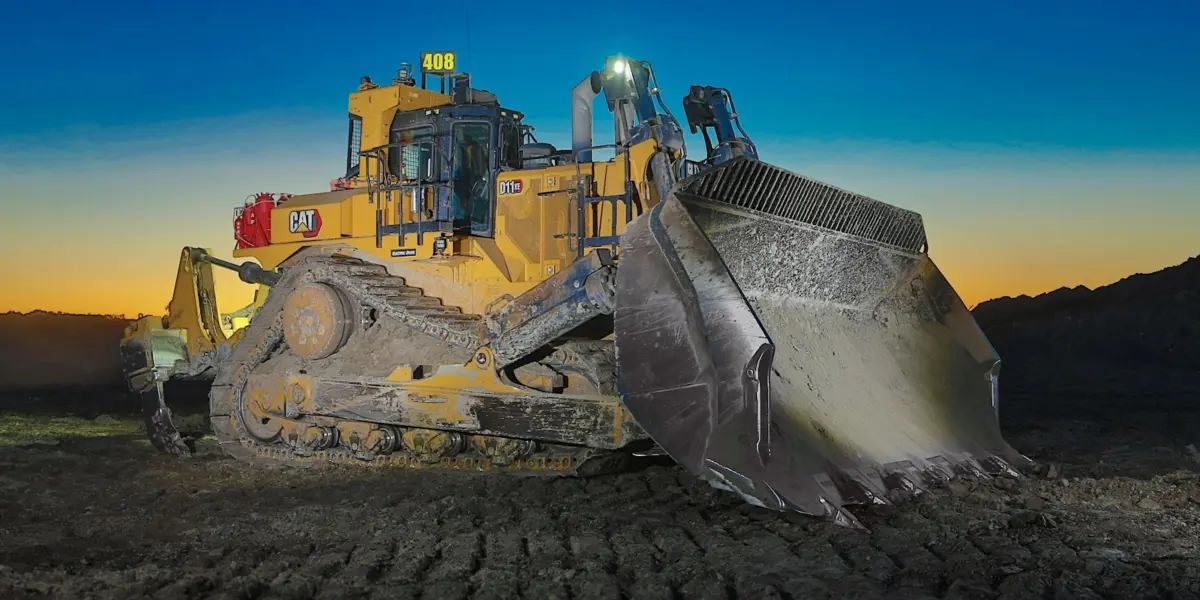
The Cat D11 XE Electric Drive is a masterclass in heavy industrial engineering, blending immense physical proportions with cutting-edge electric powertrain architecture. At its heart lies a robust Cat® C32B engine, engineered to meet stringent U.S. EPA Tier 2 equivalent and U.S. EPA Tier 4 Final/EU Stage V emissions standards.
Operating at a net power output of 642 kW (861 hp) when moving forward, and up to 715 kW (959 hp) in reverse, the dozer delivers infinitely variable speeds ranging from 0 to 11.2 km/h (0 to 7.0 mph). Depending on the configuration—whether equipped with a single-shank ripper and standard semi-universal blade or a heavy ripper paired with a massive carrydozer blade—the machine’s operating weight ranges from a staggering 108,316 kg (238,796 lbs) to over 117,007 kg (257,958 lbs).
Cat D11 XE Specifications Overview
| Technical Metric | Specification |
|---|---|
| Engine | Cat® C32B |
| Powertrain Architecture | Electric Drive |
| Emissions Compliance | U.S. EPA Tier 2 Equivalent & U.S. EPA Tier 4 Final / EU Stage V |
| Net Power Forward (SAE J1349 / ISO 9249) | 642 kW (861 hp) |
| Net Power Reverse (Tier 2 Equivalent) | 715 kW (959 hp) |
| Net Power Reverse (Tier 4 Final / EU Stage V) | 712 kW (955 hp) |
| Forward / Reverse Speed (Infinitely Variable) | 0–11.2 km/h (0–7.0 mph) |
| Operating Weight (Standard Ripper & U-Blade) | 108,316 kg (238,796 lbs) |
| Operating Weight (Heavy Ripper & Carrydozer) | 117,007 kg (257,958 lbs) |
| Blade Capacity (Semi-Universal) | 27.2 m³ (35.6 yd³) |
| Blade Capacity (Universal) | 34.4 m³ (45.0 yd³) |
| Blade Capacity (Carrydozer) | 43.6 m³ (57.0 yd³) |
Unlike traditional mechanical-drive dozers that rely on complex transmission systems with physical gears, the D11 XE utilizes a dedicated drive motor for each track. This configuration eliminates traditional gear-shifting entirely, resulting in a smoother, simpler power delivery mechanism. Furthermore, powering both tracks independently throughout turns yields exceptional maneuverability and unprecedented pryout force.

Chronology: The Evolution of Cat Dozers and the Push Toward Electrification
To truly understand the significance of the D11 XE, it is essential to examine the historical trajectory of Caterpillar’s flagship crawler tractors and the incremental evolution of their electric drive technology.
- 1986: Caterpillar introduces the first-generation D11N dozer, establishing a dominant new benchmark for high-production earthmoving and heavy mining operations globally.
- Decades of Iteration: Over the next thirty years, the D11 platform undergoes continuous refinements in engine output, structural integrity, hydraulic efficiency, and operator comfort, solidifying its status as the undisputed king of the job site.
- Recent Years: Caterpillar pivots toward hybrid and electric drive architectures across its product line, successfully introducing middleweight electric-drive models like the D6 XE and D8 XE. These machines prove to skeptical fleet operators that electric-drive systems can survive harsh working environments while delivering profound fuel savings.
- Present Day: Caterpillar unveils the D11 XE Electric Drive dozer, scaling its proven electric powertrain technology up to its largest, most demanding crawler tractor class. This launch marks a definitive turning point for ultra-heavy earthmoving equipment.
Supporting Data: Productivity, Efficiency, and Lifecycle Value
When commercial equipment buyers evaluate a multi-million-dollar machine, upfront acquisition cost is only one piece of the puzzle. Total Cost of Ownership (TCO) dictates long-term viability, and this is where the D11 XE completely redefines the category.
According to Caterpillar’s rigorous performance data, the D11 XE delivers up to 25% less fuel consumed per unit of material moved compared to the conventional mechanical-drive Cat D11. Zooming out across generations, the efficiency gains are even more stark: the D11 XE is up to 40% more efficient than the original D11N introduced back in 1986.

Beyond sipping significantly less fuel, the machine moves 5% to 10% more material per hour, radically increasing job site productivity. Uptime—the holy grail of heavy construction—is also heavily prioritized. The electric drive system reduces mechanical wear points, granting up to 20% longer life between internal combustion engine (ICE) rebuilds than its predecessor. Additionally, planned component repair intervals for the engine, final drives, and hydraulic systems have been extended from 15,000 operating hours up to an impressive 18,000 hours.
Official Responses and Industry Perspectives
Caterpillar leadership has emphasized that the D11 XE is not merely an exercise in green engineering, but a direct response to the core operational and economic pain points faced by heavy equipment fleet managers worldwide.
"The D11 XE is designed to help customers get more from every hour of operation," explains Luke Fischer, product application specialist for Caterpillar. "By combining the proven capability of the D11 platform with the benefits of electric drive, it delivers meaningful gains in productivity, efficiency, and lifecycle value. It also reflects how far dozer performance has advanced, offering up to 25% greater efficiency than today’s D11 and up to 40% greater efficiency than the first D11N introduced in 1986."

Recognizing that advanced powertrains require a learning curve for operators accustomed to traditional torque converters and manual gear selectors, Caterpillar has proactively addressed operator adaptation. The company is offering on-demand, mobile-friendly learning resources via its digital training platform, catoperatortraining.com. Whether operators are digital natives or seasoned veterans navigating new technology, these modules ensure rapid, frictionless proficiency.
Sam Meeker, market professional for Caterpillar, notes that market adoption is poised to accelerate rapidly as field data accumulates. "As more and more owners and operators experience what they deliver, and how Electric Drive addresses many of the operational and maintenance challenges associated with dozers," Meeker explains, "we expect that adoption of electric drive systems in earthmoving equipment will continue to grow."
Implications: The Bottom-Line Reality of Heavy Equipment Electrification
For years, widespread adoption of alternative powertrain technology in heavy heavy-duty industries has faced cultural headwinds. Many contractors and site managers in construction and mining have historically viewed environmental mandates with skepticism. However, the commercial reality of commercial fleet management is entirely insulated from political ideology: it is driven strictly by the bottom line.

When a machine proves itself to be objectively superior in performance and cheaper to operate over its lifecycle, the purchasing calculus becomes trivial. If a piece of heavy equipment is better and cheaper, fleet operators will buy one. If it is vastly superior and dramatically cheaper to run, they will buy an entire fleet.
Electrically driven heavy equipment assets—exemplified by the expansion of Caterpillar’s XE lineup from the D6 and D8 up to the formidable D11 XE—are proving that electrification is no longer an idealistic experiment. It is a hard-nosed financial advantage.
Furthermore, ancillary benefits such as drastically reduced drivetrain complexity, lower maintenance intervals, superior low-end torque control, and diminished noise pollution on crowded job sites provide compounding operational advantages. Fewer mechanical failures mean fewer unexpected downtime events, reduced labor hours spent on component overhauls, and happier, less fatigued operators working inside modern, high-precision cabs.

As the heavy equipment sector looks toward the future, the Cat D11 XE Electric Drive serves as a powerful proof of concept. By marrying a legendary century-old locomotive powertrain concept with modern power electronics and rugged civil engineering, Caterpillar has ensured that the evolution of earthmoving machinery will continue to push the boundaries of productivity, efficiency, and industrial profitability.
