

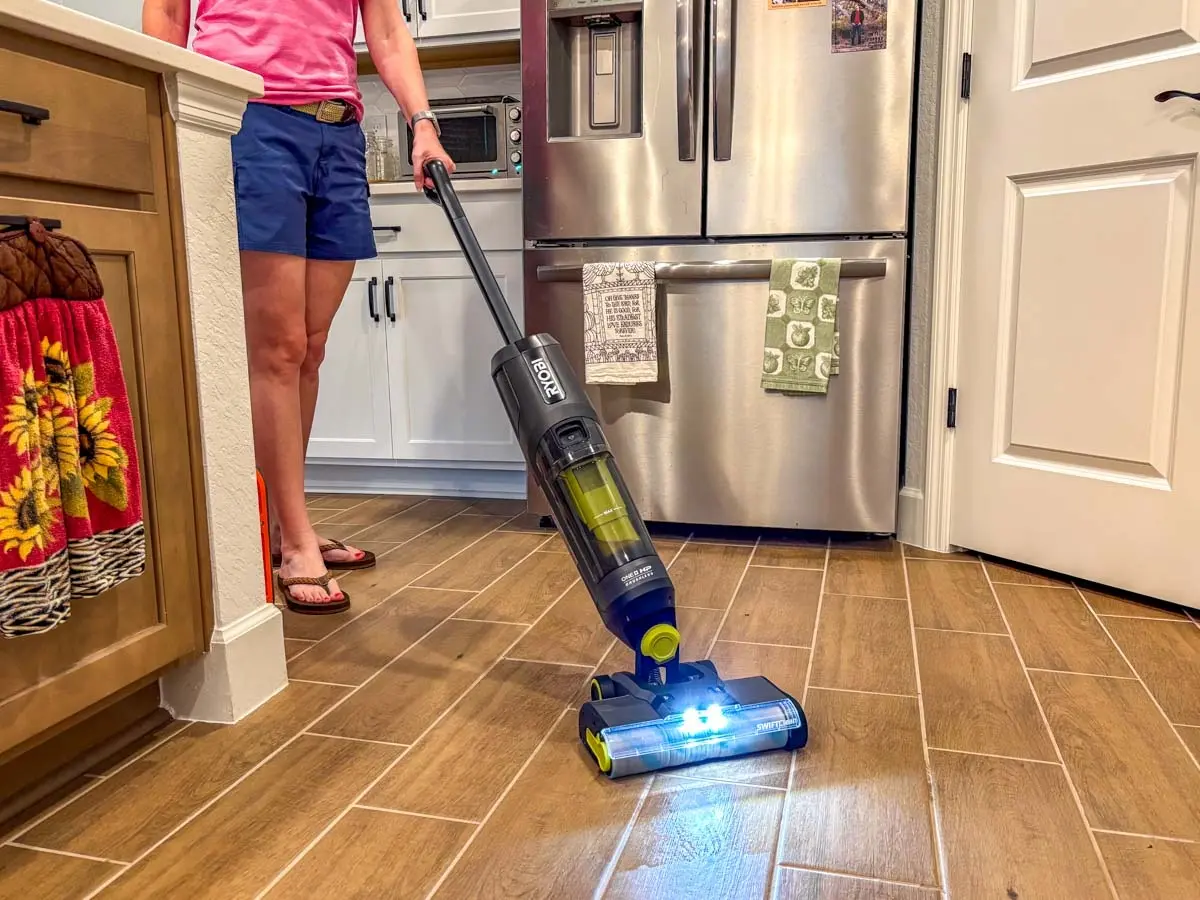
Main Facts: The Evolution of Hard Floor Maintenance
When Ryobi officially pulled the wrapper off its second-generation 18V One+ HP SwiftClean Wet Dry Vacuum Mop (Model PBLUV748), it introduced a notable quality-of-life update to an already popular cleaning platform. Stepping into a newly built home featuring over 1,700 square feet of continuous hard flooring, the search for a more efficient, streamlined cleaning routine became a primary household objective.
Ryobi’s newest iteration promised to carry forward the time-saving dual vacuum-and-mop design of its predecessor while introducing critical structural refinements—most notably, an integrated charging base. Retailing at $349 as a bare tool or $399 as a full kit (which includes a 4.0Ah High Performance battery and the upgraded charging station), this specialized appliance targets homeowners looking to consolidate chores without sacrificing cordless convenience.

However, prospective buyers should note its specific niche: it is engineered strictly for hard surfaces. Carpets and rugs remain outside its operational scope, meaning households with mixed flooring will still require a secondary traditional vacuum.
Chronology: Hands-On Real-World Testing
To properly evaluate the PBLUV748, the unit was put through a rigorous multi-week testing phase across a 1,700-square-foot hard-surface layout.

Initial Unboxing and Setup
Out of the box, assembling the unit requires minimal effort. The handle clicks securely into place, and the charging stand snaps together quickly. Unlike the previous model (PBLSV747), which required users to pull the battery out and place it on a separate charger, the new generation allows the battery to remain docked on the unit while it rests in the charging stand. This design choice immediately found a welcoming home in the laundry room, where the machine plugs discreetly into a wall outlet, ready for action.
Daily Cleaning Cycles
Throughout the testing period, the vacuum was subjected to a wide variety of household messes, ranging from everyday dust and tracked-in sand to kitchen mishaps like spilled flour, dried-on taco sauce, and heavier debris generated during meal preparation.

Operationally, the machine utilizes a plush front roller designed to maximize surface contact. During dry vacuuming, this plush material excels at pulling in fine particulate matter—such as sand—even at lower suction settings. Mopping evaluations proved equally successful; the ability to vacuum and dispense cleaning solution simultaneously effectively eliminated the traditional two-step floor-cleaning chore.
Supporting Data & Technical Specifications
A side-by-side comparison between Ryobi’s first-generation model (PBLSV747) and the new second-generation iteration (PBLUV748) reveals identical core performance metrics, with the notable addition of onboard charging:

| Feature | PBLSV747 (Previous Generation) | PBLUV748 (New Generation) |
|---|---|---|
| Cleaning Width | 10 inches | 10 inches |
| Suction Power | 50 IOW | 47 IOW (Adjusted metric for accuracy) |
| Cleaning Modes | On / Max / Solution | On / Max / Solution |
| Auto Wet Shut-Off | Yes | Yes |
| Self-Cleaning Mode | Yes | Yes |
| Edge Cleaning | Yes | Yes |
| Tank Capacity | 22 oz clean / 14 oz dirty | 22 oz clean / 14 oz dirty |
| Rated Noise Level | 65 decibels | 65 decibels |
| LED Headlights | Yes | Yes |
| Base Station | Self-Cleaning Only | Self-Cleaning & Charging |
| Self-Standing | Yes | Yes |
Runtime and Coverage Performance
Powered by the included 4.0Ah High Performance battery, Ryobi rates the vacuum for up to 19 minutes of runtime in Max mode and up to 30 minutes in standard mode. Real-world testing closely mirrored these manufacturer claims:
- Max Mode: Achieved 18 minutes and 41 seconds of continuous operation, covering approximately 1,100 square feet.
- Standard Mode: Reached 33 minutes and 9 seconds of runtime, successfully clearing all 1,700+ square feet of hard flooring with battery power to spare.
Official Responses and Engineering Insights
When queried about the nominal numerical drop in suction rating from 50 Input Air Watts (IOW) down to 47 IOW, Ryobi representatives clarified that the underlying motor architecture remains entirely unchanged between the two generations. The adjustment reflects a more accurate, standardized internal rating system rather than a reduction in actual motor performance.

Furthermore, engineering design notes highlight the machine’s distinct self-propelled characteristic. Because the front roller spins forward, it actively pulls the vacuum along during operation. While this does not necessarily reduce the physical effort required—users must still pull back against the forward momentum—it provides a distinct operational feel that first-time users should anticipate.
Implications for Homeowners and the DIY Market
Performance Pros and Design Highlights
- Time-Efficiency: Eliminating the need to pre-vacuum before mopping cuts hard-floor cleaning time nearly in half.
- Acoustic Comfort: Operating at a manufacturer-rated 65 decibels, the machine is remarkably quiet. In standard mode, normal conversational speech is entirely uninterrupted, a rare trait for wet-dry vacuum cleaners.
- Maintenance Automation: The 60-second automated self-cleaning cycle—housed directly on the base station—flushes the brush roller effectively, minimizing manual cleanup.
- Ecosystem Synergy: For current owners of Ryobi’s vast 18V One+ cordless tool platform, the ability to share batteries across more than 300 products adds exceptional value.
Operational Considerations and Minor Drawbacks
- Default Settings: Upon startup, the machine defaults directly to the wet-mopping function. For households that primarily dry-vacuum between deep cleans, users must manually toggle the mop function off via the LED interface to prevent the pump from running dry.
- Low-Profile Limitations: While the vacuum head is low enough to navigate under most standard furniture, angling the handle too low causes the cleaning head to tilt upward and lose floor contact, limiting deep reach beneath low-clearance items like dining tables.
- Tank Safeguards: The unit features an automatic shut-off to prevent the dirty water tank from overfilling. When triggered, it produces a sharp sound resembling a loose vacuum hose, which can momentarily startle users before they realize it is simply indicating a full recovery tank.
Verdict: Should You Buy It?
The Ryobi 18V One+ HP SwiftClean Wet Dry Vacuum Mop proves to be a robust, highly efficient addition to any hard-floor maintenance arsenal. Priced at $399 for the complete kit, it successfully bridges the gap between daily sweeping and deep mopping.

While it cannot replace a dedicated carpet vacuum and may require supplementary batteries for sprawling floor plans, its seamless dual-action cleaning, quiet operation, and newly integrated charging base make it an easy recommendation for homeowners looking to reclaim valuable time on their weekend chores.
