

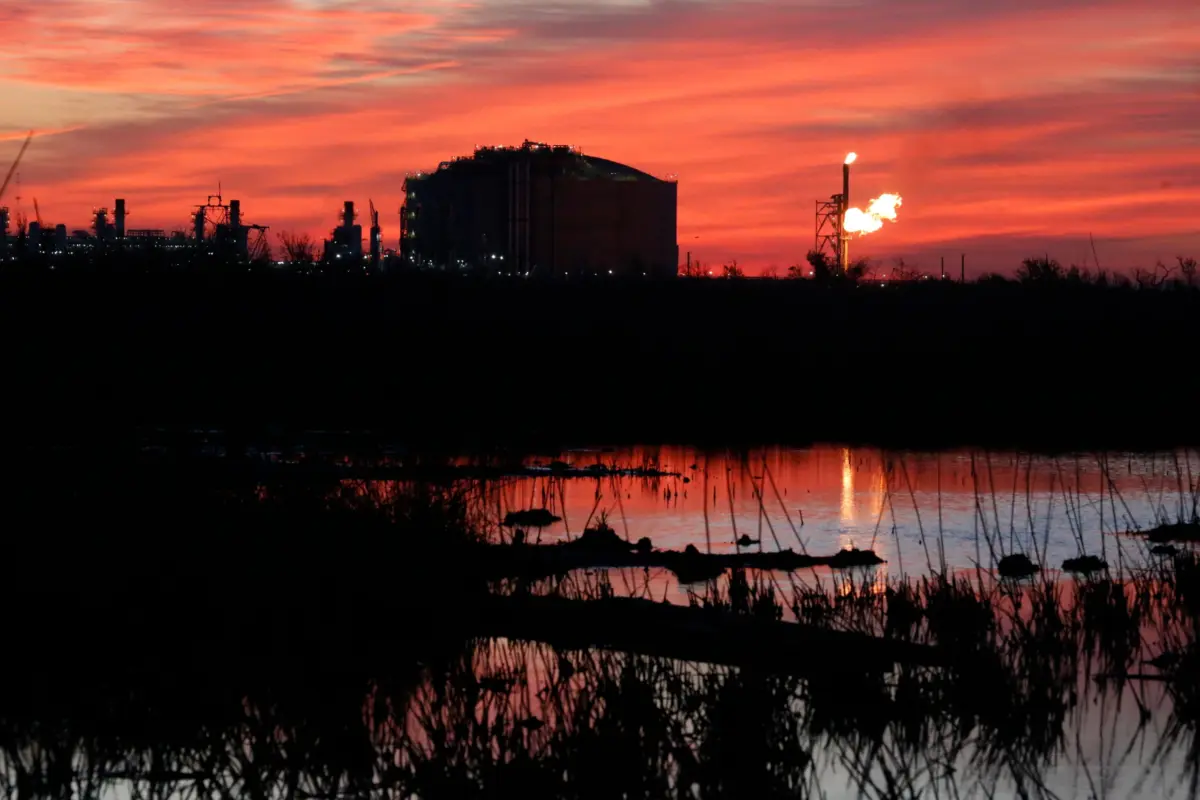
CAMERON PARISH, La. — Along the vulnerable, marsh-fringed coastline of southwest Louisiana, a bitter clash between traditional maritime livelihoods and the booming liquefied natural gas (LNG) industry has reached a boiling point. A coalition of commercial fishers, fishing guides, and seafood processors has filed a high-stakes lawsuit against energy giant Venture Global, alleging that massive dredging operations tied to the construction of a multi-billion-dollar export terminal triggered a devastating sediment spill.
The lawsuit, lodged in the 38th Judicial District Court, contends that the environmental disaster obliterated millions of cultivated oysters, choked critical aquatic nurseries, and severely diminished regional catches of finfish, crabs, and shrimp. It marks the latest flashpoint in an escalating war over the ecological and economic future of Cameron Parish—once heralded as the nation’s premier seafood-producing region.
Main Facts: The Human and Economic Toll
At the heart of the litigation is Venture Global’s CP2 project, a massive $30 billion terminal currently under construction in Cameron Parish, situated adjacent to the company’s existing $10 billion export facility. To accommodate the colossal LNG tankers required to service the new terminal, Venture Global has been aggressively enlarging and deepening shipping channels near Calcasieu Lake.
However, local stakeholders say the collateral damage of these industrial expansions has been catastrophic. The July 30 lawsuit features 20 primary plaintiffs who claim their businesses have been driven to the brink of ruin.
Among them is Anthony “Tad” Theriot, a veteran shrimper and oyster farmer with three decades of experience on the water. Theriot estimates his immediate financial losses at over $450,000, noting that his annual income plummeted from more than $300,000 in 2020—primarily derived from shrimping—to a meager $57,000.
"That’s how much difference this plant being in my town has made," Theriot said. "Best case scenario, they pay you for every year that they mess up and… then you get to go back fishing."
The legal complaint targets not only Venture Global but also its primary dredging contractor, Callan Marine Ltd., and engineering contractor, Providence Engineering and Environmental Group. Additionally, the Cameron Port, Harbor and Terminal District—a public agency that oversaw parts of the dredging operations and assisted with permitting—is named as a fourth defendant.
Plaintiffs are seeking comprehensive damages for dead and diminished marine catches, lost and broken equipment, and the persistent, choking turbidity clouding their historic fishing grounds and estuaries.
Chronology of a Disaster: How the Spill Unfolded
The ecological crisis traces back to the early summer of 2025, capturing a timeline of corporate denial, mounting evidence, and eventual admissions of massive environmental degradation.
- Early June 2025: Dredging operations officially commence for the CP2 terminal project, aiming to widen access channels leading to Calcasieu Lake.
- July 2025: A local crabber sounds the alarm with the Cameron Parish government, reporting mud-covered traps entombed in a marsh dangerously close to the CP2 construction site.
- August 2025: Local fishers and environmental advocates capture undeniable video footage of thick, muddy water cascading over a small earthen dam, pouring directly into the southern reaches of Calcasieu Lake.
- Late August 2025: Venture Global initially denies that sediment has reached the estuary, despite mounting eyewitness accounts from local fishers encountering turbid water, mud-caked oysters, and ruined gear. Under pressure, the company eventually concedes that an accidental discharge occurred, releasing between 9,000 and 18,000 cubic yards of dense sediment into the channel and adjacent marshlands.
- Late 2025 to Early 2026: Additional infrastructure failures plague the project, including a burst sediment pipe earlier this year that forces a temporary, mandatory pause in dredging operations.
- July 30, 2026: Twenty commercial fishers, guides, and processors officially file their lawsuit in the 38th Judicial District Court.
Cooper Fournet, legal counsel for the plaintiffs, vividly illustrated the scale of the initial August spill for the court. "If you took a standard-sized dump truck and lined them up, it would be like 5 miles of dump trucks," Fournet said.
Supporting Data: The Collapse of the Alternative Oyster Culture (AOC) Park
Nowhere has the impact of the sediment spill been felt more acutely than within Cameron Parish’s Alternative Oyster Culture (AOC) Park. Established in 2018 through a collaborative effort between the local port and the Louisiana Department of Wildlife and Fisheries (LDWF), the park was envisioned as a beacon of sustainable innovation.
Faced with the decline of wild Gulf oyster reefs due to relentless storms, historical pollution, and climate change, local entrepreneurs turned to off-bottom cage farming. This method fast-tracks oysters to market maturity in under a year, bypassing the traditional two-to-three-year timeline.
By 2023, tenants had leased all 24 two-acre plots in the southern basin of Calcasieu Lake. Among them was David Sorrells, a former chef and owner of Lake Charles’s Restaurant Calla, who launched Pig and Rooster Oyster Farms. Alongside fellow grower Theriot and other regional producers, the park’s tenants rapidly scaled their operations. Sorrells invested roughly $600,000 in farm infrastructure, stocking his cages with 5.3 million oysters. Theriot invested $100,000, managing 750,000 oysters.
When the August 2025 sediment plume swept through the park, farmers pulled thousands of mud-caked, suffocated oysters from their floating cages. Weeks of frantic washing and remediation efforts by Theriot, Sorrells, and employees of The Oyster Ranch proved futile. The surviving oysters were rendered entirely unsellable due to severe mud blistering.
According to farmer estimates and a 2023 economic impact analysis by Louisiana Sea Grant, leaseholders at the AOC park collectively lost roughly 13 million oysters, translating to between $7 million and $13 million in lost sales.
The legal fallout from the AOC devastation extends beyond the primary July lawsuit:
- The Revival Oyster House Dispute: In November, a now-closed restaurant sued Pig and Rooster Oyster Farms over a delivery of 5.3 million contaminated, unmarketable oysters intended for the eatery.
- Third-Party Demands: Pig and Rooster fired back with a third-party legal demand against Venture Global, estimating its losses at over $5 million. A judge ordered comparative sediment testing between the dredge material and mud collected from the farm’s cages.
- Federal Rejection: In a separate legal challenge, environmental groups and commercial fishers petitioned a federal court to overturn the Federal Energy Regulatory Commission’s (FERC) approval of the CP2 project, arguing the agency ignored the industry’s destruction. A federal appeals court in Washington, D.C., rejected these claims.
"I’ve got 5.3 million oysters I can do nothing with," Sorrells lamented. "I’m out that whole year of business. It’s looking like I’m out of the second year of business… What I want is for them to cover our losses… They need to fix our ecosystem."
Official Responses and Corporate Defense
Faced with escalating litigation, regulatory scrutiny, and public outrage, defendants have offered measured responses, often leaning on remediation commitments or declining direct comment due to active litigation.
In a written statement addressing the claims, a Venture Global spokesperson acknowledged the operational failure:
"In August 2025, a discharge that contained a higher volume of sediment than anticipated traveled from the placement area into an offsite channel. Since this isolated migration event last year, we have worked directly with independent experts, state and federal regulators, community stakeholders, and affected parties to develop and execute mitigation and remediation plans and remain committed to conservation efforts in the area."
Despite these assertions, the company declined to answer direct questions regarding the specifics of the new lawsuit. Representatives for dredging contractor Callan Marine Ltd. and engineering firm Providence Engineering and Environmental Group did not respond to multiple requests for comment.
Cameron Port Director Kim Montie also declined to comment, citing ongoing litigation.
Meanwhile, state regulators defended their oversight. Patrick Courreges of the Louisiana Department of Conservation and Energy (LDCE)—the agency that issued the original dredging permits—stated that Venture Global is legally bound to replace lost wetlands with an equivalent value of restored habitat, with LDCE conducting routine inspections to ensure compliance. However, Courreges was unable to provide the date of the agency’s most recent inspection prior to publication.
Broader Implications: The Slow Erasure of a Coastal Heritage
The conflict in Cameron Parish is symptomatic of a larger existential crisis facing coastal Louisiana. For generations, the region’s expansive marshes have served as the vital "nursery" for the Gulf of Mexico’s seafood supply, sheltering juvenile shrimp, crabs, and finfish before they migrate to open waters.
Local fishers argue that Venture Global’s mitigation practices are fundamentally altering this landscape. Under permit guidelines, dredged material is slated to restore 260 acres of marsh across the Sabine and Cameron Prairie National Wildlife Refuges. However, fishers and environmental advocates claim the mud is being piled far too high, turning delicate, productive wetlands into dry, solid landmasses ("spoil banks") that can no longer hold water or support marine life.
"They’re diking in large swaths of what used to be marsh land and filling in it with mud, making it solid land, which will remove habitat for the growing crabs," said Scott Spicer, a third-generation crabber and plaintiff in the lawsuit.
Furthermore, traditional fishers report that the relentless traffic of massive LNG tankers is eroding shorelines through destructive wave action and tearing up expensive commercial gear. Eddie Lejuine, a 62-year-old drum-fisher and petitioner in the suit, noted that he no longer sets his lines near Calcasieu Lake’s historic oyster reefs because the fish have vanished. Instead, he drives 2.5 hours twice daily to Sabine Lake, doubling his labor to secure a fraction of his former catch.
The sociological impact is equally profound. In 1985, Cameron Port ranked as the nation’s top seafood producer by volume, hosting roughly 200 active shrimp boats in its waters. Today, veteran fishers estimate that number has dwindled to just 15. Faced with collapsing yields, many multigenerational fishing families are actively steering their children toward entirely different career paths—ironically, often finding work within the very oil and gas sectors transforming their coast.
As the legal battles mount and the Louisiana Department of Environmental Quality weighs a new wastewater discharge permit for Venture Global, local stakeholders remain deeply skeptical of corporate promises.
Despite the bleak outlook, resilience persists in small measures. Both Theriot and Sorrells have purchased fresh batches of oyster seeds to plant in the AOC Park this year, testing the waters once more.
"We started back little again," Theriot said, surveying the altered estuary. "We’re going to see what they do." But looking out over the clouded expanse, he added a sobering caveat: "The water just doesn’t look nothing like it used to."
