

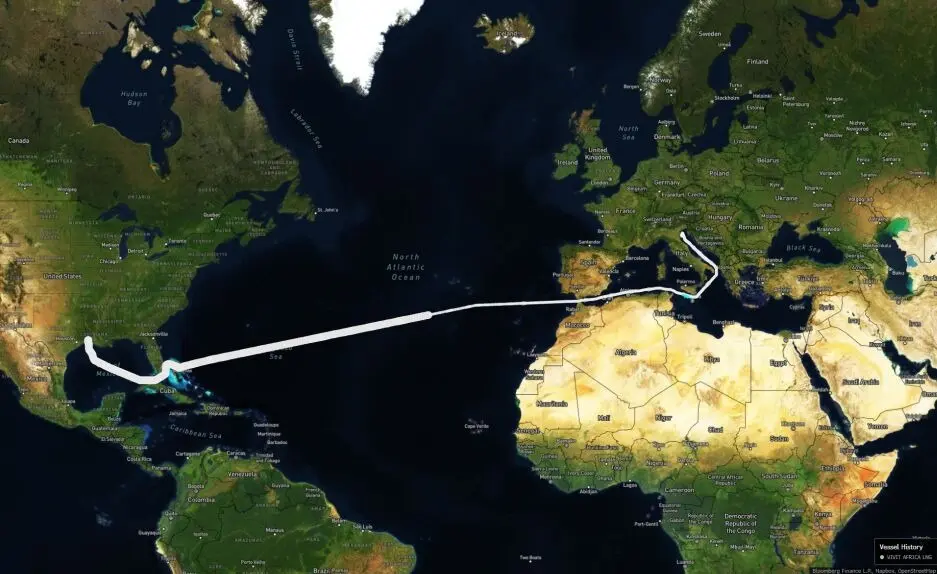
MARITIME SECURITY — In a concerning escalation of digital threats facing global supply chains, a liquefied natural gas (LNG) tanker transporting American fuel to Europe experienced a critical systems failure earlier this month that the onboard crew officially reported as a suspected cyberattack.
The incident involving the Vivit Africa LNG highlights the mounting vulnerabilities of critical maritime infrastructure. It underscores a growing international anxiety over the weaponization of cyber capabilities against commercial shipping, particularly vessels carrying volatile energy supplies across vital geopolitical chokepoints.
1. Main Facts: The Incident Aboard the Vivit Africa LNG
The Vivit Africa LNG, a vessel laden with fuel lifted from the United States, was navigating eastward through the Mediterranean and Adriatic seas toward Italy when disaster struck. According to individuals familiar with the matter who spoke on the condition of anonymity due to the sensitive and confidential nature of the information, the crew suddenly lost access to critical internal control systems.
The sudden digital blackout crippled the ship’s operational oversight, particularly the sensitive instrumentation required to safely manage and monitor cargo parameters.
- The Vessel: The Vivit Africa LNG is a South Korean-owned LNG carrier operated by H-Line Shipping Co. Ltd.
- The Charterer: Global energy trading giant Vitol Group confirmed that it has the ship under a long-term time charter, though the company declined to offer further comments regarding the operational disruption.
- The Cargo: The ship was transporting a consignment of liquefied natural gas loaded at Louisiana’s Cameron LNG terminal, bound for European energy markets hungry for US supply.
- The Equipment: The vessel utilized specialized marine technology provided by Kongsberg Maritime, a prominent manufacturer of positioning, navigation, and propulsion systems.
While investigations remain in their infancy, the loss of digital visibility paralyzed the ship’s operational capabilities, transforming a routine commercial voyage into an immobilized safety hazard sitting off the coast of Southern Europe.
2. Chronology of Events: From Atlantic Crossing to Mediterranean Standoff
The unfolding crisis aboard the Vivit Africa LNG can be traced across a timeline spanning weeks of transatlantic transit, sudden technological failure, localized emergency intervention, and an abrupt retreat from its intended destination.
Late August – Early September: The Transatlantic Voyage
Having successfully taken on its volatile energy cargo at the Cameron LNG export facility in Louisiana, the Vivit Africa LNG embarked on its routine transatlantic crossing. Satellite navigation and shipping data compiled by Bloomberg indicate that the vessel crossed the Atlantic Ocean without incident, entering the Mediterranean Sea in the opening days of September. The ship was slated to deliver its vital energy payload to Rovigo, Italy.
Early September: The Digital Failure and Distress Call
As the carrier neared its destination, navigating through the Mediterranean and Adriatic seas, the crew experienced an abrupt and catastrophic loss of internal control functions. Recognizing the severity of the situation—and suspecting a malicious digital intrusion—the master of the vessel immediately notified the Korean Register, the classification society acting as the technical and safety adviser to the South Korean owner.
Mid-September: Italian Coast Guard Intervention
With critical systems failing, the Vivit Africa LNG was forced to idle off the Italian coast, unable to discharge its cargo. The Italian Coast Guard was swiftly mobilized to secure the area.
Captain Roberto D’Arrigo detailed the local response in an emailed statement, noting that the coast guard intervened "after the master reported a malfunction in the systems used to monitor cargo parameters, requiring intervention by the company’s technicians."
Because the root cause of the onboard malfunction could not be immediately identified, the Chioggia Coast Guard stepped in strictly for navigational safety. Authorities issued an urgent notice to mariners (NOTAM) mandating that all nearby vessels maintain a safe distance from the immobilized LNG carrier to prevent a potential maritime disaster.
Mid-September: The Retreat Toward Spain
Unable to resolve the technical and suspected security failures locally, the ship’s itinerary was drastically altered. On Wednesday, shipping data revealed that the Vivit Africa LNG abandoned its plans to dock in Rovigo. Instead, it began sailing away from the Italian coast, charting a course back toward the western Mediterranean and heading in the direction of the Spanish port of Algeciras, located near the strategic entrance to the Strait of Gibraltar.
3. Supporting Data: A Global Wave of Maritime Cyber Threats
The immobilization of the Vivit Africa LNG is not an isolated incident; rather, it represents a disturbing pattern of escalating cyber hostility directed at the global commercial fleet.
A Wider Pattern of Targeting
Maritime cybersecurity experts have tracked a sharp uptick in digital anomalies and outright attacks on commercial shipping over the past several years. Just weeks prior to the Vivit Africa LNG incident, in late August, two separate oil and gas tankers off the coast of the United States were boarded by heavily armed teams from the US Coast Guard and the Federal Bureau of Investigation (FBI). Those boardings were triggered by potential cyberattacks that threatened the operational integrity of the vessels’ navigation and propulsion suites.
US Government Surveillance
The frequency of these events has forced Western governments to elevate maritime cybersecurity from an IT compliance issue to a matter of national security. According to officials briefed on the matter, United States intelligence and law enforcement agencies are currently monitoring nearly 20 ships worldwide for active or latent cyber threats.
The geopolitical implications are profound. Modern LNG carriers are essentially floating industrial complexes, heavily reliant on interconnected digital networks, automated control systems, and satellite communications. A successful, sustained cyberattack on an LNG carrier could theoretically result in catastrophic structural damage, environmental disaster, or the intentional choking of crucial energy supply arteries into Europe.
4. Official Responses and Industry Accountability
As investigators comb through the digital logs of the Vivit Africa LNG, stakeholders across the maritime, technology, and energy sectors are scrambling to address accountability and manage communications.
Silence from Shipowners and Class Societies
Both the vessel’s owner, South Korea’s H-Line Shipping Co. Ltd., and its safety adviser, the Korean Register, have maintained a tight-lipped stance. Neither organization immediately responded to repeated international requests for comment regarding the nature of the systems failure or the validity of the crew’s cyberattack suspicions.
The Technology Supplier’s Perspective
Because the ship incorporates advanced maritime technology from Kongsberg Maritime—a global leader in positioning, navigation, and propulsion systems—attention has naturally turned to the equipment manufacturer.
Jon Berge, a spokesman for Kongsberg Maritime, confirmed that the company is fully aware of the reports surrounding the Vivit Africa LNG. However, Berge urged caution, stating that "it is too early to draw conclusions regarding the cause or any potential security implications."
Industry experts note that while Kongsberg provides foundational hardware and software architecture, many modern ships integrate third-party satellite communications networks, remote maintenance portals, and proprietary cargo-management software that can introduce vulnerabilities outside the direct control of the original equipment manufacturer.
Charterer Reticence
Vitol Group, the commodity trading titan holding the vessel under a long-term time charter, acknowledged its commercial relationship with the ship but refused to elaborate on how the disruption would impact its European energy delivery commitments. The company’s silence reflects broader corporate anxieties over liability, insurance ramifications, and market panic in the delicate European energy sector.
5. Broader Implications for Global Energy and Maritime Security
The suspected cyberattack on the Vivit Africa LNG serves as a glaring wake-up call for the global maritime industry, exposing deep-seated vulnerabilities in how commercial vessels are designed, operated, and secured.
The Vulnerability of Connected Ships
For decades, maritime engineering focused primarily on physical safety, weather resilience, and mechanical reliability. However, the rapid digitization of maritime trade—embracing automated cargo handling, remote engine diagnostics, and satellite-based navigation—has vastly expanded the "attack surface" for malicious actors.
Ships at sea frequently rely on legacy software systems that lack robust cybersecurity protocols, making them prime targets for ransomware gangs, state-sponsored hackers, or industrial saboteurs seeking to disrupt global commodity flows.
Geopolitical Pressures on European Energy
The timing of the incident adds another layer of geopolitical sensitivity. Europe has spent the past several years aggressively diversifying its energy supplies, moving away from pipeline gas and increasing its reliance on seaborne liquefied natural gas, particularly from the United States. Disrupting even a single LNG carrier via a cyber incident sends ripples through the European energy market, stoking fears of price volatility and supply chain bottlenecks heading into high-demand seasons.
The Path Forward: Regulation and Enforcement
In light of the Vivit Africa LNG incident and the broader cluster of attacks monitored by US authorities, maritime regulators are expected to face mounting pressure to enforce stricter cybersecurity mandates. International bodies like the International Maritime Organization (IMO), alongside flag states and classification societies, will likely be forced to move beyond voluntary guidelines and implement mandatory digital hardening standards for commercial fleets.
Until such robust frameworks are universally adopted and enforced, floating energy giants traversing the world’s oceans will remain vulnerable ghosts in the machine—susceptible to unseen digital adversaries capable of turning multi-million-dollar supply vessels into stranded metal hulks in the open sea.
