

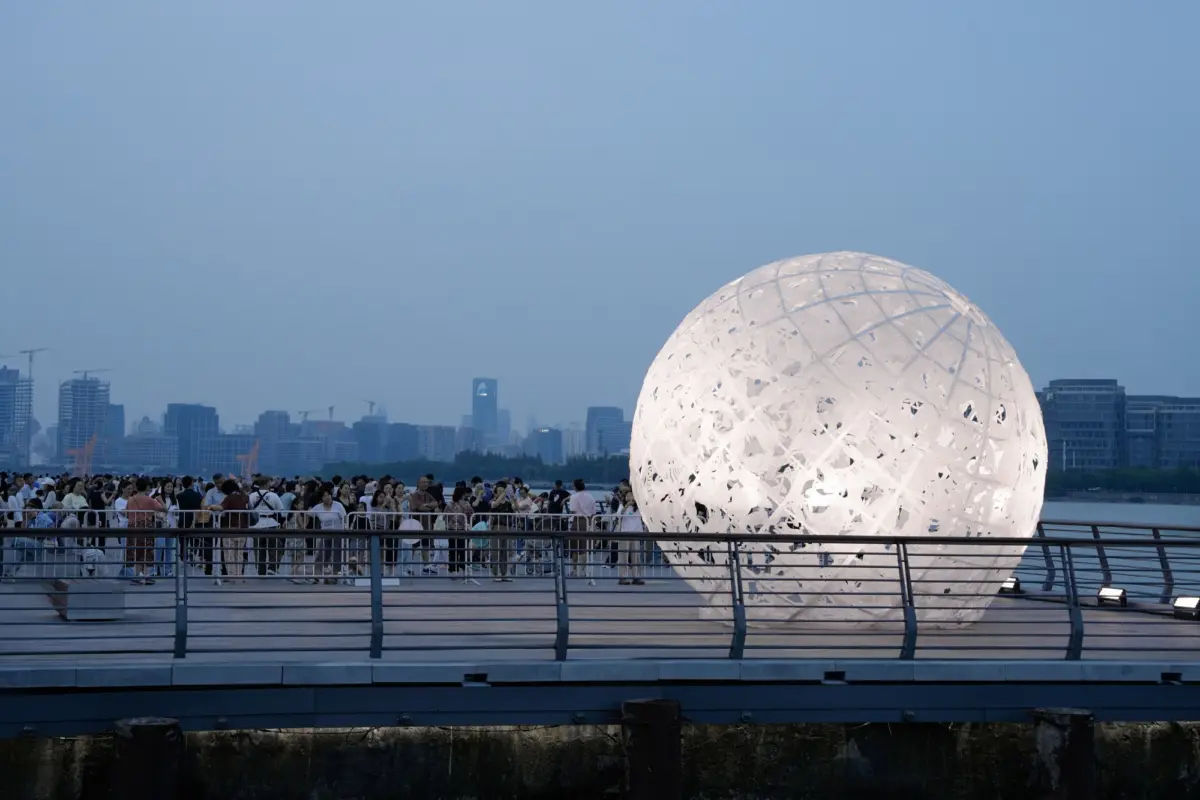
SHANGHAI — In the heart of one of the world’s most dynamic contemporary cultural districts, tradition and cutting-edge urban design have converged in a brilliant display of light, shadow, and folklore. Invited by the prestigious Power Station of Art (PSA), the acclaimed SHISUO Design Office has officially unveiled its latest public art installation, "The Full Moon."
Drawn to Shanghai’s vibrant West Bund during the festive Mid-Autumn season, the large-scale installation immediately captured the public imagination, drawing massive crowds of locals, art enthusiasts, and international visitors. Blending classical iconography with avant-garde architectural techniques, the project serves as a physical meditation on the cyclical nature of existence, the passage of time, and the enduring power of communal folklore.
Main Facts: Architecture Meets Ancient Folklore
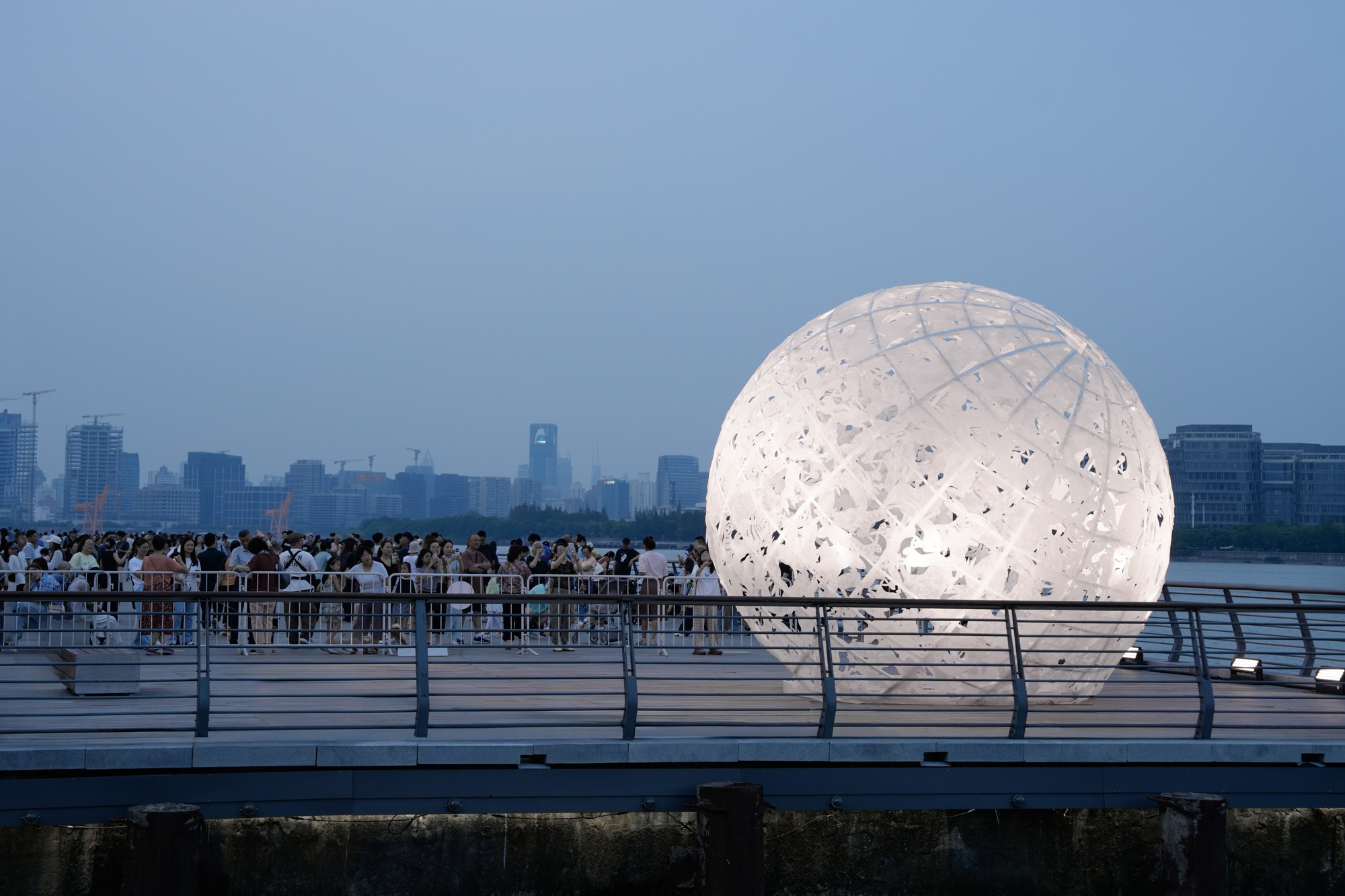
"The Full Moon" is not merely an aesthetic object; it is a complex, multi-layered urban intervention. Curated by HAN Shuang and realized in close collaboration with Shi Qinling—a master inheritor of traditional Shanghai-style (Haipai) paper-cutting—the installation anchors its narrative around two deeply symbolic figures from classical Chinese mythology: the moon and the rabbit.
- Project The Full Moon
- Design Office: SHISUO Design Office
- Curator: HAN Shuang
- Collaborator: Shi Qinling (Shanghai-style paper-cutting inheritor)
- Exhibition Venue: Power Station of Art (PSA) / West Bund, Shanghai
- Photographer: Jianyuan Ye
- Key Materials: Crackle-textured acrylic panels, structural steel frames, and integrated lighting systems
Across diverse global cultures, the rabbit holds a unique position in the human psyche, serving as one of the few animal figures universally beloved and mythologized. In classical Chinese Mid-Autumn folklore, the jade rabbit is inextricably linked to the moon. While the lunar orb metaphorically represents the eternal, cyclical waxing and waning of life and existence, the rabbit symbolizes raw vitality, organic growth, and the flourishing of all living beings.
SHISUO translated these deeply ingrained cultural motifs into a physical space using contemporary materials. Most notably, the installation incorporates intricate rabbit patterns etched into crackle-textured acrylic panels. These specialized panels refract natural sunlight by day and artificial illumination by night, casting dynamic, shifting patterns across the surrounding urban landscape. Depending on the viewer’s vantage point, the installation reveals different phases of the moon, offering a personalized, participatory experience for every passerby.
Chronology: From Concept to Cultural Sensation
The realization of "The Full Moon" represents a meticulous timeline of cross-disciplinary collaboration, material experimentation, and urban integration.

Phase 1: Conceptualization and Cultural Research (Early Planning)
The genesis of the project began when the Power Station of Art (PSA) approached SHISUO Design Office to commission a temporary public art installation for the Mid-Autumn Festival. Seeking to move beyond commercial interpretations of the holiday, the design team initiated a deep-dive research phase into Haipai (Shanghai-style) folk arts. Recognizing the decline of traditional crafts in modern metropolis environments, SHISUO made a deliberate choice to integrate authentic intangible cultural heritage into the design framework.
Phase 2: Collaborative Craftsmanship (Mid-Development)
SHISUO partnered with Shi Qinling, a recognized master of Shanghai-style paper-cutting. This phase required translating delicate, two-dimensional paper-cut motifs into large-scale, three-dimensional architectural components. The designers experimented with various synthetic materials before selecting crackle-textured acrylic panels, which could simultaneously withstand outdoor structural requirements and mimic the fragile, translucent beauty of traditional cut paper.
Phase 3: Installation and Urban Deployment (Exhibition Launch)
Constructed and assembled on the West Bund—Shanghai’s premier contemporary arts corridor—the installation transformed the public plaza outside the PSA. The assembly process required precise engineering to ensure that the massive spherical structure could be viewed from 360 degrees, allowing visitors to witness distinct lunar phases depending on their angle of approach.

Phase 4: Public Engagement and Phenomenon (Exhibition Peak)
Upon its official opening, "The Full Moon" instantly became a viral cultural sensation. Drawing tens of thousands of visitors daily, the installation bridged demographic divides, attracting elderly residents familiar with the folklore as well as tech-savvy youth documenting the glowing structure for social media platforms.
Supporting Data: Materiality, Scale, and Public Impact
Analyzing the success of "The Full Moon" requires looking closely at the technical and quantitative metrics that underpinned its construction and public reception.
- Material Innovation: The primary structural skin utilizes high-grade, crackle-textured acrylic. This material was chosen specifically for its light-diffusing properties, which prevent harsh glares during peak daylight hours while creating a soft, ethereal glow after sunset.
- Geographical Footprint: Positioned adjacent to the Power Station of Art—China’s first state-owned museum dedicated to contemporary art—the installation occupied a high-traffic urban node along the Huangpu River waterfront, maximizing pedestrian flow and civic engagement.
- Visual Versatility: Over 20 distinct photographic and spatial configurations were documented by architectural photographer Jianyuan Ye, highlighting how shifting solar angles transform the installation from a solid white monument by day into a luminous, multi-faceted celestial body by night.
- Crowd Metrics: Throughout its exhibition window, the West Bund site recorded a significant spike in weekend pedestrian traffic, directly attributable to the interactive nature of the public art piece.
Official Responses and Curatorial Insights
The convergence of traditional craft and modern computational design elicited widespread praise from cultural institutions, critics, and the designers themselves.

Curator HAN Shuang emphasized the intentionality behind blending ancient myths with contemporary urban spaces:
"In a hyper-modern metropolis like Shanghai, citizens often feel disconnected from the natural rhythms of the cosmos and the tactile warmth of heritage crafts. ‘The Full Moon’ acts as a spatial bridge. By scaling up the delicate art of paper-cutting and merging it with the metaphor of the lunar cycle, we invite people to pause, reflect, and reconnect with collective cultural memories in a thoroughly modern context."
Representatives from the Power Station of Art noted that the collaboration aligns with the museum’s ongoing mission to democratize contemporary art and integrate it into the daily lives of Shanghai’s residents. By stepping outside the traditional white-cube gallery space and onto the riverfront, the institution successfully activated public space, proving that contemporary design can serve as a catalyst for community bonding.
SHISUO Design Office added that the project challenged their team to rethink the boundary between architecture and installation art.
"We didn’t want to design an object that people merely looked at; we wanted to create an environment that people could inhabit," noted the lead design team. "When you walk around the structure, the cracking textures of the acrylic catch the light in unpredictable ways, mirroring the imperfect, organic beauty of nature and human craftsmanship alike."
Implications: The Future of Public Art in Urban Metropolises
The triumph of "The Full Moon" carries profound implications for the future of urban design, public art curation, and the preservation of intangible cultural heritage in rapidly developing global cities.

1. Revitalizing Intangible Heritage Through Modern Architecture
Too often, traditional crafts such as paper-cutting are cordoned off into museums or folklore archives, treated as relics of a bygone era. SHISUO’s collaboration with Shi Qinling demonstrates a viable blueprint for keeping traditional arts alive: scaling them up, integrating them with industrial materials, and embedding them directly into the high-traffic fabric of contemporary cities. This approach validates traditional artisans as vital contributors to modern design discourse.
2. Humanizing the Post-Industrial Waterfront
The West Bund of Shanghai—much like post-industrial waterfronts in London, New York, and Sydney—has undergone massive regeneration from heavy industrial zones into cultural hubs. However, these vast concrete expanses can occasionally feel sterile or alienating. Temporary, interactive public art installations like "The Full Moon" humanize these large-scale urban spaces, creating intimate gathering points that foster a sense of place and community belonging.
3. Participatory Design as a Civic Necessity
As urban populations grow increasingly dense, public art must evolve beyond passive monuments. "The Full Moon" proved that interactive design—where the artwork changes based on the viewer’s physical angle, time of day, and perspective—deepens public engagement. Future urban interventions in Shanghai and beyond will likely draw heavily from this model, prioritizing sensory, immersive, and culturally resonant experiences that speak to both local identity and universal human wonder.
