

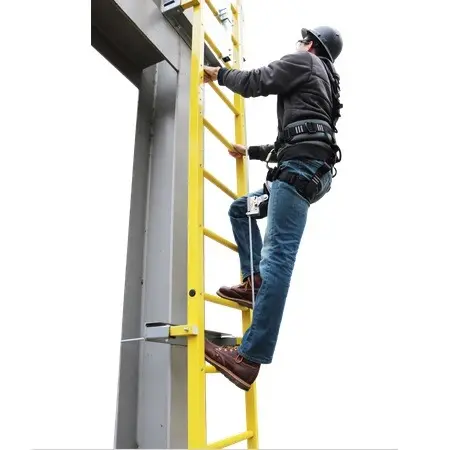
Introduction: Redefining Vertical Access Safety
For decades, the silhouette of an industrial building’s exterior was incomplete without the familiar sight of a caged fixed ladder. To building owners, facility managers, and even many contractors, these steel hoops offered a visual reassurance of safety—a structural barrier seemingly designed to catch a falling worker. However, engineering studies and accident forensic data have dismantled this safety illusion.
In response, the Occupational Safety and Health Administration (OSHA) enacted a sweeping regulatory overhaul that fundamentally redefines vertical access safety.
Under the amended OSHA Standard 1910.28(b)(9), the traditional ladder cage is being systematically phased out in favor of active fall protection technologies. This regulatory shift places a significant responsibility on roofing contractors and building owners. Not only must they understand the immediate compliance requirements for new installations and repairs, but they must also prepare for a hard, retroactive deadline that will make all traditional caged ladders obsolete.
With the compliance timeline currently in its active transition phase, navigating these changes requires a deep understanding of the regulations, the mechanical differences between compliant safety systems, and the biomechanics of fall arrest.
Main Facts: The New Paradigm of Fixed Ladder Safety
The regulatory landscape governing fixed ladders changed permanently on November 19, 2018, when OSHA published its updated walking-working surfaces rules. The core of this update was a critical reassessment of what constitutes effective fall protection on fixed ladders that extend more than 24 feet above a lower level.
+-----------------------------------------------------------------------------+
|                          OSHA FIXED LADDER COMPLIANCE                       |
|                             (Ladders > 24 Feet)                             |
+-----------------------------------------------------------------------------+
|                                                                             |
|  [ Installed Pre-Nov 19, 2018 ]   --->   Allowed: Cage, Well, PFAS,         |
|                                          or Ladder Safety System            |
|                                                                             |
|  [ Any Component Replaced ]       --->   MUST Upgrade to: PFAS              |
|                                          or Ladder Safety System            |
|                                                                             |
|  [ Installed Post-Nov 19, 2018 ]  --->   MUST Install: PFAS                 |
|                                          or Ladder Safety System            |
|                                                                             |
|  [ DEADLINE: Nov 18, 2036 ]       --->   ALL Ladders MUST Have PFAS         |
|                                          or Ladder Safety System            |
|                                          (Cages no longer compliant)        |
+-----------------------------------------------------------------------------+
The Demise of the Safety Cage
Historically, cages were accepted as a primary means of fall protection. OSHA’s revised standard, however, explicitly strips cages and wells of this designation for any ladder installed after the 2018 effective date.
The agency’s research revealed that cages do not stop a worker from falling; instead, they merely confine the fall. A worker who slips inside a cage often plummets vertically, striking the steel hoops and rungs on the way down, which frequently results in severe impact injuries or death.
Consequently, for any fixed ladder exceeding the 24-foot threshold, cages are no longer recognized as a stand-alone safety measure.
Defining Compliant Systems
To meet modern compliance standards, facilities must implement one of two approved methods:
- Ladder Safety System: Defined by OSHA as an integrated assembly designed to eliminate or reduce the possibility of a worker falling off a ladder. This typically includes a rigid rail or a flexible cable carrier permanently attached to the ladder, a safety sleeve (or cable grab) that travels along the carrier, a connector (such as a carabiner), and a full-body harness.
- Personal Fall Arrest System (PFAS): A system used to arrest an employee in a fall from a working level. For vertical ladder applications, this consists of an anchorage, connectors, and a body harness, often integrated with a vertical lifeline or a self-retracting lanyard (SRL).
These systems are designed to arrest a fall within inches, preventing the worker from colliding with the ladder structure or the ground below.
Chronology: The Road to the 2036 Deadline
OSHA’s regulatory transition was designed as a multi-stage, 18-year phase-out to prevent immediate financial shocks to building owners while steadily raising safety standards. Understanding this timeline is crucial for capital planning and facility maintenance scheduling.
       2018                          2036
---------|-----------------------------|--------->
     Nov 19, 2018                  Nov 18, 2036
     - Rule takes effect.          - Hard deadline.
     - New ladders require         - ALL fixed ladders >24'
       PFAS/Safety Systems.          must have PFAS/Safety Systems.
     - Repairs trigger upgrades.   - Cages completely phased out.
Phase I: The Pre-November 19, 2018 Legacy Era
Prior to the effective date of the amendment, building owners were permitted to install cages or wells on fixed ladders exceeding 24 feet to satisfy fall protection requirements. Ladders installed during this period are temporarily grandfathered under OSHA 1910.28(b)(9)(i)(A).
Owners of these legacy systems may continue to use them, provided they remain in good repair and no modifications are made. However, they must be equipped with a personal fall arrest system, ladder safety system, cage, or well.
Phase II: The November 19, 2018 Line in the Sand
For any fixed ladder installed on or after November 19, 2018, the grandfather clause does not apply. Under OSHA 1910.28(b)(9)(i)(B), all new installations exceeding the 24-foot height threshold must be equipped with a personal fall arrest system or a ladder safety system from day one. Cages can still be physically installed (often to deter unauthorized access or vandals), but they cannot serve as the designated fall protection system.
Phase III: The Maintenance and Replacement Trigger
The transition period features a critical "trigger clause" designed to gradually eliminate cages through routine maintenance. Under OSHA 1910.28(b)(9)(i)(C), if any section, rung, or portion of a legacy caged ladder is replaced, the entire ladder must be upgraded to include a personal fall arrest system or a ladder safety system.
This means that minor repairs can trigger a mandatory, comprehensive system retrofit.
Phase IV: The November 18, 2036 Hard Deadline
The final milestone of the phase-out is set for November 18, 2036. On and after this date, OSHA 1910.28(b)(9)(i)(D) mandates that all fixed ladders exceeding 24 feet, regardless of their installation date, must be equipped with an active personal fall arrest system or a ladder safety system.
By this date, the grandfathering of legacy caged ladders will officially end, making non-compliant systems a direct regulatory violation.
Supporting Data: Engineering and Biomechanical Realities of Falls
The transition from passive cages to active fall arrest systems is supported by significant engineering and biomechanical data.
The Failure of Cages in Vertical Falls
Biomechanical studies show that when a climber slips on a ladder, their natural instinct is to reach out and grab a rung. If they fail to do so, their descent is rapid.
Within a safety cage, the clearance between the climber and the cage hoops is typically 27 to 30 inches. This space is wide enough to allow a body to tumble freely, but narrow enough to guarantee high-velocity impacts with the steel structure during a fall.
+-----------------------------------------------------------------------+
|                       FALL DISTANCE AND FORCE COMPARISON              |
+-----------------------------------------------------------------------+
| SYSTEM TYPE             | FREE-FALL DISTANCE   | TYPICAL IMPACT FORCE |
+-------------------------+----------------------+----------------------+
| Standard Safety Cage    | Unlimited (to base)  | Fatal / Severe       |
| Cable Fall Arrest       | 6 to 18 inches       | < 900 lbs (Arrested) |
| Rigid Rail System       | 2 to 6 inches        | < 900 lbs (Arrested) |
+-----------------------------------------------------------------------+
Data from the Bureau of Labor Statistics (BLS) consistently identifies falls from height as one of the leading causes of fatal occupational injuries in construction and maintenance. By arresting a fall within inches, active safety systems reduce the impact forces on the human body to well below the threshold of severe trauma (typically limiting arresting forces to under 900 pounds, in compliance with ANSI standards).
The Ergonomics of Harness Selection: Solving the Neck and Chin Hazard
While roofing contractors are generally familiar with personal fall arrest systems, applying these systems to vertical fixed ladders introduces unique ergonomic and safety challenges. A key, often overlooked regulation is OSHA 1910.140(d)(1)(iv), which governs the performance of personal fall arrest systems. It mandates that the system must:
"…sustain the employee within the system/strap configuration without making contact with the employee’s neck and chin area."
This requirement has major implications for harness selection. Traditional fall protection harnesses utilize a single dorsal (back) D-ring. While highly effective for horizontal work and roof decks, a dorsal D-ring is poorly suited for vertical ladder safety systems.
   Traditional Dorsal D-Ring                 Sternal/Waist D-Ring
      (Back Attachment)                       (Front Attachment)

            |  (Lanyard pulls                         |  (Lanyard pulls
            |   up and back)                          |   forward/up)
            v                                         v
         [O] (D-ring)                              [O] (D-ring)
        /                                        /
       /        <-- Harness shifts              /        <-- Harness stays
      |  ( )  |      upward, pressing           |  ( )  |      aligned; no
         ^  /       webbing against                  /       neck contact.
          |          neck/chin.
If a climber falls while connected to a vertical cable system via a dorsal D-ring, the pulling force is directed from behind. This force pulls the harness straps upward and forward, which can force the chest strap and collar webbing directly against the user’s throat and chin. This presents a serious risk of airway obstruction or neck injury during arrest.
To resolve this issue, employers and contractors must utilize harnesses equipped with a sternal (chest) D-ring or a specialized waist-mounted D-ring. These front-facing attachment points keep the arresting force centered on the user’s torso, ensuring the body remains upright and preventing the harness webbing from sliding upward toward the neck and chin.
Official Responses and Industry Perspectives
The transition away from safety cages has drawn strong reactions and strategic adjustments from regulators, safety associations, and industry manufacturers.
Regulatory Intent and Enforcement
OSHA’s regulatory impact analysis projected that the updated walking-working surfaces rule would prevent nearly 30 fatalities and over 5,800 injuries annually across all affected industries. OSHA inspectors have increased their focus on vertical access points during facility walk-throughs, paying close attention to:
- Ladder installations dating post-November 2018.
- Any signs of recent repairs on older caged ladders that should have triggered a full upgrade.
- The presence of appropriate labeling on installed ladder safety systems.
Industry Adaptations
The National Roofing Contractors Association (NRCA) and other safety advocacy groups have focused on educating contractors about these changes. The primary challenge is often educating facility owners, who may view their existing caged ladders as perfectly safe because they have been in place for decades.
Equipment manufacturers have responded by developing modular, easy-to-install retrofit kits. Rather than requiring the complete demolition of an existing ladder, modern solutions allow contractors to mount vertical cable systems directly to the existing rungs.
For example, system components like the Roofmaster Fall Arrest Cable System can be retrofitted onto existing structures, providing a cost-effective path to compliance without requiring complete structural replacement.
Strategic Implications: Liability, Compliance, and the Role of Roofing Partners
The transition away from ladder cages is more than a technical safety update; it is a significant risk-management issue for building owners and roofing contractors alike.
Mitigating Owner Liability and Risk
For building owners, maintaining a non-compliant or outdated vertical access system carries major liability risks. In the event of a fall-related injury on an unmodified legacy ladder, the owner may be shielded from some liability if the ladder was grandfathered.
However, if any repairs have been made to that ladder post-2018 without upgrading the safety system, the facility is in direct violation of OSHA standards. This exposure can lead to substantial regulatory fines, increased insurance premiums, and potential civil litigation.
Furthermore, proactive building owners are choosing to bypass the 2036 deadline entirely by upgrading their systems during scheduled roof renovations. This approach minimizes mobilization costs and ensures facility safety well ahead of the regulatory mandate.
+--------------------------------------------------------------------------+
|                       CHECKLIST FOR BUILDING OWNERS                      |
+--------------------------------------------------------------------------+
|  [ ] Identify all fixed ladders exceeding 24 feet (internal & external). |
|  [ ] Document installation dates to determine grandfathering status.     |
|  [ ] Inspect ladders for any post-2018 repairs or modifications.         |
|  [ ] Verify that user harnesses feature sternal/waist D-rings.            |
|  [ ] Develop a capital improvement plan to retrofit systems before 2036.  |
+--------------------------------------------------------------------------+
The Role of Contractors as Safety Consultants
Roofing contractors are uniquely positioned to act as safety consultants for building owners. When bid opportunities arise for roof replacements or maintenance, contractors should routinely inspect both internal roof hatches and external access ladders.
By identifying non-compliant systems and proposing integrated safety upgrades, contractors can provide valuable expertise, protect workers, and build stronger, trust-based relationships with clients.
Partnering with Experienced Suppliers
Implementing compliant ladder safety systems requires sourcing high-quality hardware designed to meet both OSHA standards and the practical demands of field use. From vertical lifelines and cable systems to specialized front-attachment harnesses, selecting the right equipment is critical.
With over 70 years of industry experience and five locations nationwide, Roofmaster is well-equipped to help contractors navigate these complex regulatory requirements. By providing expert guidance and a comprehensive range of OSHA-compliant vertical safety systems, Roofmaster continues to support the contracting community in building a safer, fully compliant industrial infrastructure.
