

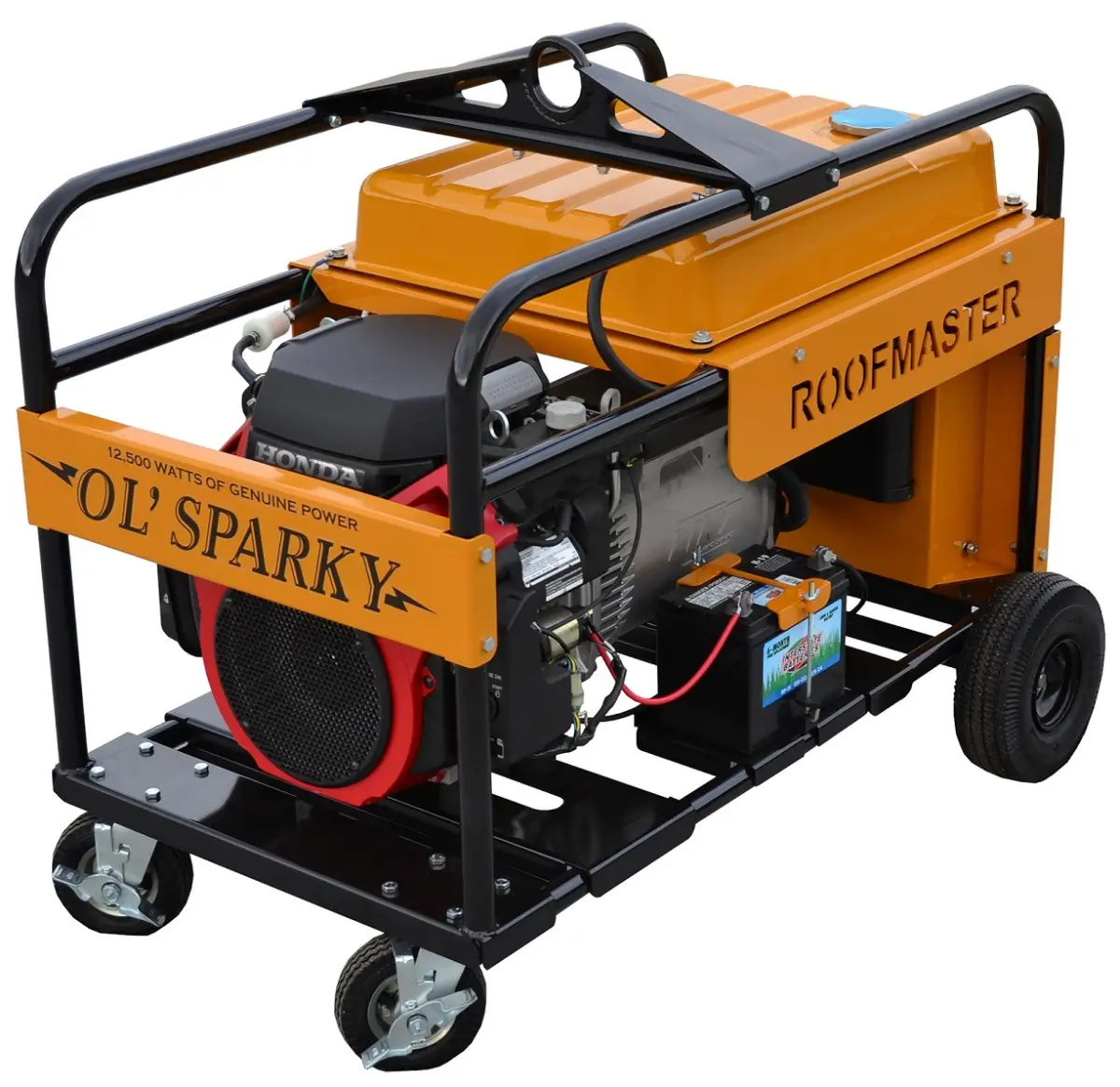
As California steps into a new regulatory era, a sweeping environmental mandate is quietly reshaping the state’s construction, roofing, and specialty contracting landscapes. Passed in 2021 under Assembly Bill 1346, the state’s ban on the sale of new gas-powered Small Off-Road Engines (SORE) officially took effect on January 1, 2024.
While initial public discourse focused almost exclusively on residential lawnmowers and leaf blowers, the reality of the regulation extends far deeper into industrial supply chains. Today, California contractors are grappling with a hard truth: the law bans the sale of most gas-powered portable generators, roofing pumps, material handling hoists, and tear-off equipment. As pre-2024 equipment inventories dwindle, the construction sector faces an unprecedented transition toward battery and electric power—a shift for which many argue the technology is not yet ready.
1. Main Facts: The Scope of Assembly Bill 1346
At its core, Assembly Bill 1346 targets Small Off-Road Engines (SORE), defined by the California Air Resources Board (CARB) as spark-ignition engines rated at or below 19 kilowatts—equivalent to approximately 25 gross horsepower.
[All SORE Equipment ≤ 25 HP]
       │
       ├─► Residential/Landscaping (Lawnmowers, Leaf Blowers, Weed Trimmers)
       │
       └─► Industrial/Construction (Portable Generators, Roofing Pumps, Hoists)
While the public was assured that heavy-duty construction and agricultural machinery would remain unaffected, the 25-horsepower threshold swept up an array of essential jobsite tools. The regulations do not outlaw the use of existing gas-powered SORE equipment; contractors and homeowners may continue to operate their current fleets. However, the law strictly prohibits the sale of new gas-powered units manufactured after December 31, 2023.
For the roofing and commercial construction sectors, this ban impacts several critical categories of equipment:
- Portable Generators: The lifeline of jobsites lacking grid connectivity, used to power high-draw tools, commercial lighting, and safety equipment.
- Roofing Pumps and Spray Applicators: Used for transporting liquid-applied membranes, adhesives, and coatings to elevated work areas.
- Material Handling and Hoisting Equipment: Small gas-powered winches and hoists used to lift heavy materials to rooftops.
- Tear-Off Machines: Gas-powered scrapers and cutters used to strip old roofing systems down to the deck.
The Inventory Loophole: A Temporary Reprieve
Under the CARB framework, manufacturers and distributors are permitted to sell off their remaining stock of equipment powered by certified engines manufactured prior to 2024. Consequently, distributors are currently supplying the market with 2023-compliant models. However, once these warehouse inventories are exhausted, new gas-powered options under 25 horsepower will permanently disappear from California retail shelves.
2. Chronology: The Road to the 2024 Cutoff
The transition from legislative proposal to market reality took place over a swift three-year period, catching many specialized industries off guard.
2021 (Oct)        2021 (Dec)        2022-2023         2024 (Jan 1)      2024+
  │                 │                 │                 │                 │
  ▼                 ▼                 ▼                 ▼                 ▼
AB 1346          CARB Adopts       OEM Stockpile     Sales Ban        Inventory
Signed Regulations Phase Takes Effect Depletion- October 2021 – Legislative Passage: Governor Gavin Newsom signed Assembly Bill 1346 into law. The bill directed CARB to write and adopt regulations to phase out the sale of SORE by 2024, or as soon as CARB determined was technologically feasible.
- December 2021 – CARB Rulemaking: CARB formally adopted the SORE regulations. The board established a strict enforcement date of January 1, 2024, for most categories of small engines, including those used in commercial landscaping and portable power generation.
- 2022 to 2023 – The Stockpiling Phase: Original Equipment Manufacturers (OEMs) and industrial distributors began adjusting production schedules. Many accelerated the production of 2023-compliant engines to build a buffer stock, anticipating the supply crunch that would hit California in 2024.
- January 1, 2024 – Enforcement Commences: The manufacture and import for sale of new non-compliant gas-powered SORE under 25 horsepower within California became illegal.
- Mid-2024 and Beyond – The Exhaustion Era: The industry entered the "sell-through" phase. Distributors began rationing and selling remaining 2023 inventories, signaling the final countdown for gas-powered acquisition in the state.
3. Supporting Data: The Environmental and Technical Divide
The regulatory push behind AB 1346 is rooted in stark environmental data, but the practical execution of the law highlights a severe technological divide between residential lawn care and industrial construction.
The Environmental Argument
According to CARB, small off-road engines are disproportionately dirty compared to modern passenger vehicles, which have benefited from decades of highly advanced catalytic converter and emissions-control technologies.
| Equipment Type / Metric | Smog-Forming Emissions Equivalent |
|---|---|
| Commercial Leaf Blower (1 Hour of Operation) | Driving a 2017 Toyota Camry 1,100 miles |
| Standard SORE Lawnmower (1 Hour of Operation) | Driving a modern passenger car 300 miles |
By 2020, CARB estimated that SORE emissions in California exceeded emissions from light-duty passenger cars. With the state aiming for carbon neutrality by 2045, regulators identified SORE as a critical, high-yield target for immediate emissions reductions.
The Technical Reality: The Roofing Power Deficit
While battery technology has successfully replaced small gas engines in hand tools like screw guns, drills, and reciprocating saws, it faces physical limitations when scaled up to meet the demands of commercial roofing applications.
Commercial roofing often utilizes single-ply membranes (such as TPO or EPDM) that must be fused together using automatic hot-air welders. These machines require clean, continuous, high-voltage power to operate effectively.
[Typical Commercial Hot-Air Welder]
       │
       ├─► Voltage Requirement: 230V (Single or Three-Phase)
       ├─► Current Draw: 15 to 30 Amps
       └─► Continuous Run Time: 8 to 10 Hours per Shift
To run a single commercial hot-air welder continuously for an eight-hour shift requires approximately 30 to 40 kilowatt-hours (kWh) of electricity.
- Gasoline Energy Density: A small, 10-horsepower gas generator can easily supply this power for a full day on just a few gallons of gasoline.
- Battery Alternative Weight & Cost: A battery system capable of delivering 40 kWh of continuous high-voltage power weighs upwards of 600 to 800 pounds and costs thousands of dollars. Transporting such heavy battery banks onto a roof introduces structural load challenges and safety hazards for workers.
4. Official Responses: Regulators vs. Industry
The rollout of AB 1346 has exposed a significant disconnect between the optimistic projections of state regulators and the logistical concerns of trade associations.
The California Air Resources Board (CARB)
CARB maintains that the transition to Zero-Emission Equipment (ZEE) is not only necessary for public health but is also economically viable in the long run. In regulatory impact reports, CARB asserted:
"Zero-emission equipment is widely available, quieter, and has lower operating and maintenance costs than gas-powered equivalents. The health benefits of reducing localized smog-forming pollutants and toxic air contaminants will save lives and reduce healthcare costs across California, particularly in disadvantaged communities."
Addressing concerns regarding portable generators, CARB pointed to the growing market for commercial-grade portable battery power stations and solar-integrated generators as suitable, scalable alternatives.
Industry and Trade Associations
In contrast, roofing and construction trade groups, such as the Western States Roofing Contractors Association (WSRCA), have expressed deep concern over the speed of the mandate and the lack of viable alternatives for heavy-duty applications.
Industry representatives argue that the "construction exemption" widely discussed during the bill’s drafting was misleading. While heavy earth-moving equipment and large diesel engines (above 25 HP) are exempt, the small, highly portable tools that form the backbone of daily jobsite operations are not.
A spokesperson from a major regional roofing equipment distributorship summarized the industry’s frustration:
"We support clean air initiative goals, but the technology is simply not there yet to support a commercial jobsite on battery power alone. When you are on a roof with multiple trades requiring three-phase clean power, batteries are not a viable option. Forcing this transition before the infrastructure is ready puts contractors in an impossible situation."
5. Implications: The Post-Gasoline Construction Landscape
As California’s inventory of pre-2024 gas-powered SORE equipment depletes, the construction and roofing industries face a series of near-term disruptions.
[Dwindling 2023 Gas Inventory]
       │
       ├─► Option A: Shift to Heavy Diesel Generators (>25 HP) ──► *Higher emissions, higher costs*
       ├─► Option B: Sourcing from Out-of-State ────────────────► *Regulatory & compliance risks*
       └─► Option C: Transition to Battery Power ───────────────► *High capital expense, weight limits*
The Diesel Paradox
One of the most immediate unintended consequences of the SORE ban is the potential pivot to larger, dirtier engines. Because engines above 25 horsepower are exempt from AB 1346, contractors unable to use small gas generators may be forced to lease or purchase larger, tow-behind diesel generators.
These diesel units, while capable of providing the necessary three-phase power, are heavier, more expensive to operate, and often emit more total particulate matter than the small, efficient gas generators they replace. This creates a regulatory paradox where environmental policy inadvertently drives the use of larger fossil-fuel engines.
The Out-of-State "Leakage" Market
Industry analysts predict a rise in "border leakage," where California-based contractors travel to neighboring states like Nevada, Arizona, or Oregon to purchase new, non-compliant gas equipment.
While operating this equipment back in California remains technically legal for the time being, the logistical hassle and lack of local dealer warranty support for non-compliant models will create operational headaches for fleet managers.
Capital Cost Inflation
The financial burden of transitioning to zero-emission technology will fall heavily on small-to-mid-sized contracting businesses. A standard, reliable gas-powered generator costs between $800 and $2,500. A commercial-grade lithium-ion power station with comparable output and running time can easily cost between $6,000 and $15,000, excluding the cost of replacement batteries and specialized charging infrastructure. These increased capital costs will inevitably be passed down to consumers, further inflating the cost of building and maintaining infrastructure in California.
The Immediate Action Call for Contractors
For contractors operating within the Golden State, the window of transition is closing rapidly. While manufacturers and distributors still hold limited reserves of 2023-certified gas equipment, these stocks are finite.
For businesses that rely on portable gas power, pumps, and hoists to maintain operational efficiency, the strategic advice from industry distributors is clear: the best time to invest in backup gas-powered fleet assets was yesterday. The second-best time is today, before the remaining inventory disappears from the California market entirely.
