

By Alan Bradley
Consumer Technology & Outdoor Equipment Contributor
Main Facts
Electric pressure washers have fundamentally transformed how homeowners tackle routine outdoor maintenance. Offering a compelling alternative to gas-powered machinery, modern electric models eliminate the need for flammable fuels, heavy engine maintenance, and ear-splitting noise levels. Because of this high level of everyday convenience, corded electric and battery-powered pressure washers now dominate testing metrics across the consumer landscape. However, as prices scale from economical entry-level units to feature-heavy premium models, a pressing consumer question remains: Just how much additional performance are buyers actually getting for their money at the higher end of the pricing spectrum?

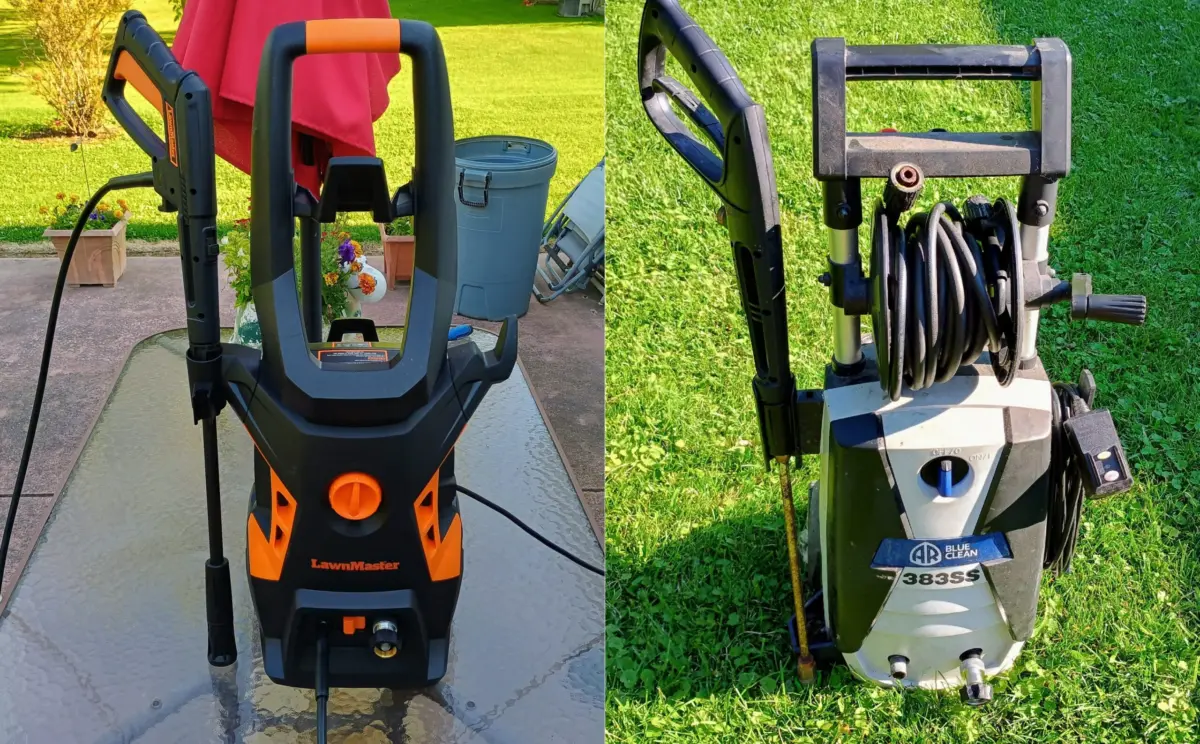
To answer this question directly, a side-by-side performance evaluation was conducted comparing the budget-friendly LawnMaster LT506-2000A—which retails between $100 and $120 depending on localized PSI specifications—against the AR Blue Clean 383SS. While the specific AR Blue Clean 383SS model evaluated here is no longer actively manufactured or sold, it was originally purchased for approximately $250 a few years prior, with comparable modern mid-to-high-tier iterations currently retailing between $300 and $400.
The testing methodology pitted a designated value-class contender against an established, mid-tier incumbent. Both units were subjected to identical environmental stressors, utilizing the exact same water supply, comparable spray widths, and matching application distances. The findings reveal that budget electric hardware has evolved significantly, with the LawnMaster matching or even exceeding its more expensive rival across multiple core metrics.

Chronology and Testing Evolution
The evaluation process was structured to test each machine’s assembly ease, portability, hardware integration, and real-world cleaning efficiency. Prior to testing, both units were unpacked, evaluated for build quality, and prepared for active duty.
Phase 1: Unboxing and Assembly
- AR Blue Clean 383SS: Long-term ownership of the AR Blue Clean revealed a slightly complex assembly and setup process. Reconnecting legacy hoses and nozzles routinely involves troubleshooting minor fittings and leaks—a common symptom of wear over three years of operation.
- LawnMaster LT506-2000A: In stark contrast, unboxing and assembling the LawnMaster was completed in under 15 minutes. Utilizing intuitive snap-fit components and a minimal number of structural screws, the out-of-the-box experience proved exceptionally user-friendly.
Phase 2: Real-World Performance Trials
To establish an empirical baseline, each washer was tested across three distinct domestic surfaces treated with a standardized mud-and-soil slurry. The AR Blue Clean utilized its default 25-degree quick-connect nozzle tip, while the LawnMaster’s integrated adjustable nozzle was manually calibrated to mirror a matching 25-degree spray width at an identical standoff distance.

- Vehicle Cleaning Test: Evaluated on the side panels and wheels of a black 2017 Chevy Bolt.
- Concrete Patio Test: Tested on a sealed, heavily stained concrete slab plagued by stubborn organic algae patches.
- House Siding Test: Deployed against a standard light-gray vinyl siding installation coated in a diluted mud wash.
Supporting Data and Hardware Specifications
Understanding the performance delta between these two pressure washers requires a close examination of their internal engineering, raw output figures, and included accessory ecosystems.
| Technical Specification | LawnMaster LT506-2000A | AR Blue Clean 383SS |
|---|---|---|
| Estimated Price Point | $100 – $120 | $300 – $400 (Equivalent current models) |
| Max Pressure Rating | Up to 2,300 PSI | Up to 1,900 PSI |
| Rated Pressure (Manual) | 1,650 PSI | Not Specified |
| Water Flow Rate (GPM) | 1.4 Gallons Per Minute | 1.3 Gallons Per Minute |
| Motor Specifications | 13-Amp, 120-Volt | 13-Amp, 120-Volt |
| Total Unit Weight | ~22.6 pounds | ~32.0 pounds |
| Hose Length | 20-foot high-pressure hose | 30-foot high-pressure hose |
| Power Cord Length | 35 feet | 35 feet |
| Onboard Integration | Foam bottle, spray gun, specialized brushes | Hose reel, 28-oz detergent tank, pro spray gun |
Hardware Analysis: Power vs. Practicality
The technical data sheet grants the LawnMaster an immediate numerical advantage in maximum pressure capacity (2,300 PSI vs. 1,900 PSI) and water displacement volume (1.4 GPM vs. 1.3 GPM). However, industrial engineers and consumer advocates alike note that peak PSI is only a single component of a washer’s overall efficacy. Pump consistency, water flow dynamics, nozzle engineering, and unit maneuverability dictate how effectively a stream lifts and displaces bonded particulates.

Both systems are engineered exclusively for cold-water applications. They are explicitly designed for routine residential sanitation tasks rather than heavy-duty commercial operations. Consumers must maintain realistic expectations: neither electric unit should be mistaken for a professional gas-powered pressure washer capable of stripping exterior house paint, stripping deep-set wood stains, or scouring multi-acre commercial parking lots. Instead, these compact electric machines excel at delicate-to-moderate household chores, including vehicle detailing, patio furniture maintenance, barbecue grill degreasing, and localized deck scrubbing.
Accessories and Ergonomics
- LawnMaster Inclusions: The LT506-2000A ships with an adjustable spray gun, high-pressure hose, turbo lance, integrated foam bottle, a general cleaning brush, and a dedicated wheel-hub brush. While its 20-foot high-pressure hose is notably shorter than the AR’s 30-foot line, the inclusion of specialized automotive and wheel brushes provides immediate out-of-the-box value for car owners.
- AR Blue Clean Inclusions: The 383SS adopts a more traditional configuration featuring quick-connect nozzle tips, a rotary turbo nozzle, a built-in 28-ounce detergent tank, and an integrated hose reel. The hose reel greatly simplifies post-use storage, though the trade-off is physical weight: at 32 pounds, the AR model is noticeably heavier and less agile to lift than the 22.6-pound LawnMaster.
Both systems incorporate a "Total Stop System" (TSS) feature, which automatically cuts power to the electric motor the moment the spray gun trigger is released, thereby conserving energy and minimizing premature pump wear.

Detailed Test Results
Test 1: Vehicle Detailing
- AR Blue Clean Performance: On an initial single-pass sweep across the muddy side panels of the Chevy Bolt, the AR removed the bulk of loose surface dirt. However, it left behind visible streaking and concentrated patches of grime along the tire sidewalls and lower door framing.
- LawnMaster Performance: The LawnMaster delivered a more uniform cleaning pass, particularly around the rear tire assembly. While minor smudging remained—expected from a single, quick pass without manual agitation—the LawnMaster avoided leaving large, unwashed blocks of dried mud, demonstrating superior coverage and stream control.
Test 2: Concrete Patio Restoration
- AR Blue Clean Performance: Operating on sealed, weathered concrete featuring embedded green algae, the AR successfully lifted general atmospheric staining and discoloration. However, it struggled significantly against the stubborn biological growth, leaving the majority of the algae intact after a single pass.
- LawnMaster Performance: The LawnMaster leveraged its superior maximum pressure output to decisively outperform its rival on concrete. A single pass successfully blasted away not just surface discoloration, but the vast majority of visible algae.
This test clearly illustrated how numerical pressure advantages translate into time savings on hard masonry surfaces. While subsequent passes with the AR Blue Clean eventually cleared the remaining algae, the LawnMaster completed the task efficiently in a single run.
Test 3: Vinyl House Siding
- AR Blue Clean Performance: Applied against a heavily soiled section of light-gray vinyl siding coated in a mud slurry, the AR performed admirably, erasing all traces of mud and leaving both the siding and underlying concrete pristine in one pass.
- LawnMaster Performance: The LawnMaster matched this performance stride-for-stride, making quick work of the vertical siding and leaving the test zone thoroughly sanitized.
Because the mud slurry adhered less aggressively to vertical vinyl surfaces than to porous concrete, performance parity was highest during this trial. Both machines proved more than capable of handling typical siding maintenance.

Official Responses and Manufacturer Positioning
While neither LawnMaster nor AR North America provided ad-hoc corporate statements for this specific comparative review, industry positioning and product documentation outline clear corporate strategies for both brands.
AR Blue Clean has historically positioned its product lines around robust build quality, premium onboard storage features like integrated hose reels, and expansive service networks aimed at long-term durability. Their mid-to-high-tier pricing reflects a philosophy centered on user convenience features and professional-grade aesthetic styling.

Conversely, LawnMaster targets the value-conscious consumer demographic by streamlining unnecessary structural bulk—resulting in a lighter, highly portable chassis—while maximizing raw output specifications (PSI and GPM) and bundling high-value accessories (such as specialized wheel brushes and foam bottles) directly into the base purchase price. This strategy aims to capture market share from legacy brands by offering high-impact performance at an aggressive, sub-$120 price point.
Implications for Consumers
The comparative evaluation of the LawnMaster LT506-2000A and the AR Blue Clean 383SS carries several distinct implications for the consumer hardware market:

- The Erosion of the "Price-Performance" Gap: For decades, buyers looking for high cleaning power were forced into the $250–$400 price bracket. The performance of the LawnMaster demonstrates that budget-engineered electric pressure washers can now match or exceed legacy mid-tier models in core cleaning tasks like concrete restoration and vehicle washing.
- Value vs. Long-Term Longevity: A primary consideration for budget-tier power equipment is long-term mechanical durability. While premium brands often utilize heavier-duty brass or aluminum pump components designed to last a decade, budget models often rely on composite or mixed-material pumps. However, at a retail price point of around $100, the financial risk is substantially mitigated, making budget washers attractive even for seasonal or sporadic users.
- Ergonomic Priorities: Consumers must weigh feature convenience against portability. Features like integrated hose reels and 30-foot hoses (found on units like the AR Blue Clean) add weight and bulk, whereas lightweight designs (like the LawnMaster) prioritize ease of lifting and compact garage storage over heavy-duty structural housing.
Final Verdict and Buying Recommendations
For shoppers currently navigating the crowded electric pressure washer market, the LawnMaster LT506-2000A emerges as an exceptionally strong recommendation. By combining a lightweight frame, high maximum pressure output, and an extensive kit of included accessories at a price point roughly $150 to $200 cheaper than comparable mid-tier alternatives, it represents an outstanding consumer value.
While questions regarding long-term multi-year durability remain inherent to any upstart budget-tier hardware, the immediate out-of-the-box performance metrics speak for themselves. The LawnMaster matched or significantly outperformed an aging, more expensive legacy competitor across rigorous multi-surface testing. For homeowners seeking a reliable, powerful, and budget-friendly tool to manage routine vehicle detailing, patio cleaning, and seasonal home maintenance, the LawnMaster LT506-2000A stands out as a clear market winner.
