

By Automotive Desk
Published: October 2026
Volkswagen has officially pulled the covers off one of its most critical electric vehicle launches to date: the all-new, purely electric Volkswagen ID. Tiguan. Designed to succeed the aging ID.4 and ID.5 models—which have served as the backbone of the German automaker’s global EV strategy since 2021—the ID. Tiguan promises to correct course on several design and usability criticisms that plagued its predecessors.
With a traditional, more robust SUV aesthetic, a massive interior tech overhaul that notably welcomes back physical buttons, and a class-leading range of up to 372 miles (600 km) on the WLTP cycle, the ID. Tiguan is being positioned as a "True Volkswagen" ready to conquer both European and North American markets.
![Volkswagen’s best-seller has gone electric, and it will replace the ID.4 and ID.5 [Images]](https://electrek.co/wp-content/uploads/sites/3/2026/10/Volkswagen-ID-Tiguan-ID-4-images.jpeg?quality=82&strip=all&w=1400)
Main Facts
The Volkswagen ID. Tiguan represents a complete pivot in the brand’s design philosophy and product execution for its high-volume electric segment. Key highlights of the new vehicle include:
- The Core Replacement: The ID. Tiguan officially replaces the ID.4 and ID.5 crossovers, building upon the massive success of its predecessors, which have notched over 950,000 sales globally since 2021.
- Exterior Styling: Moving away from the ultra-aerodynamic, sometimes polarizing "jellybean" shape of the ID.4, the ID. Tiguan adopts VW’s new Pure Positive design language. It features a boxier, wider, and chunkier front end that mimics its gas-powered Tiguan sibling, complete with traditional pull-style door handles.
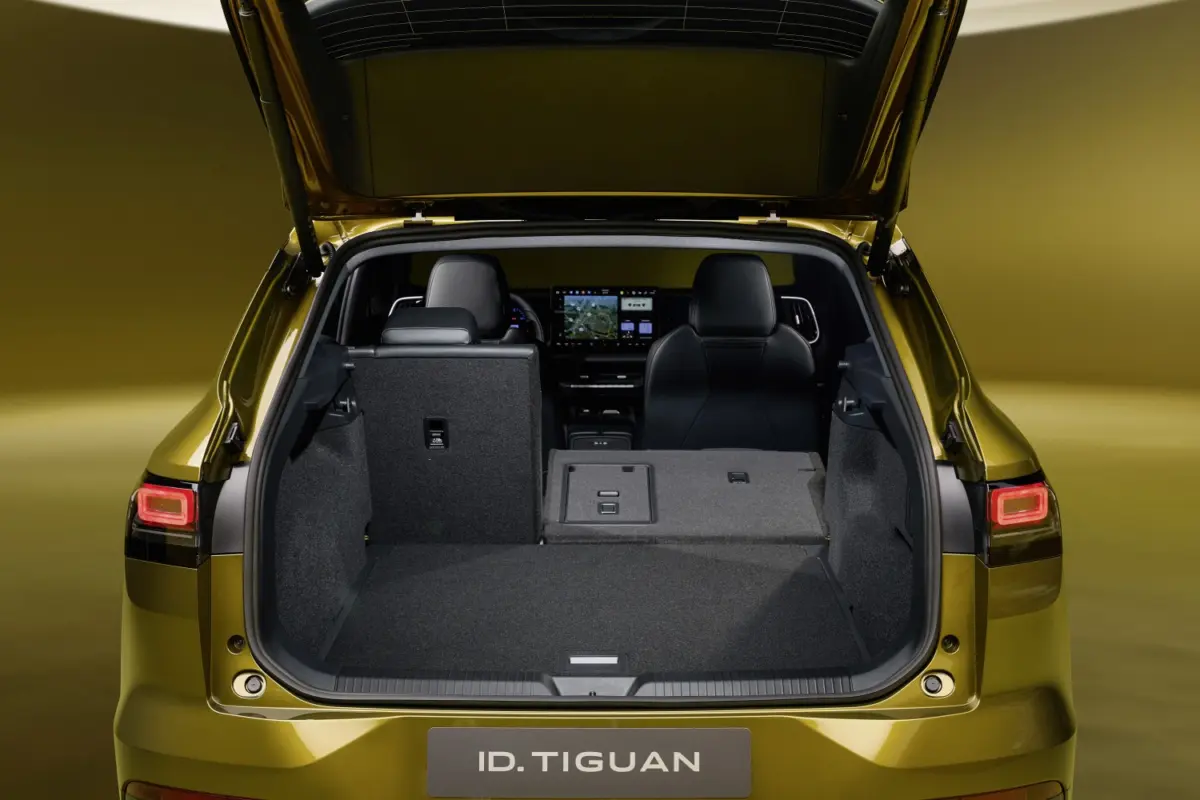
- Cabin and Technology Overhaul: The interior receives a major upgrade, anchored by a 10-inch Digital Cockpit and a prominent 15-inch central infotainment screen, with an optional 12-inch front passenger display.
- The Return of Physical Buttons: Responding directly to consumer and media feedback, Volkswagen has reintroduced physical buttons below the central display and directly onto the steering wheel, drastically improving ergonomics.
- Nostalgic Software Features: The digital cockpit features a fun "Retro Mode" mirroring the iconic blue-red instrument lighting of the Golf IV, alongside a virtual "garage" where drivers can display classic VW models like the Golf I, Golf II Country, Beetle, and Race Touareg.
- Powertrain, Range, and Performance: Available with two battery sizes (58 kWh and 77 kWh) and three power tiers reaching up to 295 horsepower (299 PS), the ID. Tiguan achieves a phenomenal WLTP range of up to 372 miles (600 km). Towing capacity reaches up to 4,400 lbs (2,000 kg).
- Pricing and Availability: European sales kick off on October 13, with a starting price of 42,695 euros ($47,800) across four trim levels (Trend, Life, Style, and R-Line). It will roll out broadly across Europe ahead of an official North American launch.
Chronology of Development: From ID.4 to the ID. Tiguan
The path to the ID. Tiguan has been a multi-year evolutionary process for Volkswagen, marked by shifting consumer demands, interior complaints, and a corporate drive to align electric vehicles with the brand’s core heritage.
2021–2023: The ID.4 Era
When Volkswagen launched the ID.4 in 2021, it was heralded as a major milestone—the first true global mass-market EV built on the modular MEB platform. Joined later by the coupe-styled ID.5, the vehicles performed admirably well, moving over 950,000 units worldwide. However, as the electric vehicle market matured, owners and reviewers levied consistent critiques against the vehicle. The heavy reliance on touch-sensitive capacitive sliders, the lack of physical buttons, and the slippery, anonymous aerodynamic exterior styling left many traditional Volkswagen loyalists wanting a more grounded, practical vehicle.
![Volkswagen’s best-seller has gone electric, and it will replace the ID.4 and ID.5 [Images]](https://electrek.co/wp-content/uploads/sites/3/2026/10/Volkswagen-ID-Tiguan-ID-4-images-1.jpeg?quality=82&strip=all)
2024–2025: The Course Correction
Recognizing that the EV market required a transition from early adopters to mainstream buyers, Volkswagen’s leadership initiated a sweeping interior and exterior redesign strategy. Following the lower-tier introductions of the smaller ID. Polo and ID. Cross, engineering teams focused heavily on the core segment: the compact SUV market historically dominated by the Tiguan nameplate. VW realized that keeping the iconic "Tiguan" moniker—synonymous with ruggedness, family utility, and traditional SUV styling—was far more powerful than maintaining a purely alphanumeric naming convention.
October 2026: The Global Unveiling
Volkswagen officially debuted the ID. Tiguan, setting the stage for its commercial rollout. By leveraging the Tiguan name, the company aims to bridge the psychological gap for internal combustion engine (ICE) drivers hesitant to make the jump to electric mobility. The vehicle marks the definitive retirement of the ID.4 and ID.5 naming architecture in key markets as Volkswagen streamlines its global electric offerings.
Supporting Data & Technical Specifications
The engineering underlying the ID. Tiguan highlights significant advancements in efficiency, battery density, and utility compared to the outgoing ID.4.
![Volkswagen’s best-seller has gone electric, and it will replace the ID.4 and ID.5 [Images]](https://electrek.co/wp-content/uploads/sites/3/2026/10/Volkswagen-ID-Tiguan-ID-4-images-side.jpeg?quality=82&strip=all)
| Metric / Feature | Outgoing Volkswagen ID.4 | New Volkswagen ID. Tiguan |
|---|---|---|
| Platform | MEB (First Generation) | Advanced MEB Evolution |
| Design Language | Aerodynamic / Rounded | "Pure Positive" / Traditional Boxy SUV |
| Max Range (WLTP) | ~320 miles (depending on pack) | Up to 372 miles (600 km) |
| Max Horsepower | Up to 295 hp (AWD variants) | Up to 295 hp (299 PS) |
| Battery Options | 52 kWh / 77 kWh / 82 kWh (US) | 58 kWh / 77 kWh |
| Max Towing Capacity | ~2,700–3,500 lbs | Up to 4,400 lbs (2,000 kg) with 77 kWh |
| Infotainment Display | 10" or 12" center screen | 10" Digital Cockpit + 15" Center (Opt. 12" Passenger) |
| Ergonomics | Touch sliders / Haptic buttons | Physical buttons + touch controls |
Battery, Performance, and Utility Breakdown
The ID. Tiguan introduces class-leading efficiency numbers for Volkswagen’s European lineup. The integration of lighter, denser battery packs allows the vehicle to achieve a WLTP-rated 372 miles of range, blowing past the efficiency metrics of its predecessor.
Furthermore, utility has not been sacrificed for styling. With a maximum towing capacity of 4,400 lbs (2,000 kg) when equipped with the larger 77 kWh battery pack, the ID. Tiguan easily outperforms many compact electric crossovers on the market, making it an ideal vehicle for active families, campers, and those needing genuine utility from an EV.
Official Responses and Corporate Strategy
Volkswagen executives have heavily emphasized that the ID. Tiguan is more than just a mid-cycle refresh—it is a philosophical turning point for the brand.
![Volkswagen’s best-seller has gone electric, and it will replace the ID.4 and ID.5 [Images]](https://electrek.co/wp-content/uploads/sites/3/2026/10/Volkswagen-ID-Tiguan-ID-4-images-interior.jpeg?quality=82&strip=all)
"The ID. Tiguan is designed to be a True Volkswagen in every sense of the word," notes corporate messaging from the automaker. "It combines the emotional connection of our most successful historical nameplates with the cutting-edge efficiency of our next-generation electric architecture."
Volkswagen has explicitly framed the exterior redesign around shifting consumer preferences. By stepping away from strict aerodynamic teardrop shapes in favor of a wider, chunky front end and traditional pull-style door handles, the company aims to elevate the vehicle’s perceived value.
“It looks like a vehicle from the premium segment,” Volkswagen claimed during the unveiling event in Germany.
![Volkswagen’s best-seller has gone electric, and it will replace the ID.4 and ID.5 [Images]](https://electrek.co/wp-content/uploads/sites/3/2026/10/Volkswagen-ID-Tiguan-ID-4-images-display.jpeg?quality=82&strip=all)
Additionally, addressing the severe customer pushback regarding touch-only controls, management validated user complaints by bringing back tactile, physical buttons. The inclusion of the "Retro Mode"—allowing drivers to view classic instrument panels inspired by the Golf IV—signals a newfound corporate confidence in celebrating Volkswagen’s rich automotive history rather than trying to mask it behind futuristic minimalism.
Market Implications: What This Means for Europe and North America
The launch of the ID. Tiguan carries massive ramifications for Volkswagen’s competitive standing in the global EV landscape, particularly as legacy automakers face fierce pressure from aggressive domestic and international competitors.
1. Re-capturing Mainstream Buyers in Europe
Starting at 42,695 euros ($47,800) in Germany, the ID. Tiguan hits the sweet spot of the European market. By offering four distinct trim levels (Trend, Life, Style, and R-Line) and a staggering 372-mile range option, VW provides choices tailored to budget-conscious commuters as well as high-end buyers. October 13 marks the initial sales push across Germany and select European territories, acting as a crucial test for whether traditional nameplates can successfully anchor an EV transition.
![Volkswagen’s best-seller has gone electric, and it will replace the ID.4 and ID.5 [Images]](https://electrek.co/wp-content/uploads/sites/3/2026/10/Volkswagen-ID-Tiguan-ID-4-images-interior-rear.jpg)
2. The North American Transition
While Europe gets first dibs through early 2027, Volkswagen has confirmed that the ID. Tiguan will eventually replace the ID.4 in North America. Though exact North American pricing, timelines, and final EPA estimates remain to be announced "in due course," the implications are clear.
The outgoing ID.4 utilizes an 82 kWh battery pack yielding an EPA-estimated range of up to 291 miles for the rear-wheel-drive variant, and roughly 263 miles for the all-wheel-drive model. Given that the European ID. Tiguan achieves roughly 25 additional miles over its predecessor on the WLTP cycle, automotive analysts project that the North American-spec ID. Tiguan will comfortably clear the psychological 300-mile EPA range barrier.
Combined with a more rugged, traditional SUV stance that resonates deeply with North American buyers, the ID. Tiguan could provide Volkswagen with the exact catalyst it needs to revitalize its American electric vehicle market share.
![Volkswagen’s best-seller has gone electric, and it will replace the ID.4 and ID.5 [Images]](https://electrek.co/wp-content/themes/ninetofive/dist/images/google-preferred-source-badge-dark.png)
Conclusion
Volkswagen’s introduction of the ID. Tiguan demonstrates a mature, listening manufacturer willing to pivot based on real-world feedback. By blending the trusted, high-volume Tiguan brand equity with superior battery range, a premium design overhaul, and the much-welcomed return of physical buttons, the ID. Tiguan is poised to redefine expectations for electric family SUVs when it hits showrooms globally through 2027.
