

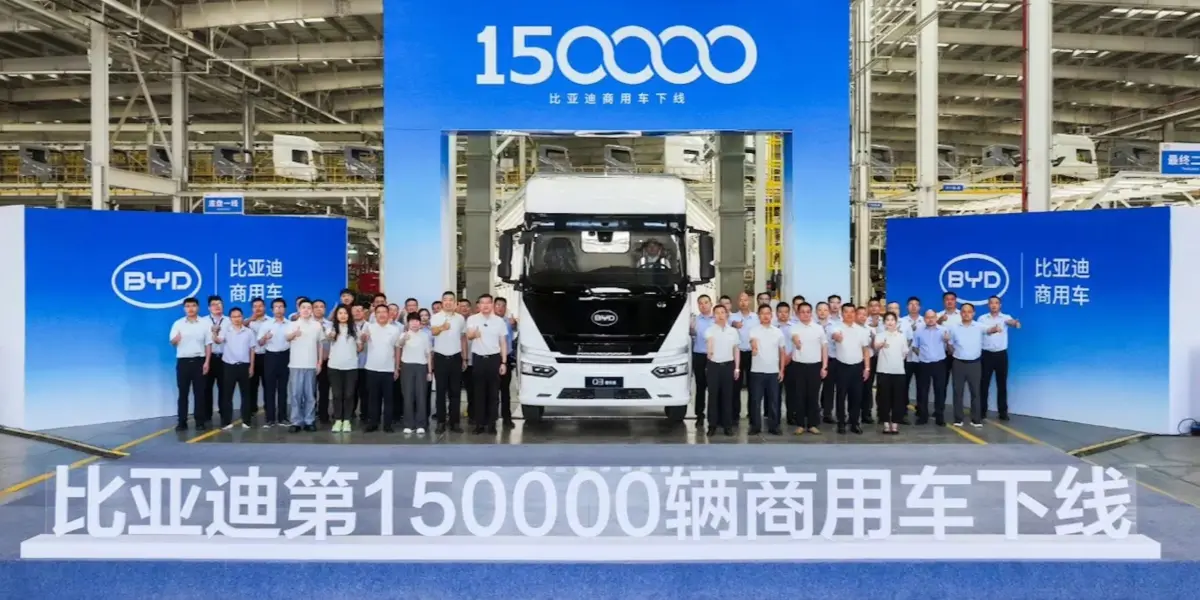
JIANGSU, CHINA — Global electric vehicle titan BYD has officially stamped its dominance into the heavy-duty commercial sector, celebrating the rolling off of its 150,000th new energy commercial vehicle (NEV). The milestone unit—a heavy-duty BYD Q3 battery-electric semi-truck—was completed this week at the company’s advanced commercial manufacturing plant in Huai’an, located in China’s eastern Jiangsu province.
While BYD has spent the better part of two decades establishing itself as a household name in passenger cars, urban transit buses, and advanced battery technology, this latest production benchmark underscores a profound strategic pivot. The company is aggressively scaling up its commercial truck operations, aiming to replicate its passenger car success in the grueling, high-emissions world of global logistics and heavy freight.
As regulatory pressures mount worldwide and fleet operators search for viable alternatives to fossil fuels, BYD’s heavy-duty electric vehicle (HDEV) division is rapidly transforming from an experimental venture into a formidable, standalone economic engine.
Main Facts: The 150,000th Milestone and the BYD Q3
The vehicle anchoring this production milestone is no ordinary hauler. The BYD Q3 battery-electric semi-truck is a technological tour de force designed to tackle the most demanding logistics operations without burning a single drop of diesel.
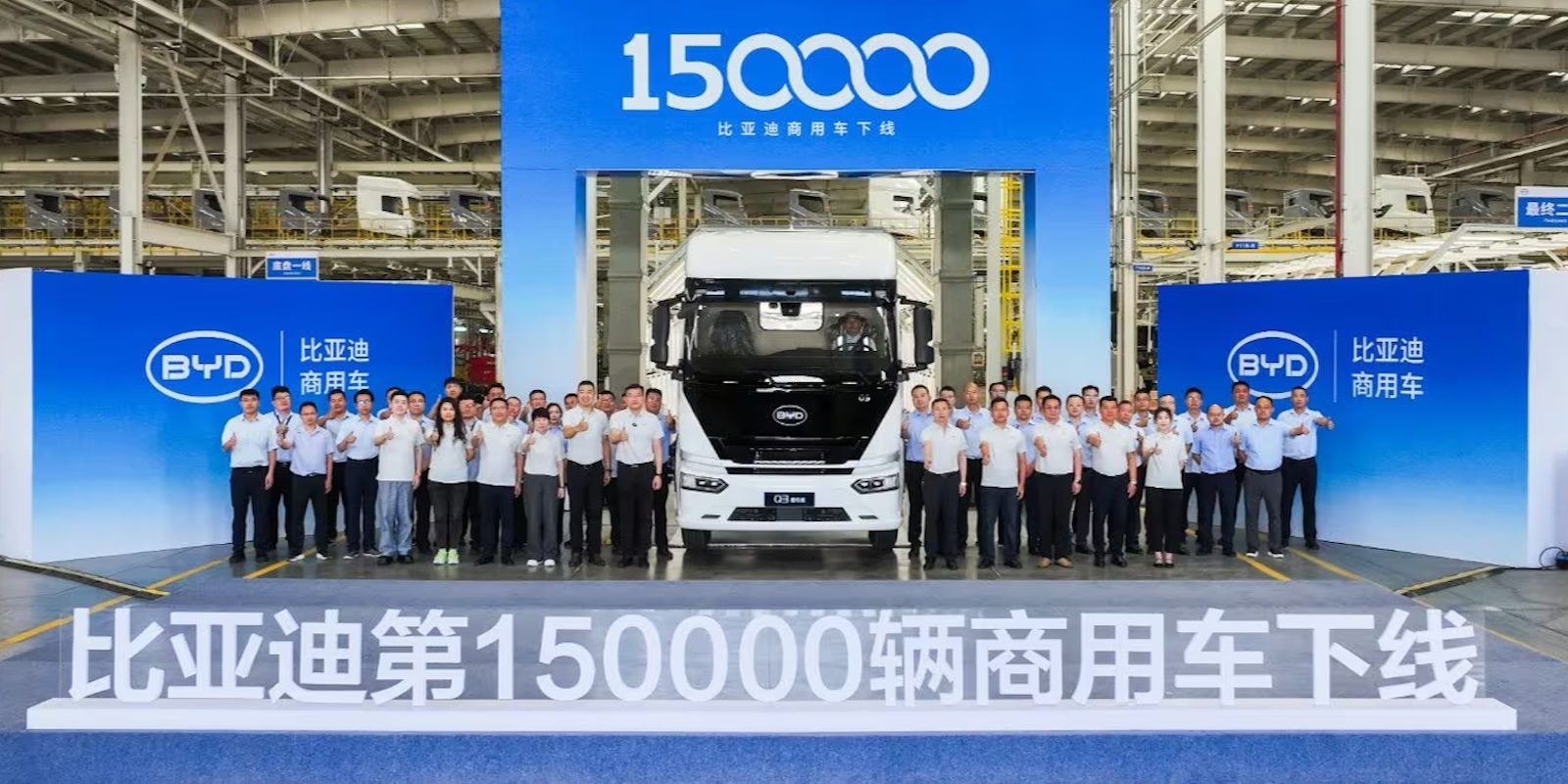
At the heart of the Q3 is a massive 600 kWh battery pack utilizing BYD’s proprietary, safety-focused lithium iron phosphate (LFP) "blade" battery architecture. This energy storage system feeds a robust dual-motor setup generating roughly 600 kW—equivalent to approximately 800 horsepower.
Performance metrics for the heavy-duty semi are designed to compete directly with traditional internal combustion engine (ICE) trucks:
- Gross Combined Weight Rating (GCWR): Capable of hauling up to 108,000 lbs.
- Range: Approximately 325 kilometers (around 200 miles) on a single charge under heavy load conditions, perfectly tailored for regional distribution, port drayage, and hub-to-hub logistics.
- Charging Technology: To minimize fleet downtime, the Q3 incorporates dual-gun DC fast-charging support, enabling the massive battery pack to replenish from 20% to 80% state of charge in a mere 30 minutes.
The vehicle’s debut at the Huai’an facility highlights the maturity of BYD’s modular commercial truck platform, which is engineered to provide the high torque and durability required for heavy payloads while slashing operational carbon footprints.
Chronology: From Passenger Cars to Logistics Dominance
BYD’s journey to 150,000 commercial NEVs did not happen overnight; it is the result of a deliberate, multi-year evolution in vehicle architecture and market expansion.

- The Early Years (2010s): BYD initially built its commercial reputation on municipal electrification, pioneering the deployment of commercial electric buses and sanitation fleets across major Chinese metropolitan areas and later expanding to global markets, including North America and Europe.
- The Platform Shift (2020–2023): Recognizing that urban buses represented only a fraction of commercial emissions, BYD began leveraging its passenger-car battery innovations—specifically its LFP chemistry—to design dedicated medium- and heavy-duty truck platforms.
- The Production Acceleration (2024–2025): As global supply chains normalized post-pandemic, demand for zero-emission logistics spiked. BYD invested heavily in its Huai’an facility, optimizing assembly lines for high-volume commercial NEV output.
- The 2026 Breakthrough: The first nine months of 2026 proved to be an inflection point. Driven by aggressive international marketing, soaring domestic fleet adoption, and new product introductions like the Q3 semi, monthly sales numbers shattered previous company records, culminating in the 150,000th milestone vehicle in October 2026.
Supporting Data: Explosive Growth in 2026
The commercial truck market has historically been notoriously slow to adopt alternative powertrains due to high upfront costs, range anxiety, and infrastructure deficits. However, BYD’s recent financial and sales data reveals that the tipping point for electric commercial trucking may have arrived.
According to industry reports and data highlighted by CNEVPost, BYD sold an astonishing 6,848 NEV trucks in September 2026 alone, representing a staggering 113.33% year-over-year increase.
This late-third-quarter surge propelled BYD’s cumulative commercial truck deliveries to 53,032 units through the first nine months of 2026. When compared to the same period in 2025, this represents a robust 28.46% growth rate, proving that commercial EV adoption is accelerating rather than plateauing.
Analysts attribute this growth to a combination of lower total cost of ownership (TCO) for fleet operators—driven by cheaper electricity compared to diesel and lower maintenance requirements—and tightening carbon regulations in key shipping corridors across Asia, Europe, and the Americas.

Official Responses and Industry Context
While BYD executives have kept celebratory remarks focused on the dedication of the engineering teams at the Huai’an plant, industry observers note that the timing of this milestone is no coincidence.
The achievement comes on the heels of intense global competition in the heavy-duty electric segment. For instance, recent milestones by competitors—such as Tesla scaling up volume production of its long-awaited Semi at its Nevada factory and securing large multi-thousand-truck fleet orders—have galvanized the entire sector.
Industry analysts point out that commercial fleets are no longer viewing electrification as a corporate social responsibility experiment. Instead, logistics managers are treating it as a financial necessity to hedge against volatile fossil fuel prices. BYD’s vertically integrated manufacturing model—where it produces its own semiconductors, motors, and LFP blade batteries—gives the company a distinct pricing and supply-chain resilience advantage over competitors that rely heavily on third-party component suppliers.
Implications: Reshaping Global Freight and Logistics
Reaching 150,000 commercial NEVs carries profound implications for the global logistics and transportation landscape.

1. The Death Knell for Diesel in Regional Corridors
With heavy-duty trucks like the BYD Q3 capable of hauling 108,000 lbs with rapid 30-minute charging, the traditional argument that "batteries are too heavy for long-haul and heavy freight" is rapidly losing credibility. Regional distribution hubs, port facilities, and dedicated freight corridors are prime candidates for total electrification. By shifting thousands of high-mileage diesel trucks to electric power each month, the localized reduction in particulate matter and greenhouse gases is immediate and substantial.
2. Intensifying Global Competition
BYD’s aggressive push into commercial trucks sets the stage for a fierce global rivalry. As Chinese manufacturers scale up production volumes and drive down unit costs, legacy Western truck manufacturers are under immense pressure to accelerate their own zero-emission rollouts. The battle for the future of global logistics is shifting from passenger cars to the heavy-duty semi market.
3. Infrastructure Realities and Opportunities
While vehicles like the Q3 prove that the technology is ready, the broader adoption of electric semi-trucks highlights the urgent need for heavy-duty charging infrastructure. High-power corridors, megawatt-scale charging stations, and grid upgrades will be essential to support fleets of LFP-powered haulers. As more fleet operators pivot toward electric logistics, ecosystem investments—ranging from commercial charging depots to renewable energy integration—will experience a corresponding boom.
As BYD celebrates its 150,000th commercial NEV, the message to the global transportation sector is clear: the electric truck revolution is no longer a futuristic concept. It is rolling off assembly lines by the tens of thousands, and it is ready to haul the weight of the global economy.
