

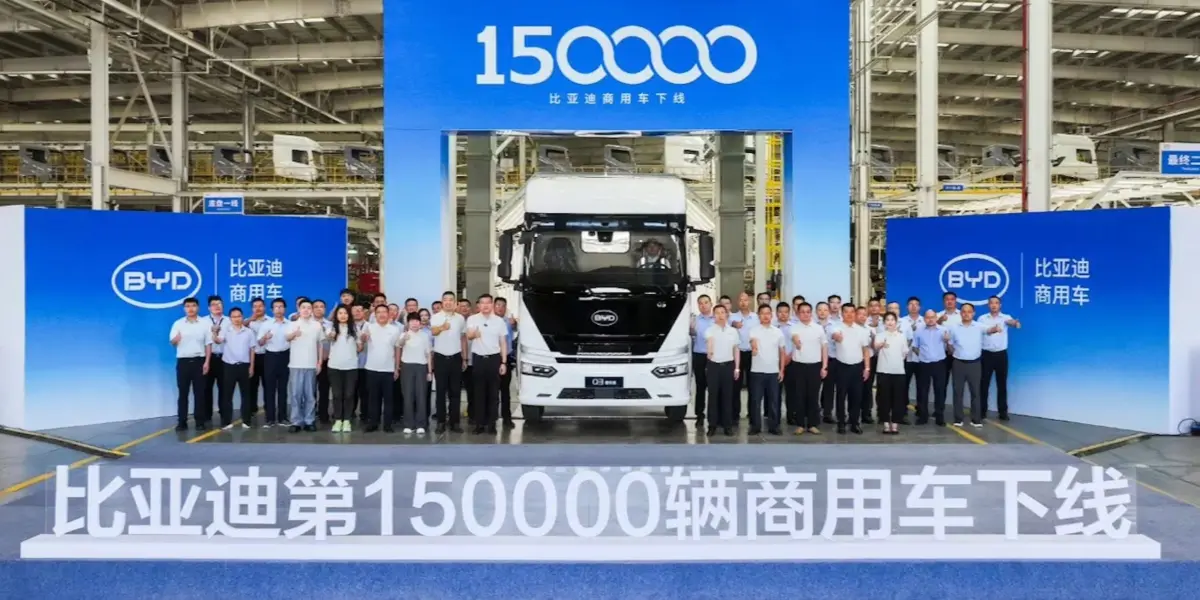
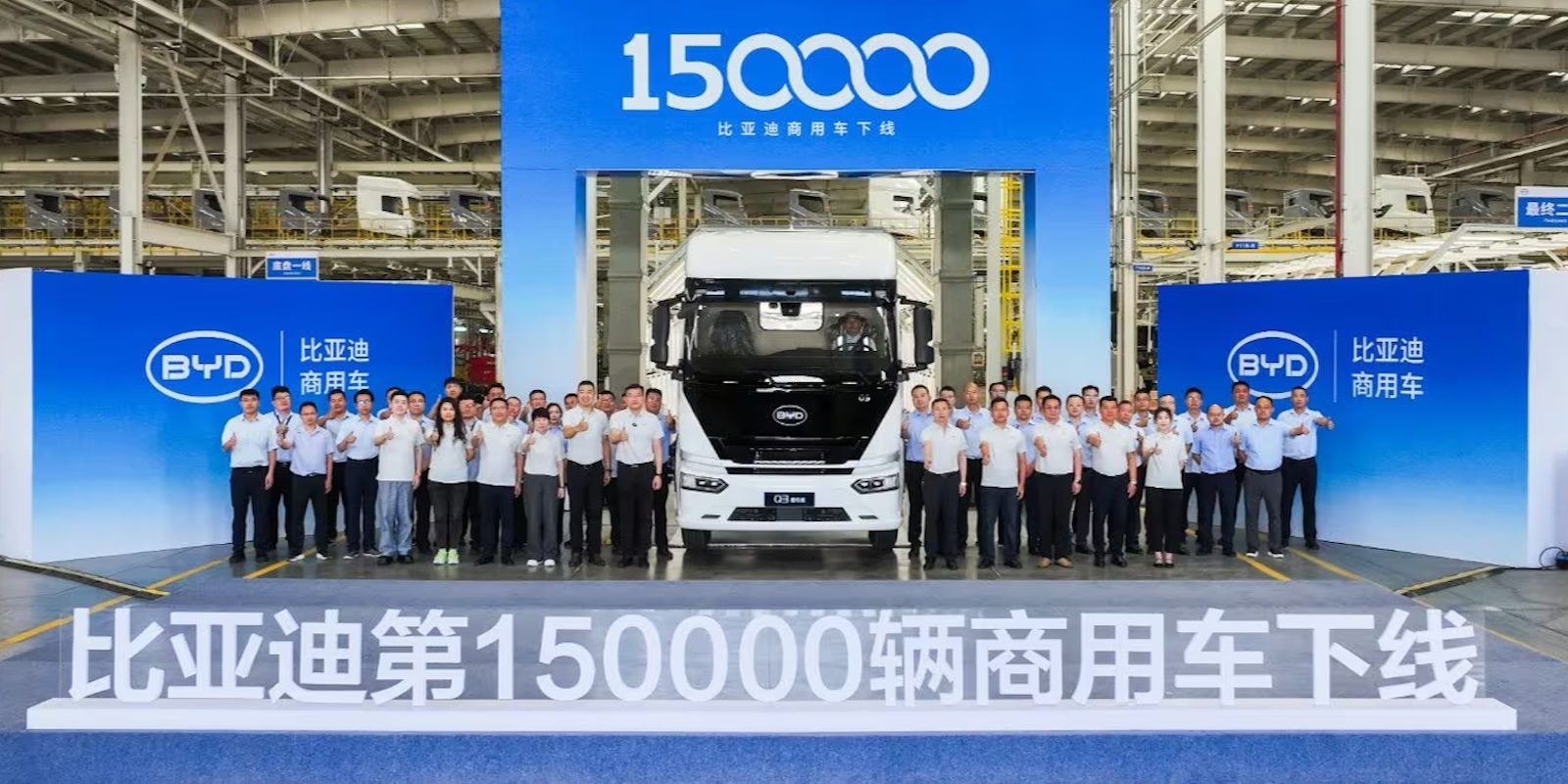
JIANGSU, CHINA — Global new energy vehicle (NEV) titan BYD has officially stamped its dominance into the heavy-duty commercial sector, celebrating the rollout of its 150,000th new energy commercial vehicle. The landmark unit—a robust BYD Q3 battery-electric semi-truck—emerged from the assembly lines at the company’s dedicated commercial manufacturing facility in Huai’an, Jiangsu province, marking a watershed moment for both the manufacturer and the broader green logistics industry.
While BYD has spent the better part of two decades dominating global headlines for its passenger cars, plug-in hybrids, and proprietary battery technologies, the company’s pivot toward the commercial and heavy-duty electric vehicle (HDEV) space is rapidly maturing. As regulatory pressures mount and fleet operators look for aggressive ways to slash carbon footprints without compromising utility, BYD’s commercial truck division is transforming into a massive, standalone industrial powerhouse.
Main Facts
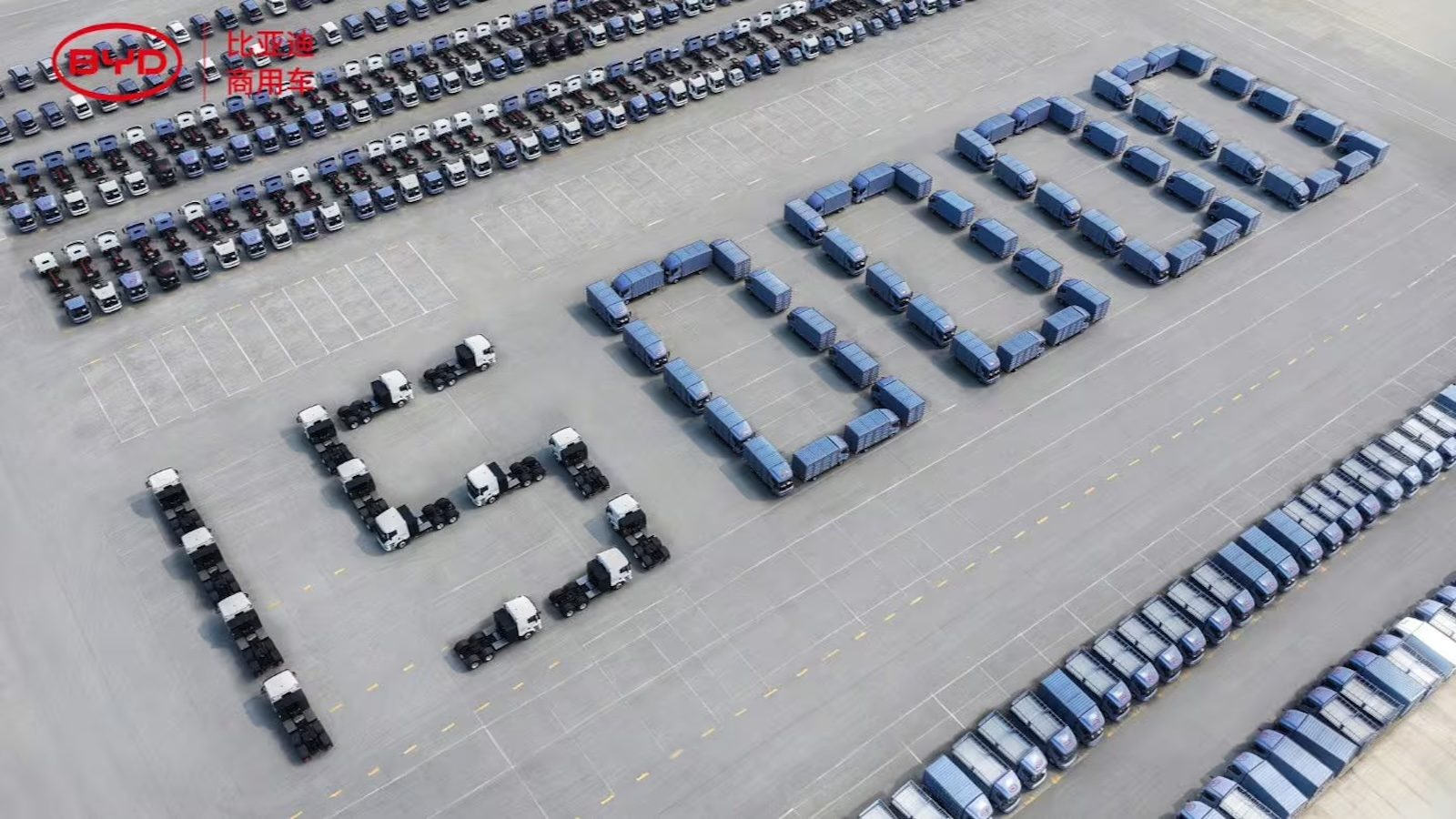
The celebration in Huai’an centers around the production milestone of 150,000 commercial NEVs, underscored by stellar sales performance. In September alone, BYD shifted 6,848 NEV trucks—a staggering 113.33% year-over-year increase. This surge has propelled total truck deliveries for the first nine months of the year to 53,032 units, marking a robust 28.46% growth compared to the same period in 2025.
At the heart of this commercial charge is the BYD Q3 heavy-duty electric semi-truck. Engineered to compete directly with diesel counterparts on sheer capability, the Q3 marries heavy-duty payload capacity with cutting-edge electric architecture:
- Battery Power: Equipped with a massive 600 kWh lithium iron phosphate (LFP) battery pack utilizing BYD’s signature safety-focused "Blade Battery" chemistry.
- Performance: Propelled by a dual-motor setup generating roughly 600 kW (approximately 800 horsepower).
- Capability: Rated for a gross combined vehicle weight (GCVW) of 108,000 pounds, allowing it to move heavy industrial loads across regional corridors.
- Range & Charging: Offers a real-world operating range of roughly 325 kilometers (~200 miles) on a single charge. To keep downtime to an absolute minimum, the Q3 features dual-gun DC fast-charging architecture, enabling a 20% to 80% state-of-charge replenishment in just 30 minutes.
Chronology of BYD’s Commercial Expansion
To understand how BYD reached the 150,000-unit milestone, it is essential to look at the methodical timeline of the company’s expansion from a battery maker to a multi-segment automotive behemoth.
- Early 2000s – 2010s: BYD establishes its reputation in rechargeable batteries before transitioning into passenger electric vehicles and early electric transit solutions, notably pioneering commercial electric buses deployed in cities worldwide, including major metropolitan areas across China, Europe, and the Americas.
- Late 2010s – 2020: Recognizing that municipal buses are only the tip of the commercial iceberg, BYD begins research and development into medium- and heavy-duty commercial trucks designed for port logistics, drayage, and regional freight hauling.
- 2021 – 2024: The company scales its EV architectures, integrating its ultra-safe LFP Blade Battery design into larger commercial vehicle platforms. Manufacturing hubs, such as the Huai’an facility in Jiangsu province, are optimized specifically for high-volume commercial production.
- 2025: BYD solidifies its supply chain and ramps up production lines, laying the groundwork for a massive surge in commercial orders and setting consecutive monthly sales records.
- September – October 2026: BYD reports 6,848 NEV truck sales in a single month (September), reflecting triple-digit year-over-year growth. Shortly thereafter, the company officially crosses the 150,000th commercial NEV production milestone in Huai’an with the completion of the Q3 semi-truck, capturing global attention alongside competing international launches like the Tesla Semi.
Supporting Data and Market Dynamics
The commercial vehicle sector has historically been one of the hardest industries to decarbonize. Heavy trucks account for a disproportionate share of transportation emissions, consuming massive quantities of diesel while traversing continents. However, shifting economic and environmental metrics are accelerating the adoption of alternative powertrains.
Sales Momentum and Growth Rates
The data emerging from BYD’s commercial division highlights an undeniable acceleration in market demand:
| Metric | Period / Value | Growth Indicator |
|---|---|---|
| Total Cumulative Production | 150,000 Commercial NEVs | Milestone reached at Huai’an plant |
| Monthly Sales (September) | 6,848 NEV Trucks | +113.33% YoY |
| Year-to-Date Deliveries (9M) | 53,032 Units | +28.46% vs. 2025 |
| Powertrain Specs (Q3) | 600 kWh LFP / 600 kW | 108,000 lbs GCVW capacity |
These figures demonstrate that BYD’s expansion is no longer experimental; it is scaling at industrial velocity. Fleet operators are increasingly willing to transition away from internal combustion engines as the total cost of ownership (TCO) for electric trucks—driven by lower maintenance costs and cheaper electricity relative to diesel—begins to favor electrification.
Official Responses and Industry Reactions
Industry analysts and market observers have noted that BYD’s dual-pronged approach—simultaneously dominating passenger vehicles while capturing lucrative commercial niches—gives the company a unique manufacturing advantage.
While formal executive commentary during the Huai’an milestone event focused on corporate gratitude toward engineering teams and logistics partners, industry analysts point out that BYD’s vertical integration is its ultimate weapon. Because BYD manufactures its own semiconductors, motors, and LFP Blade Batteries, the company is insulated from many of the supply chain bottlenecks that traditionally plague heavy-duty truck manufacturers.
Logistics experts have also praised the Q3’s infrastructure adaptability. By integrating dual-gun DC fast charging capable of a 20% to 80% top-up in 30 minutes, BYD is directly addressing the "range anxiety" and downtime concerns historically cited by fleet managers. For regional distribution hubs and port operators where trucks operate on predictable, repetitive routes, a 200-mile range paired with ultra-fast turnaround times fits seamlessly into existing shift schedules.
Global Implications for the Heavy-Duty Transport Sector
The crossing of the 150,000 commercial NEV milestone carries profound implications for the global logistics and automotive landscapes.

1. Intensifying Global Competition
The race to electrify heavy-duty transport is officially global. With companies like Tesla ramping up volume production of the Tesla Semi at its Nevada facility and traditional legacy truck makers rolling out battery-electric and hydrogen fuel-cell alternatives, BYD’s massive volume out of China positions it as a formidable international competitor. As BYD increasingly looks outward toward international markets—leveraging its growing network of cargo ships and global distribution channels—overseas fleet operators will have access to battle-tested, high-volume heavy-duty electric trucks.
2. The Dominance of LFP and Vertical Integration
BYD’s continued reliance on and refinement of Lithium Iron Phosphate (LFP) chemistry for heavy-duty commercial applications sets a benchmark for the industry. LFP batteries are inherently safer, less prone to thermal runaway, free of expensive cobalt and nickel, and boast superior cycle life compared to traditional nickel-manganese-cobalt (NMC) chemistries. For heavy commercial vehicles that cycle through daily charging and heavy usage, durability over hundreds of thousands of miles is paramount.
3. A Blueprint for Fleet Decarbonization
The success of the Huai’an plant proves that heavy-duty electrification can scale rapidly when backed by supportive industrial policy, robust battery manufacturing capacity, and vehicles engineered specifically for heavy industrial workloads. As logistics firms face tightening carbon regulations across Asia, Europe, and North America, the availability of proven 800-horsepower electric semis capable of hauling over 50 tons represents a critical turning point.
Ultimately, BYD’s 150,000th commercial NEV is more than just a commemorative milestone for a single factory floor—it is a clear signal that the era of the electric heavy-duty truck has arrived, and mass production is accelerating faster than many predicted.
