

Main Facts
In modern HVAC engineering, few phenomena are as insidious and misunderstood as the Air Handling Unit (AHU) "recirculating mode death spiral." This critical operational failure plagues AHUs utilizing complex airflow tracking or decentralized terminal control configurations, particularly when systems either intentionally or unintentionally enter a fully recirculating mode.
This installment represents the fourth part of an ongoing technical series investigating how this failure manifests across various facility typologies, focusing heavily on critical environments such as hospitals. While previous installments dissected systems utilizing direct return fan airflow tracking, Case Study 4 introduces a dangerous variation: an AHU serving hospital operating rooms where return airflow management is decentralized via terminal return Variable Air Volume (VAV) boxes, rather than traditional central return fan airflow tracking.
The core mechanics of the recirculating mode death spiral involve a destructive feedback loop between supply and return fans, uncoordinated airflow measuring stations (AFMS), and closing dampers. When an AHU’s outdoor air and relief air dampers close while the return damper opens, and the system attempts to maintain an unachievable minimum outdoor air or return airflow setpoint, the fans begin to "fight" one another.
In Case Study 4, this uncoordinated dynamic did not merely result in inefficient fan speeds or minor tracking errors. Instead, it culminated in a severe system trip: the sudden collapse of return duct static pressure that triggered a safety switch, disabling the unit entirely within minutes of disabling the economizer. Left unchecked, such pneumatic anomalies pose severe infrastructural hazards, including the potential catastrophic collapse of return ductwork due to extreme negative pressure.
Chronology: The Functional Testing of Case Study 4
The events detailed in Case Study 4 occurred during the functional testing phase of a newly installed HVAC system in a modern hospital facility during the month of March. The ambient conditions were relatively cool, and the AHU had been operating smoothly for weeks with the economizer enabled.

Phase 1: Pre-Test Warnings and Baseline Operations
Prior to official functional testing, the temperature controls contractor warned the engineering team that the specific AHU in question would trip out immediately if the economizer were disabled, citing pre-tests conducted the day before. Intrigued and eager to gather empirical data for design recommendations, the engineering team pulled up the Building Automation System (BAS) programming interface to monitor real-time inputs and outputs.
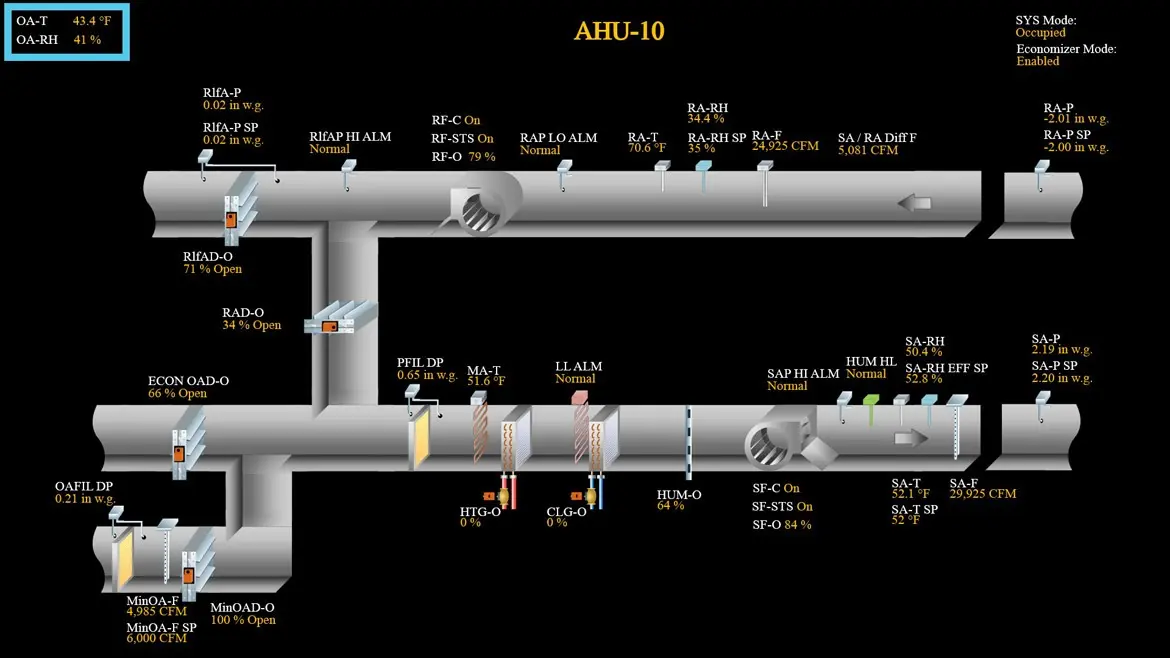
During normal operations with the economizer enabled (as depicted in standard cool-ambient profiles), the economizer outdoor air damper sat partially open (around 66%). While the duct-mounted minimum outdoor airflow measuring station registered slightly below its design setpoint due to sensor placement, the facility was pulling in more than enough total outdoor air across its multiple intake paths.
Phase 2: Disabling the Economizer
The team manually disabled the economizer to observe the transition into a minimum outdoor airflow configuration. Theoretically, with the economizer shut, the system should have balanced itself dynamically: the measured outdoor air should have exceeded the difference between supply and relief flows, causing the relief air damper to modulate slightly open to bleed off excess return air.
Instead, the system immediately deviated into an unintended control trajectory. Within moments of disabling the economizer, the return air damper went fully open while the economizer outdoor air damper slammed fully shut. Simultaneously, the relief air damper unexpectedly snapped closed—a phenomenon heavily influenced by external variables such as building envelope pressure, ambient wind direction, and return damper flow resistance.
Phase 3: The Feedback Loop Takes Hold
With the relief damper shut and the system entering a semi-recirculating state, the minimum outdoor airflow sensor read higher than its active setpoint. In response, the minimum outdoor air damper began to close.

This action choked the primary outdoor air intake, forcing the powerful supply fan to draw additional makeup air backward through the return air path. Consequently, a sudden surge of airflow was sucked through the terminal return VAV boxes serving the critical operating rooms.
The onboard airflow sensors in the return VAV boxes detected this surge and reacted defensively by modulating their dampers closed to maintain their individual airflow setpoints. This introduced massive flow restrictions across the return path.
Phase 4: The Safety Trip
As the return VAV box dampers restricted, the return air pressure dropped precipitously. The return fan, programmed to track return air static pressure, slowed down in response to the falling pressure. This deceleration only exacerbated the problem, forcing the supply fan to pull even harder through the minimum outdoor air duct, which in turn drove the minimum outdoor air damper to close even further.
Caught in this compounding feedback loop, the return fan bottomed out at its minimum speed. However, the supply fan remained large enough to continue pulling excess air through the free-spinning, throttled return fan.
With the return fan helpless and the return VAV boxes pinched shut, the static pressure in the return duct plunged so rapidly that the return air static safety switch tripped instantly. The BAS immediately shut down the AHU, averting structural damage but leaving a critical hospital department without active conditioning.

Supporting Data and Control Architecture
Understanding why Case Study 4 failed requires an examination of the specific control loops governing the equipment:
- Minimum Outdoor Air Control: The AHU actively regulated a dedicated minimum outdoor air damper to satisfy mandatory hospital ventilation codes. It relied on a duct-mounted airflow measuring station to gauge intake volumes.
- Return Fan Control: Unlike systems utilizing direct return-to-supply airflow tracking, this return fan was controlled strictly to maintain a constant return air static pressure setpoint.
- Decentralized Terminal Control: Return air VAV boxes located within the operating rooms modulated independently to maintain their respective airflow setpoints. The central AHU return airflow measuring station was strictly a monitoring device, entirely excluded from active loop control.
- Relief and Economizer Dampers: The relief damper modulated to maintain a stable relief plenum pressure, preventing backward air infiltration. The return damper and economizer outdoor air dampers operated inversely via the economizer control loop.
The root technical vulnerability stemmed from the lack of coordination between disparate airflow measuring stations and the absence of a minimum position lower limit on the outdoor air damper. When sensors drifted or when balancing technicians eventually adjusted terminal VAV boxes to fine-tune room pressurization, the aggregate difference between supply and return VAV setpoints could easily surpass the minimum outdoor air setpoint. This structural mismatch guaranteed that the AHU would stumble into the recirculating mode death spiral under the right set of boundary conditions.
Official Responses and Engineering Solutions
Faced with mounting empirical evidence from multiple hospital installations, engineering consultants and design teams recognized that relying solely on standard BAS control logic was insufficient for critical healthcare spaces.
The response from mechanical designers and controls contractors has shifted toward proactive, fail-safe programming. Rather than letting AHUs self-regulate into dangerous, uncoordinated states when sensors drift or economizers toggle, engineers are implementing robust software guardrails.
For Case Study 4, the proposed and accepted remediation involved altering the minimum outdoor airflow control loop sequencing. By introducing hard limits—such as a mandatory minimum outdoor air damper low-limit position—the control logic permanently prevents the dampers from sealing entirely shut during normal mechanical operation, regardless of conflicting or drifting signals from upstream airflow measuring stations. Furthermore, engineers recommend decoupling fragile pressure-tracking loops from terminal VAV actions when total building air balance comes under the purview of third-party Testing, Adjusting, and Balancing (TAB) professionals.

Implications for Facility Management and Healthcare Engineering
The implications of the AHU recirculating mode death spiral extend far beyond energy efficiency or momentary comfort complaints; in hospital environments, they touch directly upon patient safety and structural integrity.
1. Life Safety and Structural Hazards
As demonstrated in Case Study 4, the ultimate manifestation of this death spiral in systems with terminal VAVs is a sudden, violent drop in duct static pressure. If safety interlocks and low-limit switches fail to trip the system in time, the extreme negative pressure differential can cause heavy sheet metal return ductwork to buckle and implode. In a surgical suite or operating room corridor, such a structural failure introduces airborne particulate hazards and compromises infection control protocols.
2. The Dangers of Sensor Drift
Modern BAS architecture relies heavily on arrays of airflow measuring stations. However, these sensors are notoriously susceptible to dust accumulation, calibration drift, and turbulence-induced inaccuracies. When uncoordinated sensors feed conflicting data into active PID loops, the control system attempts to optimize a mathematical fiction, driving physical dampers into destructive configurations.
3. Commissioning and TAB Coordination
The case study underscores a vital lesson for commissioning agents and TAB contractors. When balancing technicians adjust operating room pressures by tweaking terminal VAV setpoints, they rarely account for the macro-level impact on central AHU fan curves and damper positions. Future balancing efforts must be evaluated against the operational boundaries of the central air handler to ensure that space pressurization goals do not inadvertently trigger a recirculating death spiral.
As this engineering series continues, future case studies will examine how other healthcare facilities have fallen victim to unique variations of this control flaw, reinforcing the industry-wide need for standardized, highly resilient AHU sequences of operation that permanently lock out the death spiral.
