

Main Facts: Budget Brand vs. Industry Titans
For years, Harbor Freight has aggressively targeted top-tier professional tool brands like Milwaukee, DeWalt, and Makita. Through its value-driven and pro-targeted lines, Harbor Freight aims to convince contractors and serious DIYers that they don’t need to empty their bank accounts to get job-site-ready power. On paper, the specs of Harbor Freight’s cordless power tools consistently look competitive against flagship models. But specification sheets only tell half the story.
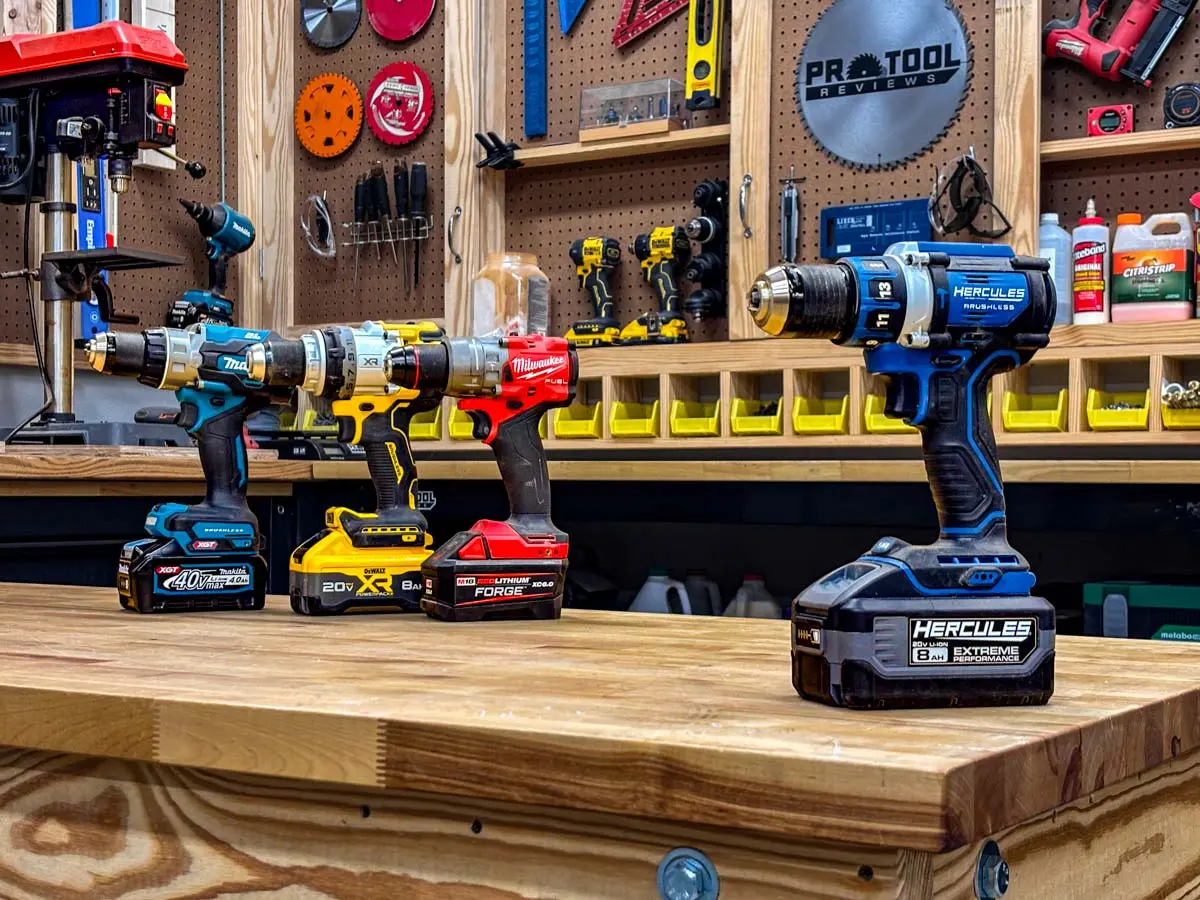
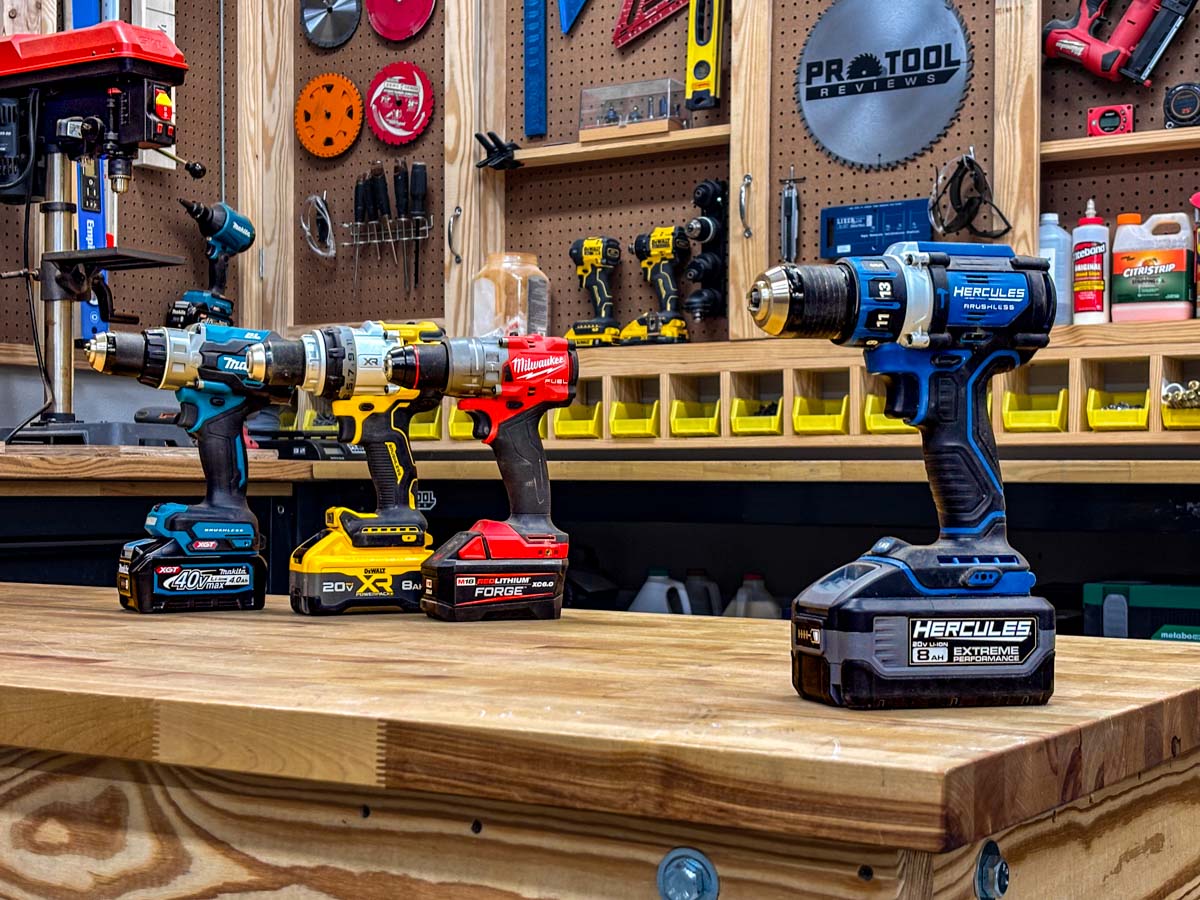
To determine how the budget brand handles real-world punishment, a rigorous, controlled testing framework was established. Harbor Freight’s Hercules HCB92B 20V Brushless Cordless Hammer Drill was pitted directly against the heavy hitters of the industry: the DeWalt DCD1007, the Milwaukee M18 FUEL 2904, and the Makita 40V Max XGT GPH01.
Initial testing drew community feedback suggesting the Hercules drill was hamstrung by using a smaller 4.0Ah Extreme battery instead of its larger 8.0Ah counterpart. In response, a fresh round of rigorous evaluations was conducted. The flagship Pro models were retested using their respective advanced 1P packs and high-output batteries to create a level playing field.
The core takeaway? While the Hercules hammer drill cannot quite dethrone the industry’s reigning elite in raw speed and peak output, it punches well above its weight class—provided it is paired with the right battery capacity. However, navigating the cost of bare tools, high-capacity power sources, and chargers reveals a nuanced financial picture that every buyer must consider.
Chronology: The Evolution of the Test and Community Feedback
Phase One: The Initial Comparison
When Harbor Freight first introduced its line-up to challenge high-end industrial brands, reviewers and tradespeople scrutinized the value proposition. Harbor Freight explicitly positioned the Hercules HCB92B to compete directly against Milwaukee’s flagship M18 FUEL 2904. Early test cycles utilized a standard, mid-tier battery configuration for the Hercules—specifically, the 4.0Ah Extreme pack.
The Community Backlash
Upon publishing the initial results, the tool-review community was vocal. Critics pointed out that evaluating the Hercules drill with a 4.0Ah battery while testing Pro-grade competitors with high-demand power systems created an unfair handicap. Voltage sag and current delivery limitations on smaller packs inherently restrict a motor’s ability to deliver peak torque under heavy loads.
Phase Two: The Retest Protocol
Recognizing the validity of the critique, testers acquired Harbor Freight’s larger 8.0Ah Extreme battery pack. To ensure total transparency and scientific accuracy, the testing team went a step further: DeWalt, Makita, and Milwaukee drills were re-evaluated alongside the Hercules using their respective advanced, high-output 1P and 2P packs. Every battery was recharged to 100% capacity prior to each test to eliminate variances in state-of-charge performance.
Supporting Data: Specifications, Benchmarks, and Pricing
Before evaluating real-world execution, analyzing the market positioning through retail pricing and factory specifications highlights why the Hercules line commands such massive consumer interest.
Market Pricing Overview
| Model | Bare Tool | Kit | 2-Tool Combo |
|---|---|---|---|
| DeWalt DCD1007 | $249 | $299 | $329 |
| Hercules HCB92B | $79.99 | Not Available | $249.99 |
| Makita GPH01 | $259 | $524 | $469 |
| Milwaukee 2904 | $229 | $329 | $349 |
The financial disparity is immediately striking. At $79.99 for a bare tool, the Hercules HCB92B costs roughly one-third of its professional competitors.
On-Paper Performance Metrics
| Model | Max Speeds | Hammer Rate | Max Torque |
|---|---|---|---|
| DeWalt DCD1007 | 450/1300/2000 RPM* | 38,250 BPM | 1530 UWO** |
| Hercules HCB92B | 550/2000 RPM | 32,000 BPM | 1200 in-lbs |
| Makita GPH01 | 650/2600 RPM | 39,000 BPM | 1250 in-lbs |
| Milwaukee 2904 | 500/2100 RPM | 33,000 BPM | 1400 in-lbs |
*Note: DeWalt’s DCD1007 operates at higher 500/1500/2250 RPM speeds specifically when in hammer-drilling mode.
**Note: DeWalt rates power output in Unit Watts Out (UWO) rather than traditional in-lbs of torque.
Battery Selection Matrix
To capture accurate performance data, tests were structured around two distinct battery tiers for each ecosystem:
- DeWalt DCD1007: PowerStack 1.7Ah (30.6Wh) vs. PowerPack 8.0Ah (144Wh)
- Hercules HCB92B: Extreme 4.0Ah (72Wh) vs. Extreme 8.0Ah (144Wh)
- Makita GPH01: 2.5Ah (90Wh) vs. High Power 4.0Ah (144Wh)
- Milwaukee 2904: High Output 3.0Ah (54Wh) vs. Forge 8.0Ah (144Wh)
Empirical Benchmark Results
1. Standard Speed & Light Drilling Tests
- Makita GPH01 (1P / 2P): 2.00 sec / 2.03 sec
- DeWalt DCD1007 (1P / 2P): 3.29 sec / 2.42 sec
- Milwaukee 2904 (1P / 2P): 3.97 sec / 2.49 sec
- Hercules HCB92B (1P / 2P): 7.98 sec / 3.43 sec (Note: Hercules required low-speed gear with its 4.0Ah battery to finish).
While Makita’s high rotational velocity easily swept this category, the transition to the 8.0Ah Extreme battery allowed the Hercules to dramatically narrow the gap against DeWalt and Milwaukee.
2. Spade Bit Applications (Mid-Range Load)
- DeWalt DCD1007 (1P / 2P): 3.61 sec / 2.54 sec
- Makita GPH01 (1P / 2P): 2.77 sec / 2.62 sec
- Milwaukee 2904 (1P / 2P): 3.15 sec / 2.62 sec
- Hercules HCB92B (1P / 2P): 3.88 sec / 3.33 sec
In mid-tier applications, all four drills successfully executed the tasks in high gear. While Hercules trailed its competitors, the performance delta narrowed significantly.
3. Self-Feed Bits (Heavy-Duty Load)
- Makita GPH01: 1.59 sec average
- DeWalt DCD1007 (1P / 2P): 2.83 sec / 1.73 sec
- Milwaukee 2904 (1P / 2P): 2.50 sec / 1.89 sec
- Hercules HCB92B (1P / 2P): 5.50 sec / 2.18 sec
Under extreme loads, the limitations of the smaller battery became apparent; the Hercules stalled multiple times on the 1P pack, requiring a drop to low gear. However, upgrading to the 8.0Ah battery unlocked sufficient current to power through the test, though it still lagged behind the blistering speeds of the Pro-tier models.
Official Perspectives and Testing Integrity
Evaluating heavy machinery across diverse testing protocols requires accounting for human and mechanical variables. During the concrete bit testing phase, researchers noted an unexpected anomaly. Because concrete drilling relies entirely on manual downward pressure rather than self-feeding geometry, technique variances across different operators heavily influence drill times.
Data analysis revealed that subsequent operator runs yielded significantly faster metrics than initial baseline tests conducted by primary testers. Consequently, the concrete testing data was deemed an unreliable comparative metric for this specific head-to-head evaluation, underscoring the commitment to objective, scientifically valid journalism within the professional tool review space.
Harbor Freight’s corporate positioning for the Hercules line has always centered on democratizing high-performance brushless technology. Company representatives and product developers design these tools to meet the rigorous demands of production tradespeople without imposing the premium brand-name markup. While independent testers maintain that the Hercules cannot entirely replace a flagship Milwaukee or DeWalt on high-repetition industrial sites, Harbor Freight’s engineering intent—delivering 90% of the capability at half the cost—remains clearly validated by these findings.
Implications: Is the Hercules System Right for You?
When evaluating whether to invest in Harbor Freight’s Hercules hammer drill, buyers must look past the alluring $79.99 bare-tool price tag and calculate the total system cost.
Because the Hercules hammer drill is not sold as a standalone kit with a battery and charger, building an operational setup a la carte requires strategic accounting:
- Bare Tool (HCB92B): $79.99
- Extreme 8.0Ah Battery: $99.99
- Standard Charger: $49.99
- Total Out-of-Pocket Cost: $229.97
While a total investment of roughly $230 undercuts the bare-tool or kit pricing of competitors like DeWalt and Milwaukee, consumers are given an alternative path: purchasing the Hercules 2-tool combo kit. For $249.99, buyers receive a hammer drill, an impact driver, and two 5.0Ah batteries. Though the smaller batteries will not unlock the absolute peak performance witnessed with the 8.0Ah Extreme pack, the combo kit delivers exceptional introductory value for budget-conscious mechanics, remodelers, and serious DIYers.
Final Verdict
The Harbor Freight Hercules 20V Brushless Hammer Drill does not outperform the flagship models engineered by DeWalt, Milwaukee, and Makita. It operates more slowly under heavy loads, and it demands high-capacity battery infrastructure (specifically the 8.0Ah Extreme pack) to compete respectably.
However, it successfully completes every demanding task thrown its way without showing signs of catastrophic thermal distress or premature burnout. Furthermore, its ergonomics, balanced weight profile, and comfortable handle design make it a pleasure to operate.
For contractors running tools eight hours a day under extreme industrial duress, staying within the DeWalt, Milwaukee, or Makita ecosystems remains the optimal choice. But for independent tradespeople, apprentices, and advanced DIYers looking to maximize their purchasing power, the Hercules hammer drill proves that you no longer need to spend top-dollar to get professional-grade work done. Just make sure you pair it with the right battery.
