

By Global Energy Desk
Published: September 2026
Main Facts
Six months after US-Israeli military strikes disrupted Middle Eastern fossil fuel production and transformed the Strait of Hormuz into a volatile naval battleground, the global economy is grappling with a profound structural transformation. Far from triggering a permanent return to coal or an uncontrolled fossil-fuel supply panic, the conflict has fundamentally altered the economics of energy.
By dramatically inflating oil and gas prices, the war has acted as a massive catalyst, accelerating the global pivot toward renewable energy, electric vehicles (EVs), and clean manufacturing. At the same time, it has created a stark economic divide between distinct global winners and losers.
According to data compiled by the Centre for Research on Energy and Clean Air (CREA), a Helsinki-based nonprofit, global fossil fuel importers have absorbed more than $330 billion in extra energy costs since the outbreak of hostilities on February 28—a sum roughly equivalent to Finland’s entire 2025 gross domestic product. Developing nations have shouldered a disproportionate share of this burden, spending an additional 1% of their GDP to absorb the price shock, more than double the economic drag experienced by wealthier industrialized nations.
Conversely, non-Gulf fossil fuel producers in the Americas and clean-technology exporters—most notably China—have reaped massive financial windfalls. Meanwhile, Persian Gulf energy exporters have faced staggering infrastructure damage and lost revenues, while import-dependent economies in Asia and Africa have endured severe inflationary pressures and currency devaluations.
Despite early fears that the crisis would spark a desperate dash back to coal, global greenhouse gas emissions remained largely contained during the first half of the year, inching up by a marginal 0.2% compared to the same period in 2025, according to mid-year data from the nonprofit Climate Trace.
Chronology of a Crisis: The First Six Months
February 2026: The Spark and the Choke Point
- February 28: Joint US-Israeli military strikes target strategic military and industrial installations inside Iran, immediately triggering retaliatory actions across the region.
- The Strait of Hormuz Closure: The critical maritime corridor—through which roughly a fifth of the world’s petroleum passes—effectively becomes a naval battleground. Drone strikes and asymmetric attacks damage vital regional energy infrastructure, including Saudi Arabia’s largest oil refinery and a primary liquefied natural gas (LNG) export terminal in Qatar.
- Immediate Economic Shock: Rice University estimates that initial export losses across the Persian Gulf average nearly $2 billion per day in March. In the Philippines, fuel shortages prompt the government to mandate a four-day workweek and restrict air conditioning use to conserve energy.
March – April 2026: Infrastructure Damage and Emergency Measures
- Infrastructure Toll: By April, consulting firm Rystad Energy estimates that physical damage to energy infrastructure across the Gulf has reached $58 billion, requiring capital-intensive, long-term repairs.
- Scrambling for Alternatives: Import-dependent nations with high historical reliance on Middle Eastern shipments—such as Japan, South Korea, and various African states—absorb punishing price hikes. Ethiopia’s central bank is forced to burn through billions of dollars in foreign exchange reserves to defend a sinking birr against currency selloffs driven by refined oil import costs.
- The Clean Tech Pivot Begins: Developing economies realize that shielding consumers from volatile fossil fuel prices is fiscally unsustainable. Imports of Chinese solar equipment surge globally. In the Philippines, March imports of Chinese solar hardware jump 262% year-over-year.
May – July 2026: Consolidation of New Trade Routes
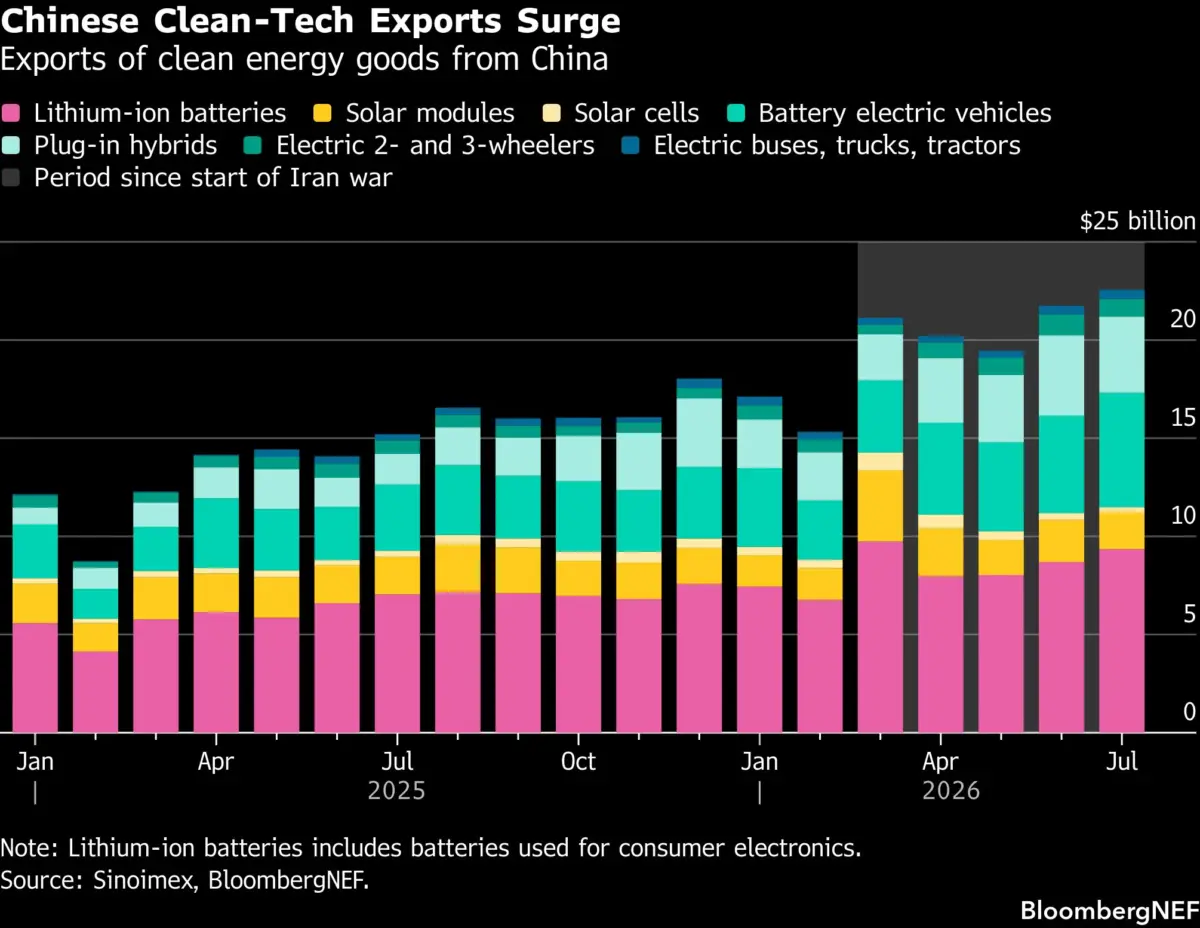
- China’s Export Boom: Benefiting from its dominant position in green technology manufacturing, China records five consecutive months of record clean tech exports in dollar terms, according to BloombergNEF (BNEF). In July alone, Chinese automakers export over 500,000 EVs and plug-in hybrids—a roughly 150% surge year-over-year.
- Hemispheric Shifts: As international buyers aggressively shun Gulf suppliers, oil-and-gas producers in North and South America ramp up production to capture windfall profits.
- Mid-Year Emissions Check: Climate Trace releases its global emissions analysis for the first half of 2026. Marginal emissions reductions in the US and China balance out increases in India and Brazil, proving that renewable expansion has successfully offset the anticipated spike in dirtier energy sources.
Supporting Data and Market Metrics
The economic ripples of the Iran war can be precisely quantified through institutional tracking data collected over the first half of 2026:
- $330 Billion: Total extra costs paid by global fossil fuel importers since February 28, matching Finland’s 2025 GDP (CREA data).
- $2 Billion per Day: Average initial export losses for Gulf oil exporters during the peak panic in March (Rice University estimates).
- $58 Billion: Estimated value of damaged Middle Eastern energy infrastructure, including pipelines, refineries, and LNG terminals (Rystad Energy).
- 1% of GDP: Economic drag experienced by developing economies absorbing energy price shocks—more than double the impact on wealthier nations.
- +150%: Year-over-year surge in Chinese EV and plug-in hybrid overseas shipments in July 2026 (BloombergNEF).
- +37%: Increase in African imports of Chinese solar equipment during the first half of 2026 compared to the previous year.
- +0.2%: The marginal increase in global greenhouse gas emissions for the first half of 2026, defying expectations of a coal-fired resurgence (Climate Trace).
Official Responses and Expert Analysis
International organizations, climate scientists, and energy market analysts have closely monitored the geopolitical shockwaves, offering diverse perspectives on the crisis.
The United Nations and Climate Experts
The UN Climate Chief described the ongoing conflict as a brutal event that is paradoxically "supercharging" the clean energy transition. Governments and corporate boards that previously debated decarbonization timelines have suddenly found themselves viewing renewable deployment through the lens of national security and immediate fiscal survival.
Ting So, lead analyst for Climate Trace, highlighted the unexpected resilience of global decarbonization efforts:
"Renewables continue to grow. That does seem like good news. But the volatility of disruptions in the Strait of Hormuz makes it hard to predict long-term trends."
So noted that fears of a major near-term pivot back to coal-fired power plants failed to materialize. Instead, renewable energy infrastructure expanded at an accelerated pace during the first six months of the conflict, a development he characterized as a positive surprise.
Economic and Market Analysts
Ethan Zindler, an analyst with BloombergNEF, emphasized that consumer behavior has driven rapid adaptation in unprotected markets:
"In countries where consumers are not being well shielded from higher fuel prices, they are moving very quickly to adjust their energy consumption pattern."
Meanwhile, analysts examining the long-term mining and commodity sectors point to structural changes that will outlast any future ceasefire. Rafael Rabioglio, a BNEF analyst, noted:
"The boost to Latin America’s mining sector could remain."
As high fuel costs permanently accelerate global electrification, the demand for critical transition minerals—such as copper and lithium—is expected to permanently benefit major South American producers like Chile and Peru. Conversely, BNEF analysts warned that regional instability has driven up the cost of debt in the Persian Gulf, undermining clean power project financing within the oil-producing states themselves in the near term.
Implications: Winners, Losers, and the Future Energy Order
The Winners: Clean Tech Giants and Western Hemisphere Producers
China stands out as the primary geopolitical and economic beneficiary of the conflict. By leveraging its unmatched manufacturing capacity in solar panels, grid-scale batteries, and electric vehicles, Beijing has cemented its role as the indispensable hardware supplier for a world desperate to break its addiction to unstable hydrocarbons.
Concurrently, traditional oil-and-gas players outside the Middle East—particularly in the United States, Canada, and Latin America—have enjoyed massive windfall revenues. By stepping in to fill the supply voids left by disabled Persian Gulf facilities, these regions have solidified their market shares. Furthermore, Latin America’s mining economies are poised for sustained long-term growth as the global scramble for battery-grade metals intensifies.
The Losers: Persian Gulf States and Developing Importers
The Persian Gulf region faces a severe dual crisis. Beyond billions in immediate lost export revenues and physical reconstruction bills totaling nearly $58 billion, the war has temporarily derailed ambitions within nations like Saudi Arabia and the UAE to position themselves as forward-thinking, diversified economic powerhouses. Elevated borrowing costs have stalled domestic green investments.
For import-dependent developing nations, the crisis has been nothing short of punishing. Emerging economies across Africa and Asia—ranging from Ethiopia to the Philippines and Indonesia—have been forced to drain foreign reserves, implement austerity measures, or mandate reduced workweeks.
A Permanent Structural Shift
Ultimately, the six-month mark of the Iran war reveals that the shock has acted less as a temporary market disruption and more as an irreversible stress test for global energy architecture. While the human and economic toll on front-line states and vulnerable consumers has been severe, the crisis has permanently lowered the friction for renewable adoption.
As developing nations aggressively secure solar panels, batteries, and electric vehicles to insulate themselves from future geopolitical conflicts in maritime choke points, the global transition away from fossil fuels has transitioned from a deliberate policy preference into an urgent imperative of economic self-preservation.
