

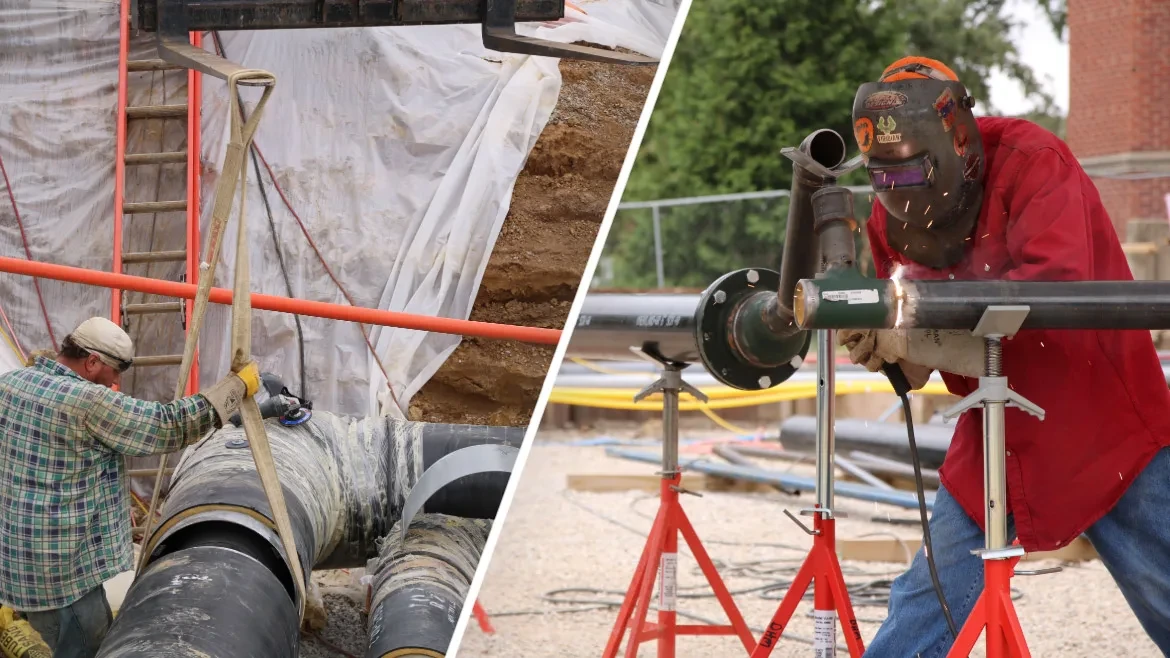
CHARLESTON, Ill. — For students, faculty, and visitors walking across the historic campus of Eastern Illinois University (EIU), the physical evidence of a massive campus transformation is impossible to miss. Temporary piping has been routed above ground across various quads and walkways, while heavy excavations have opened raw access to a complex utility network normally hidden safely beneath the sidewalks.
Below grade, specialized mechanical crews are actively replacing aging steam and condensate piping, remediating hazardous materials, and rehabilitating historical utility tunnels that have quietly served generations of academic buildings.
University leadership views this disruptive, capital-intensive work as a foundational prerequisite for EIU’s broader modernization strategy. Rather than cosmetic surface upgrades, the university is tackling deep-seated infrastructure failures head-on.
“Everything feeds from this,” said Matt Bierman, vice president for business affairs at EIU. “It’s just like fixing a roof before you start working on the interiors. We’ve got to get our infrastructure in place, so that as we do make some adjustments across the campus, we’re ready for those.”
This strategic preparation is taking on added urgency as EIU moves closer to the groundbreaking of its new Integrated Science Building—a flagship facility designed to house the chemistry, biochemistry, and biological sciences departments. By investing in the underlying distribution network now, EIU is ensuring that the new science complex can tie directly into the campus district energy system, saving millions in construction costs and eliminating the need for standalone mechanical equipment.
Chronology: From Coal-Fired Roots to Modern Upgrades
The historical trajectory of EIU’s utility infrastructure reflects the broader evolution of midwestern higher education over the past century.
The Early Decades and Historical Expansion
For decades, EIU relied on a traditional, centralized coal-fired steam plant located near the heart of campus. To distribute thermal energy to academic and residential buildings, a network of utility tunnels was constructed. While newer additions feature poured concrete, substantial portions of the original network were built using classic brick archways—architectural hallmarks of early-to-mid 20th-century municipal and institutional engineering. Over time, these tunnels evolved from simple steam pathways into comprehensive utility corridors carrying potable water, natural gas, compressed air, and vital communications infrastructure.
The 2011 Renewable Energy Center Pivot
A major milestone in the university’s energy history occurred in 2011 with the opening of the Renewable Energy Center along Illinois Route 130. Conceived to replace the aging, dirty coal-fired central steam plant, the new facility was designed to utilize biomass energy, including biomass gasification technology. However, as Bierman noted, the biomass gasification component ultimately faced technical hurdles and did not work out as originally intended.
Today, the Renewable Energy Center successfully generates steam using natural gas. While the facility modernized generation, the distribution infrastructure connecting it to the main campus continued to age, inheriting decades of deferred maintenance. The old coal-fired equipment was decommissioned, and the plant’s towering smokestack was eventually demolished. A natural-gas boiler was retained temporarily as a backup capacity measure.

The Current Four-Phase Overhaul
To combat mounting mechanical failures—specifically within the condensate piping—EIU secured state funding to launch a comprehensive, multi-phase infrastructure project. Executed by Urbana-based mechanical contractor Davis-Houk Mechanical Inc. (DHM), the project relies on a complex staging strategy.
Because the existing tunnels are congested and require asbestos abatement, DHM has implemented a four-phase approach utilizing temporary above-ground piping to maintain uninterrupted thermal service to campus buildings. The project kicks off with a northern phase near the iconic Old Main building, alongside direct-buried piping running from the Route 130 energy center toward the core of campus. Subsequent phases will address the southern and western portions of the existing tunnel network, incorporating structural repairs to the historic brick archways and expanding capacity for upcoming campus developments.
Supporting Data and Technical Scope
The scale of EIU’s infrastructure modernization is substantial, blending heavy civil engineering, industrial mechanical work, and environmental remediation.
- Project Funding & Scope: Driven by years of deferred maintenance and underfunding, EIU packaged its critical infrastructure needs into a comprehensive funding request approved by the state of Illinois.
- Contractor Involvement: Davis-Houk Mechanical Inc. (DHM), an institutional and industrial mechanical specialist headquartered in Urbana with a growing Charleston presence, leads the execution. DHM brings deep regional experience, including similar steam-distribution work completed at the University of Illinois.
- Network Dimensions: The project bridges a geographic gap, connecting the Renewable Energy Center on 18th Street/Route 130 via direct-buried piping to the historic on-campus utility tunnel distribution grid.
- Multi-Utility Integration: The subterranean network functions as a true utility corridor, housing steam, condensate return lines, potable water, natural gas, compressed air, and data lines.
- Environmental & Safety Upgrades: Beyond pipe replacement, crews are actively abating asbestos-containing pipe insulation, clearing debris from tunnel floors, and widening egress paths to ensure compliance with modern worker safety standards.
Official Responses and Industry Perspectives
The heavy focus on underground utilities highlights a fundamental truth of district energy systems: their success is entirely dependent on components that are deliberately hidden from view.
Eric Wahls, director of Facilities Planning & Management at EIU, emphasized the fiscal and operational efficiency of preserving the central system rather than building isolated mechanical systems for new developments. When planning the upcoming Integrated Science Building, EIU evaluated whether to construct an independent mechanical island with its own packaged boiler. By leveraging the upgraded campus steam network instead, the university bypassed that expense.
“We were able to cut a package boiler out,” Wahls said. “We basically get more building for our money.”
From a logistical standpoint, maintaining service during construction requires meticulous planning. Chris Rennels, president of DHM, noted that pipefitting and managing thermal expansion and contraction are central to the firm’s operations. The physical nature of the project means dealing with infrastructure modified across multiple eras of the university’s history.
“They were fortunate enough to get funding available to be able to replace and hopefully put them in a good position for years to come,” Rennels said. For Rennels, the project also carries personal resonance: he grew up locally, and his father spent nearly 30 years working for EIU facilities, including serving as plumbing foreman. “EIU’s home for me, and that’s another thing that makes this project special.”
Rob Thornton, president and CEO of the International District Energy Association (IDEA), underscored the vital importance of subterranean maintenance across the higher education sector.

“That network is invisible by design, and the tunnels and piping are the part almost no one thinks about, yet they determine whether the system actually delivers on its promise,” Thornton said. He pointed out that a central generation plant can operate at peak performance, but deteriorated distribution infrastructure will ultimately undermine the entire system. “Reliability is decided underground.”
Furthermore, Thornton noted that maintaining robust distribution networks preserves long-term options for institutions navigating future energy transitions. Whether a campus eventually integrates heat pumps, geothermal exchange, waste heat recovery, or lower-temperature hot water systems, those modern thermal technologies depend entirely on a resilient backbone capable of reliably carrying energy across the property.
Implications for EIU’s Future
The overhaul of EIU’s utility network arrives at a critical juncture for the university as it works to stabilize enrollment, optimize its physical footprint, and modernize academic offerings.
A Catalyst for the Integrated Science Building
The most immediate beneficiary of the utility work will be the planned Integrated Science Building. By aligning the southern distribution upgrades with the science building’s footprint, EIU is ensuring that chemistry, biochemistry, and biological sciences students will step into modern, state-of-the-art laboratories supported by reliable, efficient mechanical systems from day one.
“We’re excited to get them all into new spaces because our science labs need some assistance,” Bierman said, emphasizing that the underground preparation is an integral phase of the science building project itself.
Strategic Footprint Reduction
While utilities are expanding in some areas, EIU is simultaneously rightsizing its campus footprint elsewhere. Carman Hall, a former residence hall, sits unoccupied, and the university has opted not to renew the utility piping that once served it. Other spaces, such as Pemberton Hall, are being evaluated for adaptive reuse—potentially transforming into a welcome center for admissions and advancement. These strategic shifts allow the university to reallocate thermal loads efficiently, shedding dead weight from decades past.
Breaking a 30-Year Stagnation
For leadership, the current construction represents a psychological as well as physical turning point. After decades of managing managed decline and deferred maintenance under tight fiscal constraints, EIU is actively reinvesting in its core assets.
“We’ve got a lot of great things going on,” Bierman reflected. “It’s been kind of slow progress the last 30 years on this campus.”
Ultimately, EIU’s massive capital investment proves that true campus progress often begins in the dark, cramped, and historically rich corridors deep beneath the ground. When the dust settles, the temporary pipes disappear, and the new science building finally opens its doors, the heartbeat of the campus will be driven by a familiar engine: an old district energy grid, completely renewed from the inside out.
