

By Terrence O’Brien
Weekend Editor & Tech Industry Veteran
Main Facts
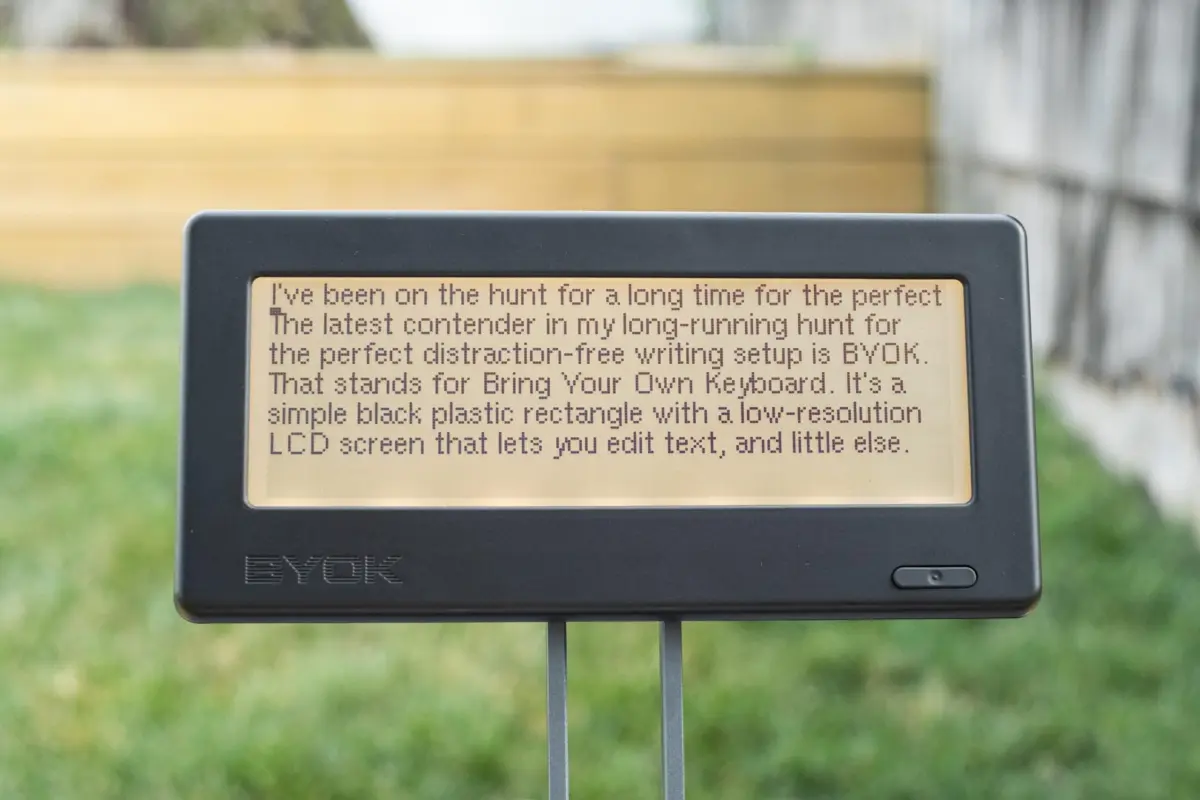
In an era dominated by multi-tasking operating systems, notification-heavy software suites, and browser tabs that multiply like rabbits, a distinct counter-movement has emerged. Writers, journalists, and novelists are increasingly seeking technological sanctuaries—single-purpose devices that strip away the digital noise and leave only the blinking cursor and the virtual page. Enter BYOK, a no-frills, minimalist writing gadget designed to do one thing exceptionally well: let users put words on a screen without interruption.
To 90 percent of consumers, a dedicated, single-purpose writing machine may seem entirely frivolous in a world where every smartphone, tablet, and laptop can process text. Yet, for the subset of the population that spends a significant chunk of their lives wrestling with prose, the allure of BYOK is undeniable. BYOK is at its absolute best when users stick to the bare minimum—pure, unadulterated text drafting.
However, success brings complexity. As BYOK has grown in popularity, its user base has voiced divergent desires. While purists love the hardware for its radical simplicity, a vocal segment of more demanding users requires greater versatility. They want to draft complex screenplays, organize sprawling epic novels, keep running character notes, and structure multi-layered nonfiction manuscripts.
Balancing the demands of these power users without alienating the purists has become the defining challenge for BYOK founder Nick Sjolinder. The solution currently in development is an upcoming scripting and optional plugin ecosystem. Rather than cluttering the core operating system with heavy software bloat that the majority of users will never touch—or overcrowding the companion Studio app with rigid, pre-set formats—BYOK is preparing to roll out optional scripts.
These scripts will allow users to tailor the device to their specific creative workflows. Early concepts include screenplay assistants, dedicated character-logging tools, and prose-analysis utilities that can check for passive voice or extract highlighted passages into separate notes. While still early in development and not yet available to the public, the company is actively soliciting community feedback via Reddit and other channels to shape how these features will eventually function.
Chronology: The Evolution of Distraction-Free Writing and the Rise of BYOK
To understand the strategic pivot BYOK is currently undertaking, it is necessary to examine the broader historical arc of distraction-free writing tools and the timeline of the device itself.
The Era of the Word Processor (Pre-Smartphone Era)
Long before modern distraction-free hardware emerged, writers relied on dedicated word processors like the AlphaSmart or early electronic typewriters. These devices were valued precisely because they lacked internet connectivity, games, and pop-up notifications. They offered a direct conduit from the human brain to the written word. However, as personal computers became ubiquitous and internet access became universal, these dedicated gadgets largely vanished, replaced by applications like Microsoft Word, Google Docs, and Scrivener running on multitasking machines.
The Modern Minimalist Hardware Renaissance
In the late 2010s and early 2020s, a backlash against digital distraction gained momentum. Devices like the Astrohaus Freewrite carved out a passionate niche by offering e-ink or mechanical-keyboard-based writing decks connected only to the cloud for backup. These devices proved that a market still existed for hardware designed exclusively to combat procrastination.
The Birth of BYOK
Building upon this minimalist ethos, founder Nick Sjolinder conceptualized BYOK as a reaction against the bulk and high cost of existing distraction-free hardware. Designed to be lightweight, focused, and deeply utilitarian, BYOK entered the market as a pure drafting tool. Its core philosophy centered on friction reduction: turn it on, open a document, and write.
The User-Base Bifurcation
As BYOK shipped to early adopters, a natural split occurred within the community:
- The Purists: Writers who viewed any feature beyond plain-text input as a slippery slope toward digital clutter. They wanted the device to remain a modern digital notebook.
- The Power Users: Screenwriters, novelists, and journalists who loved the hardware’s form factor and focus-inducing qualities, but found themselves needing structural tools—such as scene breaks, character sheets, and outlining capabilities—to manage larger projects.
The Current Phase: The Scripting Pivot
Recognizing that a rigid one-size-fits-all approach would ultimately alienate half of its audience, Sjolinder and the BYOK team initiated plans for an optional scripting architecture. Moving away from monolithic software updates, the company decided to put modularity first, opening a public dialogue on Reddit to gauge user interest and test early concepts for custom workflows.
Supporting Data: The Anatomy of Distraction and the Demands of Modern Writers
To contextualize why a device like BYOK—and its proposed scripting features—matters in the modern publishing landscape, one must look at the psychological friction of digital writing environments and the demographics of modern creators.
The Cost of Digital Multi-Tasking
According to various productivity and cognitive studies, the average knowledge worker is interrupted or switches tasks every three minutes. When writing prose—a cognitive task requiring deep, sustained focus (often referred to as "flow state")—every interruption carries a heavy penalty. Research indicates that it can take upwards of 15 to 23 minutes to return to a deep state of focus after a single distraction, such as checking an email notification or glancing at a social media feed.

Dedicated writing hardware like BYOK aims to eliminate this switching cost entirely. However, the data surrounding how writers organize their work reveals a competing truth: writing is rarely just a linear stream of words.
- Structuring Novels: A standard novel spans roughly 80,000 to 100,000 words. Authors managing multi-plot narratives frequently utilize outlining tools, character bibles, and scene-reordering software.
- Screenwriting Standards: Screenplays adhere to strict formatting rules (Industry Standard Courier 12pt, specific indentation for dialogue, parentheticals, and sluglines). While a purist might draft raw dialogue on a plain-text device, formatting it later requires transitioning to specialized software like Final Draft or Celtx.
Feature Demand Breakdown (Projected vs. Actual Use)
Internal community feedback gathered by BYOK indicates a fascinating distribution of user priorities:
- ~80% of users primarily value the device for distraction-free drafting, battery life, and tactile feel. They express concern that software bloat could ruin the device’s core value proposition.
- ~20% of users are complex project creators (novelists, screenwriters, academic researchers) who require metadata organization, search capabilities, and format flexibility.
By implementing an optional scripting engine, BYOK is attempting to satisfy the 20 percent without imposing complexity on the 80 percent. If executed correctly, scripts will remain dormant and invisible to those who want a pure typewriter experience, while acting as powerful catalysts for those who need advanced workspace customization.
Official Responses and Developer Insights
The strategic direction of BYOK’s upcoming software expansion has been guided primarily by direct interactions between founder Nick Sjolinder and the device’s passionate user community.
In recent statements and community outreach initiatives, Sjolinder has emphasized that the guiding design principle of BYOK will always be respect for the user’s focus. The core tension—how to add utility without introducing distraction—has been the central internal debate for the company.
"Balancing the wants and needs of these more demanding users has been a challenge that we have been trying to figure out how to tackle," Sjolinder noted during recent community discussions. "The answer we seem to have landed on is scripts. Rather than clutter BYOK with a ton of features that the majority of users won’t touch, or crowd the Studio app with even more rigid formats, we are planning to implement optional scripts that expand capabilities modularly."
Instead of imposing a top-down corporate roadmap, BYOK took the unusual step of opening development threads on platforms like Reddit (specifically within communities dedicated to the hardware). By inviting users to debate plugin architecture, script permissions, and text-manipulation tools, the company is attempting to build an ecosystem tailored to actual writing habits rather than theoretical use-cases.
Industry analysts have praised this community-led approach, noting that hardware startups often fail when they attempt to guess what power users want, resulting in bloated, confusing interfaces. By keeping the core device lean and pushing advanced capabilities into optional scripts, BYOK is threading a very difficult design needle.
Implications: What This Means for the Future of Writing Technology
The evolution of BYOK carries significant implications not just for the company itself, but for the broader market of dedicated productivity hardware and the future of writing ergonomics.
1. The Death of Monolithic Software in Niche Hardware
For decades, consumer electronics operated on a "more is better" philosophy. Every new software iteration added more features, more buttons, and more menus. BYOK’s approach signals a mature shift toward modular minimalism. By treating advanced features as optional scripts rather than core operating system requirements, BYOK proves that niche hardware can cater to both minimalists and power users simultaneously.
2. The Blurring Lines Between Analog Feel and Digital Power
Writers have long faced a false dichotomy: either use a traditional analog typewriter (which offers zero distractions but makes editing and publishing a logistical nightmare) or use a modern computer (which offers infinite editing power but exposes the writer to the endless siren song of the internet). Devices like BYOK—augmented by intelligent scripts that can check for passive voice or organize character notes—represent a synthesis of these worlds. Writers get the tactile, offline sanctuary of dedicated hardware combined with the intelligent parsing capabilities of modern software.
3. Community-Driven Hardware Development
By crowdsourcing the conceptualization of its scripting features, BYOK is pioneering a collaborative model of hardware iteration. Users are no longer passive consumers waiting for the next annual hardware release; they are active co-architects of the software ecosystem. If successful, this model could be adopted by other niche hardware manufacturers in fields ranging from music production (such as specialized synthesizers) to digital art and coding decks.
4. The Ongoing War for Human Attention
Ultimately, the success or failure of BYOK’s scripting experiment will serve as a bellwether for how modern creators manage attention. As artificial intelligence and notification systems continue to encroach upon every waking minute, tools that aggressively protect human focus will only grow in value. Whether BYOK can successfully introduce productivity scripts without accidentally inviting back the digital chaos it was built to escape remains the ultimate question. For now, the writing community watches with bated breath, eager to see how the blank page evolves.
