


Global — Artificial intelligence has firmly established its footprint in the insurance sector, shifting rapidly from a speculative technology experiment into a core operational engine. Yet, according to a landmark new study by global professional services and tech consulting firm Accenture, the insurance industry is leaving substantial financial value on the table.
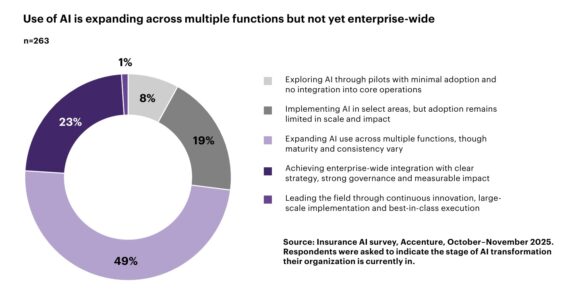
Titled “How insurers drive revenue by deploying AI with intent,” the report reveals that while the vast majority of insurance carriers are enjoying tangible revenue boosts from localized AI deployments, fewer than one in four have successfully integrated artificial intelligence across their entire enterprise. Industry analysts warn that by treating AI as a collection of isolated technology programs rather than a unified growth strategy, insurers are missing out on the compounding returns that come from total digital transformation.
Main Facts: The State of AI in Insurance Today
The core thesis of Accenture’s research is straightforward: insurance companies can no longer afford to treat artificial intelligence as a siloed experiment handled exclusively by IT departments or discrete operational units.
Key takeaways from the research include:
- The Integration Gap: Only 23% of insurers have achieved enterprise-wide integration of their AI deployments.
- Siloed Expertise: AI capability remains heavily concentrated in small, specialized groups. There is a profound lack of enterprise-wide upskilling spanning critical operational pillars such as underwriting, claims, actuarial science, and general operations.
- The "AI with Intent" Mandate: Insurers must graduate from an indiscriminate "AI everywhere" approach—where tools are thrown at random problems—to a deliberate strategy that deploys "AI with intent" to reinvent the business model from the ground up.
- The Compounding Effect: Localized wins, such as sharpening risk-pricing models or streamlining a specific underwriting workflow, offer immediate local performance boosts. However, when those insights fail to flow downstream into distribution, product design, and cross-sell strategies, carriers forfeit the compounding growth benefits that link risk intelligence directly to revenue generation.
Chronology: The Evolution of Insurance AI From Experiments to Growth Engines
To understand where the industry stands today, it is helpful to trace the evolution of AI adoption within the insurance landscape over the past several years:
- Phase 1: The Proof-of-Concept Era (Late 2010s – Early 2020s): Insurers experimented cautiously with AI. Projects were largely confined to chatbots for customer service or basic automated document processing. Risk aversion and regulatory compliance concerns kept machine learning initiatives tightly sandboxed.
- Phase 2: The Point-Solution Boom (2022 – 2024): Following breakthroughs in generative AI and advanced predictive analytics, insurance executives rushed to launch point solutions. Underwriters used algorithms to parse risk reports faster; claims teams deployed computer vision to assess auto damage. While effective locally, these initiatives fractured organizational ownership and split investment budgets.
- Phase 3: The Recognition of Value (2024 – Present): As executive surveys show, revenue growth has officially eclipsed cost-cutting as the primary driver of AI adoption. Insurers are realizing that point solutions, while helpful, hit a ceiling. The current phase demands a holistic, orchestration-heavy strategy that aligns technical capabilities directly with profit-and-loss (P&L) outcomes.
Supporting Data: The Metrics Driving the Shift
Despite fragmented deployments, the quantitative returns on AI investments have been remarkably strong, creating an optimistic baseline for C-suite leaders who are eager to scale.

Accenture’s empirical findings are built on a robust global dataset:
- Gross Written Premium (GWP) Growth: A striking 81% of surveyed insurers report at least a 5% improvement in gross written premiums directly attributable to AI and data initiatives. Furthermore, 7% of respondents have achieved GWP improvements exceeding 20%, largely powered by enhanced risk pricing, hyper-personalization, and advanced cross-selling capabilities.
- C-Suite Sentiment Shift: Among the 218 C-suite leaders surveyed across the insurance industry in 20 countries, 85% now view revenue growth as a primary and significant benefit of AI for their organizations. This represents a substantial leap from just 68% two years prior.
- Global Executive Input: The report’s findings are underpinned by a comprehensive survey of 263 senior insurance executives holding direct accountability for AI, data, technology, and business transformation. This cohort includes leaders from 89 property and casualty (P&C) carriers, 100 life and annuity firms, and 74 multi-line institutions.
- Global Qualitative Insights: To contextualize the quantitative data, Accenture conducted 15 in-depth qualitative interviews with prominent industry executives spanning Asia-Pacific (such as Dai-ichi), Europe (including Admiral, Allianz, AXA, Generali, Munich Re, and Zurich), and North America (including Liberty Mutual, MetLife, New York Life, Progressive, State Farm, The Hartford, and Travelers).
Official Responses and Executive Insights
Industry leaders and consulting experts emphasize that the next phase of insurance technology will separate market leaders from legacy laggards.
Ravi Malhotra, Global Insurance Industry Lead at Accenture, pulled no punches when commenting on the report’s findings:
"Our research shows that while AI is already delivering real revenue gains for insurers, most are leaving value on the table. They need to shift from isolated pilots to enterprise-wide intelligence—treating AI not as a technology program, but as a driver of growth, with clear links from strategy to execution to create measurable P&L impact."
Malhotra and his co-authors stress that orchestrating AI across an entire corporation allows businesses to discover hidden synergies among disparate initiatives. This ensures that every dollar spent anchors directly to measurable business outcomes rather than disappearing into departmental overhead.
Implications: What This Means for the Future of Insurance
The transition from fragmented AI pilots to enterprise-wide intelligence carries profound strategic implications for carriers, brokers, and insurtech players alike.
1. Accelerated Time-to-Market
Carriers that successfully scale AI enterprise-wide will dramatically shorten product development cycles. By creating a unified data ecosystem, actuarial insights, market trends, and risk assessments can feed into new product creation simultaneously, allowing innovative insurance products to reach consumers faster than ever before.
2. Workforce Transformation and AI Literacy
An enterprise-wide strategy requires more than just buying software; it demands comprehensive workforce upskilling. Companies that foster a culture of AI literacy will empower employees across underwriting, claims, and operations to collaborate natively with machine learning tools, building internal capabilities that are deeply embedded and difficult for competitors to replicate.
3. The Rise of Agentic Workflows
As cloud platforms like Amazon Web Services (AWS) define and popularize AI agents—software programs capable of interacting with environments, collecting data, and performing self-directed tasks to meet predetermined human goals—the insurance ecosystem is poised for deeper automation. In an enterprise-wide framework, these agents will not merely assist human workers within isolated departments; they will coordinate complex workflows across the entire insurance value chain, from initial quote generation to complex claims adjudication.
4. The Ultimate Competitive Advantage
Ultimately, Accenture’s research makes it clear that the future belongs not to the companies that simply adopt AI tools, but to those that master how those tools are deliberately scaled across the enterprise. Insurers that cling to isolated pilots risk plateauing, while those that embrace a holistic, intent-driven approach will secure enduring competitive dominance.
