

Main Facts
As extreme weather events become the new normal, local governments face an unprecedented mandate: protect residents and critical infrastructure from intensifying climate disasters. However, a recent panel discussion hosted by Clark University underscored a stark, systemic crisis in this effort. While experts agree that municipalities must act urgently to build climate resilience, they are far from starting on equal footing.
The core bottleneck is not a lack of technological know-how or planning expertise; rather, it is a profound fiscal and administrative deficit. Under-resourced localities—those most vulnerable to climate shocks—frequently lack the institutional capacity required to secure the very funding designed to help them.
According to Mark Davidson, a geography professor at Clark’s School of Climate, Environment, and Society, the municipal climate challenge is fundamentally a capacity crisis. Citing a recent National League of Cities survey, Davidson noted that 84% of municipalities report having insufficient capital budgets, while 81% are actively rethinking their infrastructure investments as federal funding programs from the Biden administration wind down.
This creates a vicious cycle. Historically, federal and state governments have attempted to bridge municipal shortfalls through competitive grant programs. Yet, competing for these funds requires extensive staff time, specialized technical expertise, and often matching financial commitments. Consequently, cities with pre-existing administrative advantages win the funding to build even greater capacity, leaving under-resourced communities further behind. To break this cycle, experts argue that cities must look beyond traditional subsidies, forge creative partnerships, and fundamentally restructure how they finance, plan, and execute climate adaptation.
Chronology
The evolution of modern municipal climate finance has moved through distinct phases over the last two decades, marked by a recent pivot away from reliance on federal windfalls toward localized, innovative economic frameworks.
- The Early 2000s: Municipalities primarily viewed climate action through the lens of voluntary green initiatives and isolated sustainability targets. Extreme heat and weather events were measured as anomalies rather than systemic, permanent threats. For instance, in 2003, cities like Riverside, California, experienced significantly fewer days over 95 degrees Fahrenheit than they do today.
- The Post-Disaster Era (2010s–2020): Driven by recurring catastrophic weather events, cities began developing formal climate action plans. However, these plans were heavily dependent on volatile municipal budgets or reactive, post-disaster federal assistance from organizations like the Federal Emergency Management Agency (FEMA), which often failed to cover holistic, long-term resilience investments.
- The Federal Funding Surge (2021–2024): The introduction of major federal packages provided a temporary influx of capital, allowing many cities to initiate ambitious planning and infrastructure projects. However, this period also exposed the administrative "capacity paradox," where smaller or economically disadvantaged municipalities struggled to capture these temporary federal dollars.
- The Current Landscape (2025 and Beyond): As federal aid tapers off, cities and states are entering a new era characterized by permanent climate risk and dwindling temporary funds. Municipalities are actively transitioning toward sustained, structural financial innovations—such as state-backed climate banks, specialized revolving funds, and deeply integrated public-private partnerships (P3s)—to ensure long-term viability.
Supporting Data
The urgency of the municipal resilience crisis is quantified by a growing body of research and municipal data highlighting the sheer scale of the threat and the financial shortfalls facing local governments:
- 84%: The percentage of municipalities reporting that they possess insufficient capital budgets to meet their infrastructure needs, according to a National League of Cities survey cited by Clark University experts.
- 81%: The percentage of cities currently forced to rethink their infrastructure investments as federal funding streams draw to a close.
- $90 Billion to $130 Billion: The estimated investment required in Massachusetts alone to address critical resilience needs—including high-hazard dams, coastal protection infrastructure, and the preservation of urban tree canopies and wetlands—through the year 2050, according to an analysis by the state’s Office of Climate Innovation and Resilience.
- 79 Days and 115 Degrees: In 2024, Riverside, California, recorded 79 days with temperatures exceeding 95°F—representing a dramatic 65% increase compared to 2003 data—alongside a blistering peak temperature of 115°F.
- $50 Million: The initial dedicated capital fund used by Massachusetts to launch the nation’s first community climate bank, designed to provide low-interest financing for affordable housing retrofits, fortified roofs, and heat pumps.
- 4,000+: The volume of community comments gathered across 36 dedicated public events by the City of Riverside during the development of its comprehensive climate action and adaptation plan.
Official Responses
During the Clark University panel, municipal leaders and resilience experts outlined three primary operational strategies to help cities finance and execute crucial resilience infrastructure in the face of dwindling federal aid.
1. Responding with Layered Programs
Faced with escalating climate hazards such as extreme heat and wildfires, cities are finding success by stacking complementary, multi-layered programs rather than relying on isolated projects.
Riverside Mayor Patricia Lock Dawson highlighted how her city of roughly 323,000 residents has responded to its surging temperatures. Partnering with Bloomberg Philanthropies, Riverside established a Youth Climate Action Fund while drafting an overarching climate action and adaptation plan. Concurrently, the city’s Fire Department Office of Emergency Management launched "Ready Riverside," a targeted campaign educating residents on heat safety and emergency preparedness.
Furthermore, utilizing a grant from the National Oceanic and Atmospheric Administration (NOAA), Riverside conducted an extreme heat summit and tabletop simulation exercise with local public and nonprofit stakeholders. By employing a community engagement map to assess existing tree canopies, the city successfully secured a California Transformative Communities grant. This funding enabled Riverside to plant 1,000 new trees and install solar panels on 100 homes in low-income neighborhoods disproportionately impacted by urban heat islands.
"Despite the federal government stepping back… the work continues," Mayor Dawson stated. "It has to."
2. Building New Financing Infrastructure
With traditional subsidies falling short of long-term needs, states and local governments are pioneering new financial architectures to attract capital.
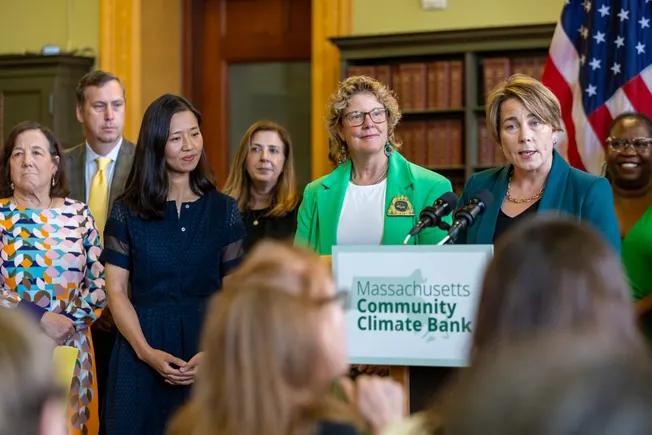
Melissa Hoffer, Massachusetts’ inaugural chief climate officer, noted that her office realized early on that subsidies alone could never cover the state’s $90 billion to $130 billion resilience price tag. Consequently, Massachusetts launched the Massachusetts Community Climate Bank, capitalized with $50 million in dedicated state funds, to deliver low-interest loans for retrofitting affordable housing with heat pumps and fortified roofs.
Additionally, after catastrophic flooding exposed systemic gaps in federal disaster relief, Massachusetts proposed the "Mass Ready Act." Championed by Governor Maura Healey, the bill establishes a state-level disaster response and resilience fund. Functioning as a revolving fund, it provides low-interest loans for pre-disaster resilience projects while requiring disaster-stricken communities to rebuild to higher resilience standards.
Nationwide, local governments are also integrating private capital at the very inception of infrastructure projects. Saharnaz Mirzazad, executive director of ICLEI USA, pointed to the organization’s newly released resilience finance guidebook. The resource is designed to help local governments quantify the financial value of risk reduction and translate that data into the language of lenders, insurers, and private investors. "This has been, in my mind, a real game-changer at the local government level," Mirzazad noted.
3. Engaging the Community Early—and Structurally
Experts stressed that community engagement must transition from an afterthought or a compliance checkbox into a foundational pillar of infrastructure planning and funding acquisition.
"It shouldn’t be just ‘good to have’—it’s important to think about it and value the opinion of the people on the receiving end of the infrastructure," Mirzazad emphasized. For major municipal projects, ICLEI USA recommends establishing local governance bodies that grant residents a direct role in prioritizing spending, maintenance, and project evolution. This structural inclusion fosters transparency, fiscal accountability, and community empowerment.
In practice, Riverside’s extensive public outreach—yielding over 4,000 public comments across 36 events—demonstrates that active, continuous civic participation validates data sets, strengthens grant applications, and ensures that mitigation projects directly address the lived realities of vulnerable populations.
Implications
The structural shifts occurring in municipal climate finance carry profound implications for the future of urban development, social equity, and economic stability.
First, the transition from temporary federal grants to permanent, localized financing mechanisms—such as revolving green funds, community climate banks, and structured public-private partnerships—signals a permanent decentralization of climate governance. Cities and states can no longer wait for top-down federal rescues; they must build robust, self-sustaining financial ecosystems capable of weathering economic downturns alongside climate shocks.
Second, addressing the administrative capacity gap is a matter of profound environmental justice. If under-resourced localities continue to be locked out of complex funding applications due to staff and expertise shortages, climate vulnerability will increasingly map onto socioeconomic divides. Wealthier cities will fortify themselves against rising seas and heatwaves, while poorer municipalities fall further behind. To counteract this, regional networks, universities, and private firms must step in to share administrative expertise and co-create institutional capacity.
Finally, embedding community engagement directly into the financial and operational design of infrastructure projects transforms public trust. When residents have a structural voice in spending decisions, climate adaptation ceases to be viewed as an imposition from distant bureaucrats and becomes a shared, community-owned defense. As Mark Davidson noted, the resilience gap is fundamentally about capacity—and overcoming it will require cities to harness every tool, partnership, and voice available to secure their futures in an era of extremes.
