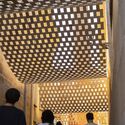
Published: August 24, 2026 Author: Olivia Poston Source: ArchDaily
Main Facts
The city of Logroño, Spain, recently served as an expansive living laboratory for experimental design during the 12th edition of the Concéntrico International Festival of Architecture and Design, held in June 2026. Eschewing the traditional model of secluded gallery exhibitions, Concéntrico has carved out a distinct identity since its inception in 2015 by anchoring full-scale architectural installations directly into the streets, plazas, and vacant lots of the city.
The 2026 program brought together more than twenty international projects conceived by architects, designers, and multidisciplinary researchers. These temporary interventions served as physical prototypes exploring how ephemeral architecture can radically reshape the future of urban public spaces. The festival was organized around three primary curatorial frameworks:
Identity and Fiction: Exploring the city as a living archive of narrative and collective memory.
Urban Ecologies: Addressing the delicate intersections of climate, material culture, natural landscapes, and architecture.
Ephemeral Agents: Utilizing temporary structures to catalyze social interactions and test new models for public space activation.
Notable contributions included works by acclaimed global talents such as Smiljan Radic, DF_DC (United Kingdom), Tão (Poland), AAU Anastas (Palestine), OFREIA, NOOF Group, Sahra Hersi, Gabriel Fontana, and Future Firm. Rather than operating as static objects, these installations were designed to engage local residents and global visitors as active, observant participants in an ongoing dialogue about the evolution of the contemporary city.
Chronology
2015–2025: The Evolution of a Festival
2015: Concéntrico is founded in Logroño with a vision to challenge conventional urban design paradigms by introducing localized, temporary architectural interventions that directly engage the public sphere.
2015–2025: Over the course of a decade, the festival steadily expands its international footprint, inviting emerging and established practices to test material innovations, community engagement strategies, and ecological frameworks within Logroño’s historical fabric.
Early 2026: Festival organizers announce the official selection criteria and open calls for international submissions, focusing heavily on climate adaptation, historical narrative, and temporary civic activation.
June 2026: The 12th Edition Unfolds
Early June 2026: Over twenty international teams arrive in Logroño to begin the rapid on-site construction of their full-scale prototypes. Collaborative workshops, public forums, and urban experimentation labs kick off alongside the physical builds.
Mid-June 2026: The festival officially opens to the public. For six intensive days, Logroño transforms into an active architectural site where residents and visitors navigate, test, and inhabit microclimates, civic gardens, acoustic listening capsules, and structural narratives.
Late August 2026: Critical reflections, documentation, and archival reviews of the 2026 prototypes are published globally, cementing the festival’s role as a leading global indicator for the future trajectory of temporary public space design.
Supporting Data and Project Breakdown
The 24 urban installations featured in the 2026 edition of Concéntrico engaged with distinct urban conditions, material palettes, and socio-spatial theories. The festival’s curatorial structure categorized these interventions into three deeply analytical lines:
1. Identity and Fiction
This thematic pillar approached Logroño as a site rich in narrative layers, utilizing architecture to unearth and re-present stories embedded within the urban fabric.
Smiljan Radic’s Installation: The renowned architect presented a striking spatial transposition of a traveling circus, converting theatrical traveling tropes into a permanent-feeling collective architecture that questioned scale, memory, and performance in public squares.
OFREIA’s Hydrological Research: Focusing on the city’s fluvial landscape, OFREIA investigated forgotten historical bathing practices and waterfront memories, translating archival research into a spatial experience along the riverbanks.
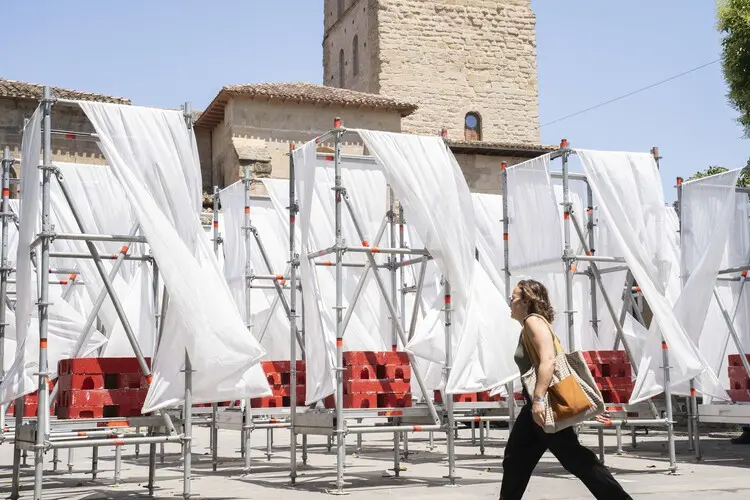
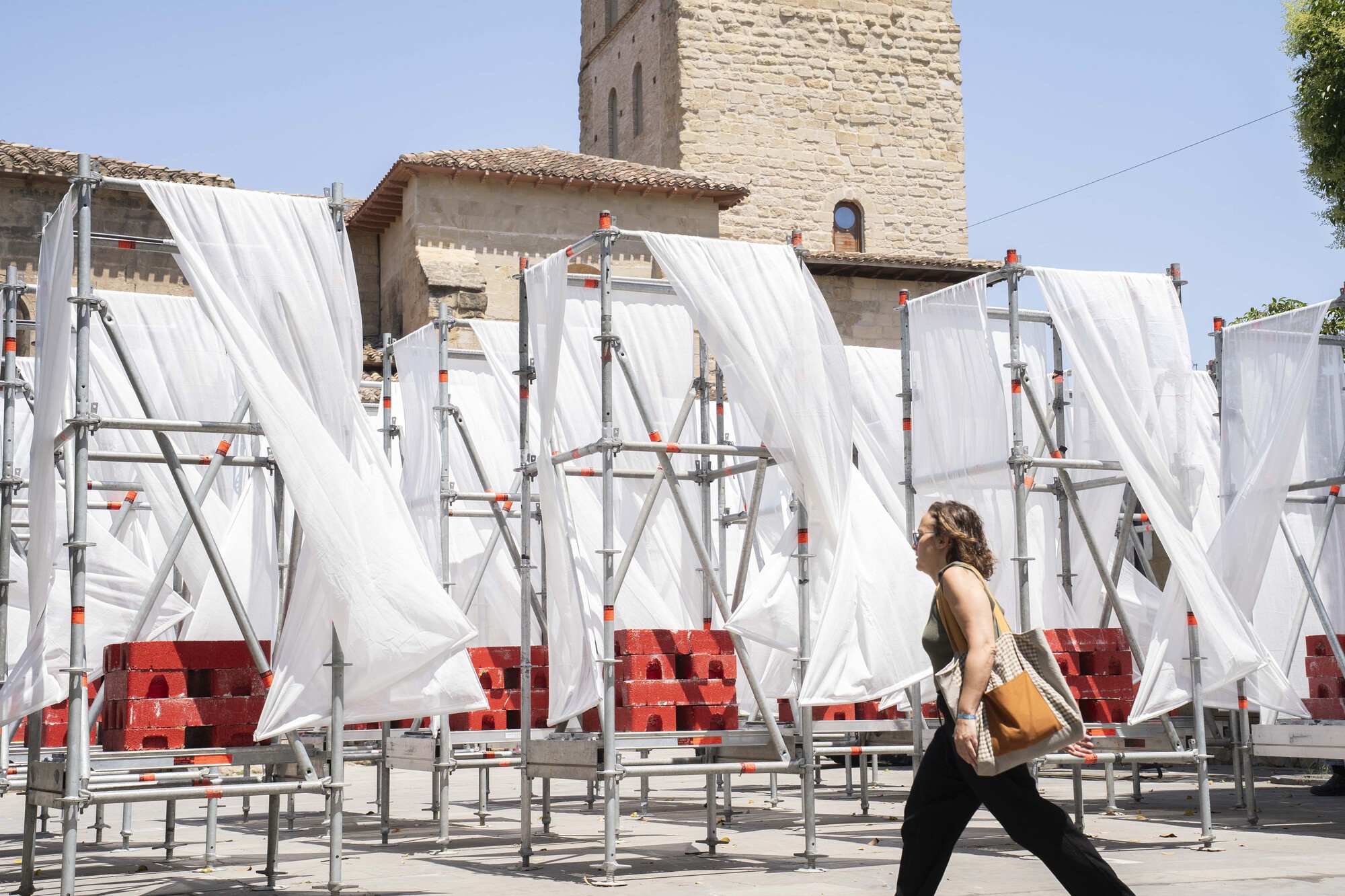
A Soft Embassy by DF_DC (United Kingdom): Capturing international attention (and featured prominently in festival imagery captured by Sara Cuerdo), this project investigated diplomatic and spatial softness, creating a welcoming, porous structure that challenged rigid civic boundaries.
2. Urban Ecologies
Addressing the urgent intersection of architecture, climate change, and material lifecycle management, these projects proposed adaptive mechanisms for the contemporary city.
NOOF Group’s Microclimate Pavilions: Responding to rising urban temperatures, NOOF developed experimental pavilions engineered to generate autonomous artificial cooling, shade, and mist, offering a tangible architectural language for thermal comfort in public spaces.
Sahra Hersi’s Civic Garden: Blurring the line between urban agriculture and civic infrastructure, Hersi established an interactive garden dedicated to local cultivation, biodiversity preservation, and community seed exchange.
3. Ephemeral Agents
This category examined how temporary structures can act as catalysts for immediate social dynamics, testing new ways citizens might utilize overlooked or transitional urban spaces.
Gabriel Fontana’s Multiform: An exploration of play, movement, and social assembly through design.
Urban Listening Capsules by AAU Anastas (Palestine): Utilizing sophisticated carpentry and acoustic research (such as their Cathedral for One prototype), the studio constructed immersive timber environments designed to collect, amplify, and reflect the ambient acoustic landscape of the city.
Future Firm’s Riverfront Connector: Bridging the architectural disconnect between an elevated pedestrian bridge and the riverside park below, this intervention successfully re-routed pedestrian flow and activated a previously underutilized topographical seam.
Official Responses and Curatorial Perspectives
The philosophy underpinning Concéntrico has consistently challenged the detached nature of conventional architectural biennials. Organizers and participating designers have repeatedly emphasized that the true value of ephemeral architecture lies not in its physical permanence, but in its capacity to provoke dialogue and test ideas without the high-stakes permanence of traditional urban planning.
"Concéntrico refuses the comfort of a distant, controlled exhibition. By embedding full-scale installations directly into the streets, plazas, and vacant lots of Logroño, architecture ceases to be an abstract drawing and becomes an active participant in daily civic life." — Festival Curatorial Statement
Designers participating in the 2026 edition highlighted the liberating nature of ephemerality. Working with temporary timeframes allows architectural practices to take calculated structural, material, and sociological risks that would face prohibitive regulatory hurdles in permanent municipal projects.
Furthermore, local residents of Logroño have historically embraced the festival as an interactive community dialogue. Rather than viewing the installations as disruptive foreign objects, the public frequently co-opts these spaces—transforming shaded microclimates into impromptu community gathering spots, acoustic capsules into storytelling booths, and temporary gardens into neighborhood hubs.
Implications for the Future of Public Spaces
The prototypes tested during Concéntrico 2026 offer profound lessons for urban planners, municipal governments, and architects worldwide as cities grapple with intersecting crises of climate change, housing pressures, and shifting public life.
Prototyping as Urban Policy
Traditional master planning is notoriously slow, expensive, and risk-averse. Ephemeral architecture offers a nimble alternative: tactical urbanism scaled up through rigorous architectural design. By constructing full-scale prototypes, cities can test how citizens actually move through, inhabit, and react to spatial reconfigurations before committing millions of dollars to permanent construction.
Climate Adaptation at a Human Scale
With urban heat islands intensifying globally, projects like NOOF Group’s microclimatic pavilions demonstrate that climate resilience does not need to look like sterile industrial HVAC infrastructure. Instead, cooling, shading, and humidity management can be integrated into beautiful, tactile, and participatory public art.
The Social Life of Vacant and Transitional Spaces
Cities are filled with residual spaces—empty lots, awkward structural transitions like bridge-to-river gaps, and underused plazas. Interventions by practices like Future Firm and AAU Anastas prove that minor, temporary architectural acupuncture can radically stitch together fragmented urban fabrics, proving that the future of public space is not about building more, but about activating what is already there with imagination, empathy, and technical ingenuity.