

By Anthony Capkun
Published: August 31, 2026
Main Facts
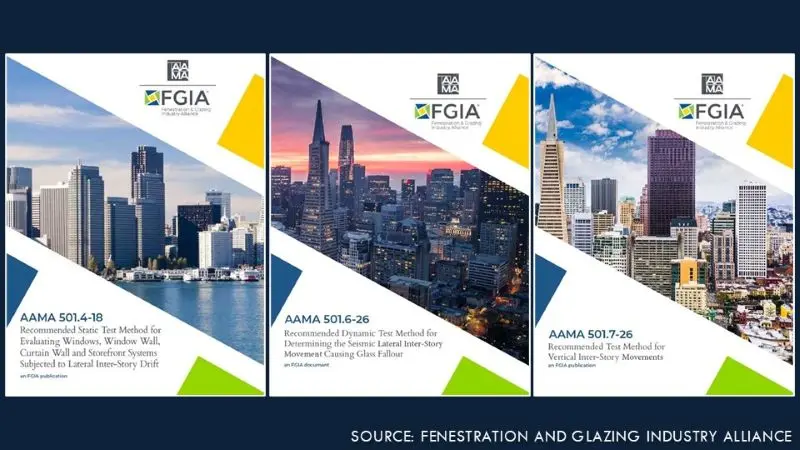
The Fenestration and Glazing Industry Alliance (FGIA) has officially announced the release of a comprehensively updated suite of technical documents establishing standardized test methods for evaluating fenestration and glazing systems during seismic events. This vital update focuses on three distinct types of structural movement—horizontal in-plane displacement, severe racking displacement leading to glass fallout, and vertical displacement—impacting commercial and residential exterior wall assemblies.
At the core of this release is the harmonization of three primary industry documents: AAMA 501.4, AAMA 501.6, and AAMA 501.7. While these standards have long served as the benchmarks for evaluating windows, window walls, curtain walls, and storefront systems under seismic stress, previous iterations suffered from minor terminology, methodological, and procedural discrepancies. The newly synchronized documents eliminate these gaps, providing architects, structural engineers, manufacturers, and testing laboratories with a unified, cohesive framework for compliance and performance validation.
The updated standards are now available for purchase through the official FGIA online store. Pricing has been set at $25 for association members and $70 for non-members, ensuring broad accessibility across the design and construction sectors.
Chronology: The Evolution of Seismic Standards in Fenestration
The path toward a fully harmonized suite of seismic testing standards spans decades of structural engineering advancements, building code evolutions, and post-disaster forensic investigations. Understanding how AAMA 501.4, 501.6, and 501.7 reached their current synchronized state requires a look back at the historical milestones of the fenestration industry.
Early Precedents and the Need for Standardized Testing (Pre-2000s)
Before the widespread adoption of formalized dynamic movement standards, the performance of glass and framing systems during earthquakes was largely governed by static calculations and empirical observation. Following major seismic events—such as the 1989 Loma Prieta earthquake in Northern California and the 1994 Northridge earthquake—post-disaster reconnaissance revealed that building envelopes sustained significant damage even when primary structural frames remained intact. Glass fallout posed a severe life-safety hazard to pedestrians below, while framing deformations caused massive water and air infiltration failures.
The Inception of AAMA 501.4 and 501.6
To address the inadequacy of static assumptions, industry experts within the American Architectural Manufacturers Association (AAMA)—which later consolidated into the FGIA—developed standardized dynamic testing protocols.
Initially, the evaluation of horizontal in-plane displacement and the determination of glass fallout thresholds were housed within a single, comprehensive document. However, industry stakeholders soon realized that testing procedures for general inter-story drift (measuring overall system survival) required a different testing apparatus and methodology than destructive testing aimed at predicting glass fallout (determining the exact amplitude at which lites dislodge from their frames). Consequently, the original document was split into AAMA 501.4 (focusing on system performance under specified horizontal displacements) and AAMA 501.6 (focusing on horizontal racking displacement amplitudes that cause glass fallout).
The Introduction of AAMA 501.7
As high-rise architecture evolved to incorporate more complex geometries, cantilevered elements, and multi-story glass systems, engineers recognized that horizontal drift was only one component of seismic activity. Buildings also experience significant vertical movements during earthquakes due to column shortening, seismic wave propagation, and structural settling. To close this gap, AAMA 501.7 was introduced to establish rigorous test methods for evaluating windows, window walls, curtain walls, and storefront systems subjected to specified vertical displacements.
The 2026 Harmonization Initiative
Over time, as AAMA 501.4, 501.6, and 501.7 were revised independently across various code cycles, minor divergences crept into their definitions, testing rates, mounting criteria, and reporting requirements. Recognizing that conflicting criteria could create confusion during multi-phase testing programs, the FGIA Seismic and Wind-Induced Inter-Story Drift Review Task Group initiated a multi-year harmonization project. Culminating in the August 2026 release, this initiative successfully aligned all three documents, establishing a singular, streamlined methodology for evaluating complex wall assemblies under multi-axial seismic stress.
Supporting Data and Technical Breakdown of the Standards
To fully grasp the significance of the 2026 FGIA update, it is necessary to examine the specific engineering mechanics governed by each of the three revised documents. Modern building codes, such as the International Building Code (IBC) and ASCE 7 (Minimum Design Loads and Associated Criteria for Buildings and Other Structures), mandate that exterior wall systems accommodate building movements without failing structurally or creating life-safety hazards. The FGIA standards provide the physical testing protocols necessary to prove compliance with these mandates.
AAMA 501.4: Evaluating Horizontal In-Plane Displacement
- Primary Purpose: Evaluates the performance of windows, window walls, curtain walls, and storefront systems when subjected to specified horizontal displacements in the plane of the wall.
- Testing Mechanism: Under controlled laboratory conditions, a test specimen is mounted to a test fixture capable of simulating inter-story drift. Hydraulic actuators apply cyclic lateral loads that rack the supporting test frame back and forth, simulating the shear forces experienced by a building during a seismic event.
- Key Metrics Monitored: The test evaluates whether glass remains captured within the pockets, whether gaskets and sealants maintain their integrity, and whether structural framing members experience permanent deformation, binding, or component fracture.
AAMA 501.6: Determining Glass Fallout Thresholds
- Primary Purpose: Determines the horizontal racking displacement amplitude of exterior wall system framing members that causes the fallout of representative architectural glass panels.
- Testing Mechanism: Unlike 501.4, which focuses on non-destructive or serviceability-level performance, 501.6 is an ultimate-limit-state test. The specimen is subjected to progressively increasing amplitudes of horizontal racking displacement until the glass lites dislodge and fall out of the frame.
- Key Metrics Monitored: This test identifies the specific drift ratio and displacement magnitude that compromises the glass-to-frame interaction. It accounts for variables such as bite depth, setting block placement, structural silicone joint performance, and dry-glazing gasket retention.
AAMA 501.7: Evaluating Vertical Displacements
- Primary Purpose: Evaluates the performance of fenestration systems when subjected to specified vertical displacements.
- Testing Mechanism: Utilizing specialized vertical displacement test rigs, researchers apply relative vertical movement between stacked floor slabs or structural sub-frames. This movement mimics the axial elongation or compression of columns and spandrels during seismic activity.
- Key Metrics Monitored: The test assesses how slip joints, vertical stack joints, and anchoring connections accommodate vertical translation without crushing glass, jamming operable vents, or compromising weather-sealing barriers.
Harmonization Specifics: What Changed in 2026?
According to the FGIA task group, the primary achievements of the 2026 update include:
- Terminological Consistency: Standardizing the definitions of cycle rates, drift angles, and displacement amplitudes across all three documents.
- Procedural Alignment: Ensuring that laboratories conducting combined test programs (e.g., sequential horizontal drift followed by vertical displacement or glass fallout testing) can utilize seamless transition protocols without recalibrating baseline assumptions.
- Data Reporting Clarity: Unifying the structural reporting requirements, making it easier for code officials to cross-reference test reports against engineering calculations.
Official Responses and Industry Perspectives
The release of the harmonized seismic documents has been met with widespread praise from structural engineers, product manufacturers, and testing laboratory directors alike.
Lothar Erkens of Winco Window Company, who serves as the vice chair of the FGIA Seismic and Wind-Induced Inter-Story Drift Review Task Group, emphasized the meticulous coordination required to achieve alignment between the documents.
"While AAMA 501.4 and 501.6 were split from a single document into two documents for a very good reason—allowing distinct focus on serviceability versus ultimate glass fallout—the need to keep these texts aligned with each other was paramount," Erkens explained. "Over successive revision cycles, minor deviations in language and testing parameters began to emerge. This 2026 update ensures that whether a laboratory is evaluating general system drift under 501.4, determining ultimate glass retention limits under 501.6, or analyzing vertical building separation under 501.7, the governing baseline principles are completely synchronized."
Industry association leaders have similarly highlighted the practical benefits for manufacturers navigating rigorous regional building codes. In seismic-heavy zones—such as the Pacific Rim, the Pacific Northwest, and various active fault zones across the globe—building officials increasingly demand empirical test data rather than relying solely on computer modeling or theoretical calculations.
By streamlining the testing framework, the FGIA aims to reduce redundant testing costs for manufacturers while simultaneously increasing the safety margins of building envelopes. Standardization lowers the barrier to compliance, ensuring that smaller and mid-sized fenestration manufacturers can clearly interpret testing requirements and bring seismically resilient products to market more efficiently.
Implications for Architects, Engineers, and Manufacturers
The implementation of the updated FGIA seismic standards carries far-reaching implications for the commercial construction, architectural design, and fenestration manufacturing industries. As building codes grow increasingly stringent, these synchronized documents will reshape how facades are specified, engineered, and tested.
1. Enhanced Life-Safety and Property Protection
The most profound impact of the updated standards is the elevation of life-safety performance. Falling glass from shattered curtain walls has historically been one of the primary causes of injury during major earthquakes in dense urban environments. By utilizing the synchronized protocols of AAMA 501.4, 501.6, and 501.7, engineers can more accurately predict the behavior of complex glass envelopes. This enables the design of facades that can undergo severe plastic deformation and inter-story drift without shedding dangerous shards of glass onto sidewalks and building egress paths.
2. Streamlined Specification and Code Compliance
For architects and structural engineers, the harmonization of these standards simplifies the specification process. Project specifiers can now reference AAMA 501.4, 501.6, and 501.7 with confidence that the methodologies do not contain conflicting provisions or ambiguous terminology. When reviewing submittals, building code officials will benefit from uniform test report layouts and consistent performance metrics, thereby reducing plan-check delays and shortening the approval timeline for complex commercial high-rise projects.
3. Reduced Testing Redundancies for Manufacturers
Fenestration manufacturers often face heavy financial burdens when certifying product lines for multiple geographic regions with differing seismic requirements. Because the 2026 FGIA update aligns the testing procedures and equipment parameters across all three documents, manufacturers can frequently structure testing campaigns to satisfy multiple criteria simultaneously. A test specimen prepared for horizontal displacement evaluations under 501.4 can often be utilized or transitioned more logically into fallout or vertical movement evaluations, optimizing laboratory time and reducing overall certification expenses.
4. Continued Innovation in Facade Engineering
Finally, these updated test methods provide a reliable baseline for innovation. As architects continue to push the boundaries of transparency—designing taller all-glass lobbies, complex unitized curtain walls, and expansive storefront systems—manufacturers must develop innovative framing designs, flexible anchoring systems, and advanced elastomeric sealants. The FGIA standards provide the rigorous, repeatable testing yardstick necessary to validate these cutting-edge facade technologies before they are installed on landmark structures around the world.
The updated documents—AAMA 501.4, AAMA 501.6, and AAMA 501.7—are available for immediate purchase through the FGIA Online Store. Industry professionals are encouraged to review the updated texts to ensure alignment with upcoming project specifications and current structural building codes.
