

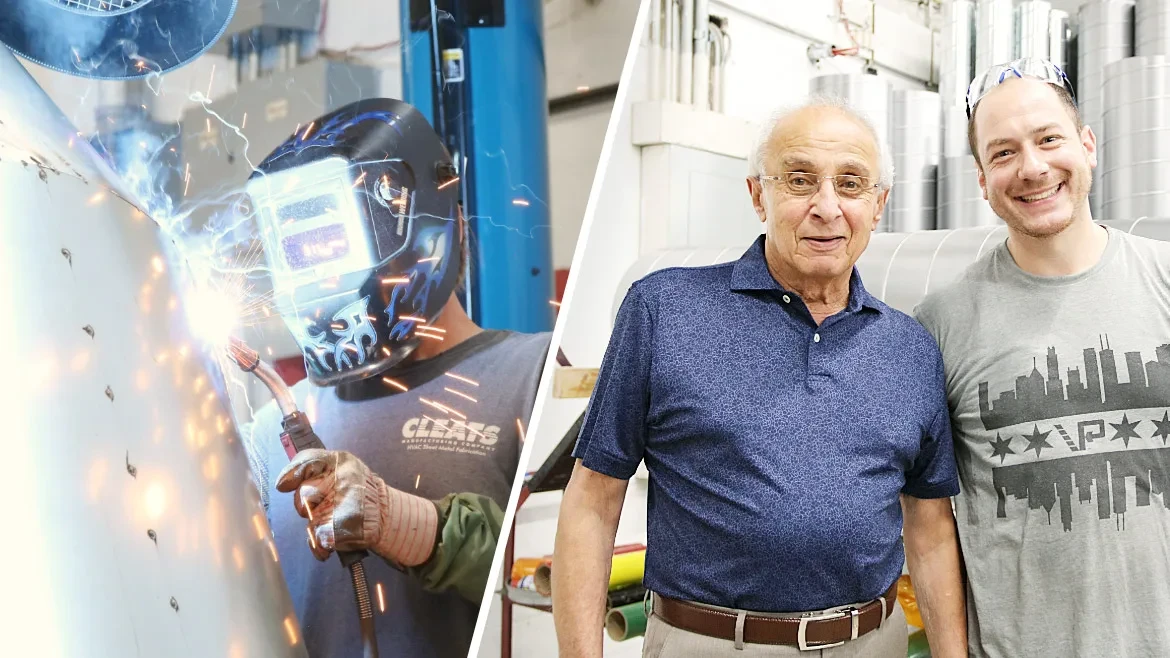
There comes a point in the life of any seasoned entrepreneur when the exit strategy becomes the most logical path. After decades of predawn starts, managing payrolls, funding heavy equipment purchases, and handling midnight customer emergencies, nobody would blame a business owner for cashing out, selling the enterprise, and retiring to a quiet beach.
Steve Passannante could have easily taken that route. Instead, every single morning, as he backs his car out of his suburban driveway, his eyes catch a small plaque honoring his late father. He pauses, points toward it, and quietly makes a familiar promise: "I’m gonna be better than you today, Dad."
Then comes the humble realization that follows every vow: "I never will be, but I never stop trying."
Though his father has been gone for decades, the daily ritual remains unbroken. Passannante still talks to him every morning. When visitors or journalists enter the orbit of Cleats Manufacturing—a powerhouse HVAC ductwork fabricator based in the Chicago area—they often come looking for a straightforward story about industrial innovation, technological disruption, and modern manufacturing metrics.
Instead, they find a masterclass in human capital, generational stewardship, and the enduring power of relationships. At Cleats Manufacturing, the evolution of the business isn’t measured solely by automated machinery or square footage; it is measured by loyalty, the passing of torches, and a philosophy that places people at the absolute center of enterprise.

Chronology: From Slip and Drive Cleats to an Industrial Titan
The roots of Cleats Manufacturing stretch back more than half a century, firmly planted in an era of construction and manufacturing that looks radically different from today’s automated plants.
- 1964: Ernie DeLord founds Cleats Manufacturing, specializing initially in the production of simple slip and drive cleats. At the time, the business operated on a much smaller scale, serving a local contracting market where sheet-metal fabrication was largely decentralized.
- 1974: Steve Passannante—DeLord’s son-in-law—joins the family business. Back then, the core product line was still heavily centered on basic sheet-metal connectors. Contractors routinely performed the bulk of their own fabrication, hauling unassembled duct materials out to active jobsites to piece them together manually.
- The Decades of Expansion: Recognizing an industry bottleneck, Cleats begins taking over heavier fabrication workloads. The company progressively expands its product line to include rectangular ducts, fittings, spiral pipes, gasketed round fittings, welded ducts, and specialized prefabricated assemblies.
- 2014: Marking its 50th anniversary, Cleats Manufacturing receives official recognition in the Congressional Record, cementing its status as one of the largest HVAC sheet-metal fabricators in the entire Chicagoland market.
- The Present Day: The second and third generations of the family now steer the enterprise. Joe Passannante serves as Chief Executive Officer, Nick Passannante operates as Vice President, and Steve Passannante Jr. serves as President, while Steve Passannante Sr. holds the title of President Emeritus.
Throughout this timeline, the fundamental business model remained remarkably consistent: shift the labor-intensive fabrication process away from messy, unpredictable jobsites and into a controlled, highly efficient shop environment. This allowed contractors to focus on installation while Cleats perfected manufacturing at scale.
Supporting Data: Innovation Through Automation and Scale
To understand how Cleats Manufacturing grew into a Chicagoland titan, one must examine the capital investments that transformed its physical operations.
In the company’s earlier days, logistics were a bottleneck. Simply moving finished ductwork from the shop floor onto a delivery truck was an arduous, time-consuming ordeal. Today, the company’s modern facility features eight dedicated loading docks designed to streamline shipping and receiving.
Inside the plant, technological upgrades have revolutionized production efficiency:

- Simultaneous Operations: The facility now operates two automated duct lines concurrently, completely eliminating the roughly 15 minutes previously lost every time workers had to stop, reconfigure, and switch production sizes.
- Advanced Machinery: Passannante and his leadership team spent decades investing in cutting-edge sheet-metal fabrication equipment. However, unlike firms that purchase technology in a vacuum, Cleats utilizes a collaborative adoption model.
- Cross-Functional Input: When evaluating a major equipment purchase, Passannante insists on involving the workers who will actually operate the machinery. "You jump in because the guy that’s selling it to you, you pick their mind, and you have your people with you, not just me," Passannante explains. "Because my people, my workers have questions I won’t ask."
This methodical approach to technology has kept Cleats competitive against modern market pressures without ever sacrificing the safety or comfort of the workforce. Automation removed the heavy manual strain from processes that once required excessive physical labor, allowing employees to focus on precision and quality control.
Official Responses and Industry Leadership
The Passannante family’s commitment to the sheet-metal industry extends far beyond the walls of their own manufacturing plant. Their engagement with trade associations has helped shape regional labor and business standards.
Joe Passannante, following in the leadership footsteps of his father, served as president of the Sheet Metal and Air Conditioning Contractors’ National Association (SMACNA) Greater Chicago chapter. This active participation in SMACNA underscores the family’s deep-rooted belief in industry collaboration, fair labor practices, and the continuous advancement of the trade.
Industry leaders frequently point to Cleats as a benchmark for operational excellence. Marty Kackys, Director of Operations at Cleats, alongside figures like Eli Howard, COO of SMACNA, have collaborated closely with the leadership team to ensure the company remains at the forefront of regional construction standards.
Yet, when company executives speak about their success, the conversation invariably pivots away from balance sheets and machinery back to the workforce.

"I didn’t do it," Steve Passannante Sr. insists when asked about building the company into a market leader. "We did it. They make this place what it is."
Shop Foreman Oscar Figueroa, who began his career at Cleats as an apprentice in 2008, echoes this sentiment. Reflecting on why numerous employees have chosen to remain with the company for over two decades, Figueroa offers a simple truth: "It’s the people. It’s always your people."
Implications: The Human Element of Modern Manufacturing
The ultimate takeaway from the Cleats Manufacturing story challenges the traditional tech-centric narrative of corporate success. While automated machinery, eight loading docks, and high-speed production lines are critical components of a modern enterprise, they do not fully explain why a company survives for over half a century, why employees stay for decades, or why clients remain loyal through shifting economic cycles.
That resilience is built on a foundation of generational values. Steve Passannante’s work ethic was forged under the watchful eye of his own father in the family’s New York and New Jersey garbage business. He recalls a worker there who taught him how to operate a heavy Bobcat loader and showed him the true meaning of physical labor. That relationship left such a profound mark that when the worker passed away, his family asked Passannante to serve as a pallbearer and escort the man’s widow at the funeral—a testament to mutual respect that transcended the employer-employee dynamic.
That same philosophy permeates Cleats today:

- Investing in Employees: Whether it is footing the bill for the local food truck to feed his crew—spending $150 to $250 a pop and noting, "How do you not treat your people? They’re making your life better"—or taking the time to personally commend hard-working apprentices, Passannante cultivates an environment of dignity. It is common for parents of young apprentices, whom Passannante has never met, to call him directly just to express gratitude for how their sons speak of their boss.
- Relational Customer Service: In sheet-metal fabrication, adjustments are inevitable. Dimensions change, and jobsite emergencies happen. Passannante’s policy on mistakes is disarmingly simple: "If I make the mistake, instantly it’s corrected. If they make the mistake, I do my best to make the change and give them a break on the price. You build a relationship with people."
- The Next Generation: When asked why he chose not to sell the company when lucrative buyout offers were undoubtedly on the table, Passannante’s motivation is intensely personal. "I didn’t want to sell this place because I wanted my kids to have it," he says. "They wanted it. That’s why I wanted them to have it. That’s why I didn’t sell it."
True innovation, as demonstrated by the trajectory of Cleats Manufacturing, does not always arrive overnight on a truck wrapped in plastic. Often, it is entirely incremental: a fitting crafted more efficiently in the shop than on a muddy jobsite; a new machine integrated smoothly through employee collaboration; an apprentice trained into a master journeyman; a customer who knows the person on the other end of the phone will honor their word.
Year after year, these accumulated moments forge an enduring legacy. And every single morning, as Steve Passannante backs out of his driveway and glances at his father’s plaque, the cycle begins anew—not with a blueprint for a machine, but with a promise to simply be better than the day before.
