

By Commercial Architecture & HVAC News Staff
As the modern office continues to evolve in response to changing work habits, sustainability mandates, and strict energy regulations, the systems operating behind the scenes must transform concurrently. Today’s commercial workplaces are no longer uniform floors of cubicles with singular heating and cooling demands. Instead, contemporary office architecture features a dynamic blend of private executive offices, open-plan collaborative areas, high-density conference rooms, critical IT and server closets, and bustling common spaces. Each of these zones demands precise, individualized thermal management.
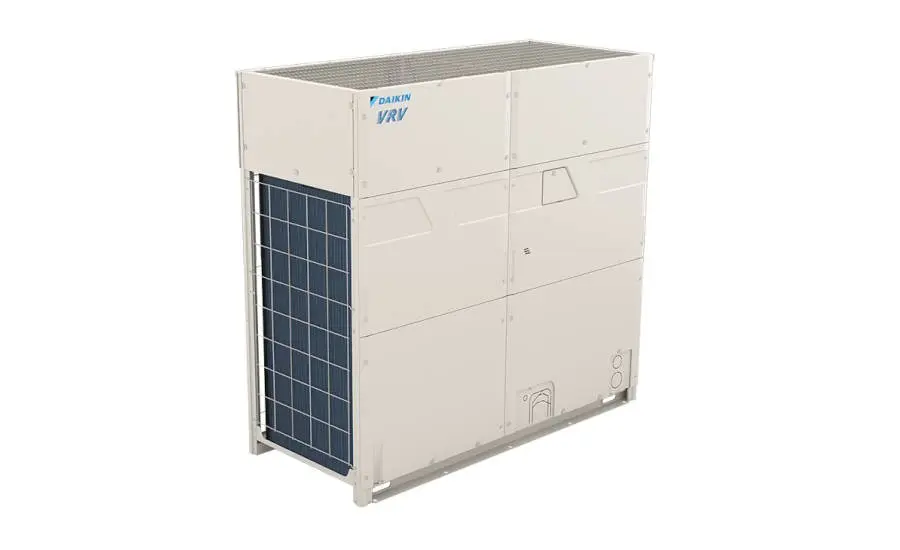
To meet these complex demands, Variable Refrigerant Volume (VRV) technology has long served as the gold standard for flexibility, energy efficiency, and occupant comfort. Now, industry leader Daikin Comfort is pushing the boundaries of what these systems can achieve. The introduction of the VRV EMERION system—powered by the low Global Warming Potential (GWP) R-32 refrigerant—represents a major milestone in HVAC engineering. By pairing high-performance thermal dynamics with a robust, integrated safety architecture, this new generation of equipment addresses the dual challenges of reducing environmental impact while complying with increasingly stringent building safety codes.
1. Main Facts: The Intersection of Performance, Safety, and Sustainability
The VRV EMERION system is designed to bridge the gap between aggressive environmental targets and the rigorous performance expectations of multi-story and high-rise commercial architecture. At its core, the system relies on R-32, a single-component refrigerant known for its lower environmental impact compared to older hydrofluorocarbons (HFCs), without sacrificing the thermodynamic properties required for heavy-duty commercial deployment.
However, transitioning to low-GWP refrigerants in commercial buildings involves navigating complex safety codes, particularly regarding A2L mildly flammable refrigerants. Daikin has addressed this proactively by engineering a comprehensive system-level safety architecture directly into the hardware.
Key facts regarding the VRV EMERION system include:
- Low-GWP R-32 Refrigerant: Delivers high operating efficiency while drastically lowering the carbon footprint compared to legacy refrigerants.
- Integrated Branch Selector Boxes (BSB) and Safety Shutoff Valves (SSOV): Designed to isolate and limit refrigerant discharge at the zone level in the unlikely event of a leak.
- Advanced Heat Recovery: Allows simultaneous heating and cooling across diverse office zones, ensuring that waste heat from sun-drenched perimeter offices or server rooms can be redirected to chilly interior zones.
- SMART VRT Technology: Variable Refrigerant Temperature dynamically adjusts refrigerant temperature to match real-time loads, optimizing both part-load efficiency and occupant comfort.
- High-Rise Capability: Fully supports extended piping lengths and vertical risers, making it an ideal drop-in or new-construction solution for multi-story commercial real estate.
2. Chronology: The Regulatory Pressures and Engineering Milestones Leading to R-32
To fully appreciate the significance of the VRV EMERION, it is necessary to examine the regulatory and technological timeline that forced the HVAC industry to reinvent its approach to multi-split and VRV systems.

The Phasedown of High-GWP Refrigerants
For decades, the commercial real estate sector relied heavily on R-410A and other high-GWP HFCs. While thermally efficient, these chemicals were recognized as potent greenhouse gases with high global warming potentials. Global environmental agreements, such as the Kigali Amendment to the Montreal Protocol, set strict timetables for the phasedown of HFC production and consumption. In the United States, the American Innovation and Manufacturing (AIM) Act accelerated these mandates, compelling manufacturers to develop equipment capable of utilizing lower-GWP alternatives.
The Emergence of R-32 as a Viable Alternative
As engineers searched for replacement fluids, R-32 emerged as a frontrunner. Boasting a GWP roughly one-third that of R-410A, R-32 offers superior volumetric cooling capacity and higher energy efficiency. Moreover, because it is a single-component refrigerant rather than a blend, it is easier to reclaim, recycle, and recharge in the field.
However, R-32 is classified under ASHRAE Standard 34 as an A2L refrigerant—meaning it is mildly flammable. While significantly safer than older hydrocarbons, the A2L classification introduced a wave of regulatory hurdles concerning how much refrigerant could be safely piped into occupied spaces, particularly in large commercial buildings where lines run extensively through walls, ceilings, and vertical risers.
The Engineering Response: Built-In Mitigation
Recognizing that building owners and mechanical engineers would hesitate to adopt A2L systems without absolute assurances of safety, Daikin’s engineering teams focused on passive and active safety mechanisms. Rather than forcing contractors to rely on external, field-engineered mitigation systems—which often lead to over-engineering, increased installation costs, and code compliance ambiguities—Daikin integrated safety components directly into the core hardware design. The development of specialized Branch Selector Boxes with integrated Safety Shutoff Valves marked a turning point, providing a standardized, factory-certified method for managing refrigerant concentrations at the zone level.
3. Supporting Data: Why Modern Offices Demand Advanced Heat Recovery and Zoning
Modern office spaces are defined by thermal diversity. A architectural layout might feature floor-to-ceiling glass windows on the southern facade, absorbing massive solar heat loads that require constant cooling, while the northern interior core requires gentle heating due to variable occupant densities and shadow lines.
The Complexity of Office Layouts
Data from commercial real estate studies indicate that tenant retention and employee productivity are directly tied to indoor environmental quality (IEQ). Poor thermal control is consistently cited by office workers as a primary source of workplace dissatisfaction.
- Private Offices vs. Open Plan: Private offices bounded by drywall trap heat differently than expansive open-cubicle farms with high concentrations of human metabolic heat and computer equipment.
- High-Density Conference Rooms: A conference room transitioning from empty to fully occupied by twenty people experiences a massive, rapid spike in cooling load.
- Server and IT Closets: Even in an era of cloud computing, local data closets and telecom rooms generate continuous sensible heat loads year-round, requiring dedicated cooling even when the rest of the building is in heating mode.
Efficiency Through Heat Recovery
The VRV EMERION heat recovery system addresses these divergent loads through advanced refrigerant routing. Instead of running separate heating and cooling loops, the system extracts thermal energy from areas requiring cooling and transfers it directly to areas requiring heating. This internal energy recycling dramatically reduces energy consumption, lowering utility operational expenditures (OpEx) for building owners striving to meet corporate ESG (Environmental, Social, and Governance) targets.
Furthermore, SMART VRT technology continuously monitors indoor and outdoor conditions, automatically adjusting the refrigerant temperature to optimize efficiency. Data shows that operating at variable temperatures rather than a fixed evaporating or condensing temperature can yield substantial efficiency gains during partial-load conditions, which account for the vast majority of an office building’s annual operating hours.
4. Official Responses and Industry Perspectives on Safety and Compliance
The introduction of low-GWP systems with A2L refrigerants has sparked widespread discussion across the HVAC design, mechanical engineering, and code-enforcing communities. Industry stakeholders have increasingly emphasized the need for equipment that bridges the gap between environmental compliance and uncompromised building safety.
Engineering Confidence Through UL Listing and Code Alignment
One of the primary challenges facility managers face when upgrading climate control infrastructure is navigating regional building codes. Safety standards such as ASHRAE 15 and UL 60335-2-40 dictate strict limits on refrigerant concentrations within occupied spaces.
Daikin’s approach with the VRV EMERION has been met with positive reception from code officials and mechanical contractors alike because the critical safety components—such as the Safety Shutoff Valves (SSOVs)—are factory-integrated, certified, and UL-listed.
Industry experts note that integrated safety architecture eliminates the guesswork for installing contractors. By limiting potential refrigerant discharge directly at the source (the Branch Selector Box) during a rare leak scenario, the system ensures that room concentrations remain well below lower flammability limits (LFL), even in smaller private offices or meeting rooms.
Optional Ventilated Enclosures for Enhanced Mitigation
For jurisdictions with exceptionally rigorous interpretations of local building codes, or for unique architectural spaces where standard mitigation pathways are insufficient, Daikin offers an optional ventilated enclosure design. This supplementary feature provides a controlled engineering pathway to manage refrigerant dispersion, ensuring that installations remain compliant without forcing engineers to over-engineer the entire mechanical layout of the building.
5. Implications for the Future of Commercial Real Estate
The deployment of advanced VRV technology utilizing low-GWP refrigerants carries profound implications for the commercial real estate and construction sectors. As cities and municipalities adopt stringent green building codes and carbon neutrality goals, traditional HVAC methodologies are rapidly becoming obsolete.

Future-Proofing Multi-Story and High-Rise Buildings
High-rise commercial buildings present unique mechanical hurdles. Long piping runs, significant vertical elevation changes, and complex spatial routing require HVAC systems with exceptional static pressure capabilities and oil-return reliability. The VRV EMERION maintains these vital structural capabilities, ensuring that building owners do not have to sacrifice design flexibility or usable floor space to meet environmental mandates.
Economic and Environmental Synergy
For property developers and asset managers, sustainability is no longer just a public relations talking point—it is a financial necessity. Buildings that fail to meet modern efficiency and carbon standards face higher utility costs, potential regulatory penalties, and a depreciation in asset value as corporate tenants increasingly demand green-certified office spaces.
By upgrading to systems like the VRV EMERION, building owners can:
- Lower Operating Costs: Capitalize on heat recovery and SMART VRT to reduce annual energy consumption.
- Enhance Tenant Comfort: Provide granular, zone-by-zone temperature control that satisfies diverse workplace needs.
- Ensure Regulatory Longevity: Adopt low-GWP technology ahead of scheduled regulatory bans, protecting capital investments from premature obsolescence.
- Simplify Compliance: Utilize factory-certified safety architectures that streamline the permitting, inspection, and installation processes.
Conclusion
The evolution of workplace climate control is an ongoing journey driven by the dual imperatives of environmental stewardship and human comfort. As office spaces continue to adapt to new patterns of use, the infrastructure supporting them must be equally agile.
Through the introduction of the VRV EMERION with R-32 refrigerant, Daikin has demonstrated that the HVAC industry can successfully transition to environmentally responsible refrigerants without compromising the legendary flexibility, heat recovery performance, and multi-story capabilities that modern commercial architecture demands. Backed by integrated safety architectures, code-conscious designs, and advanced zone-level controls, VRV technology remains firmly positioned at the forefront of the sustainable workplace revolution.
